

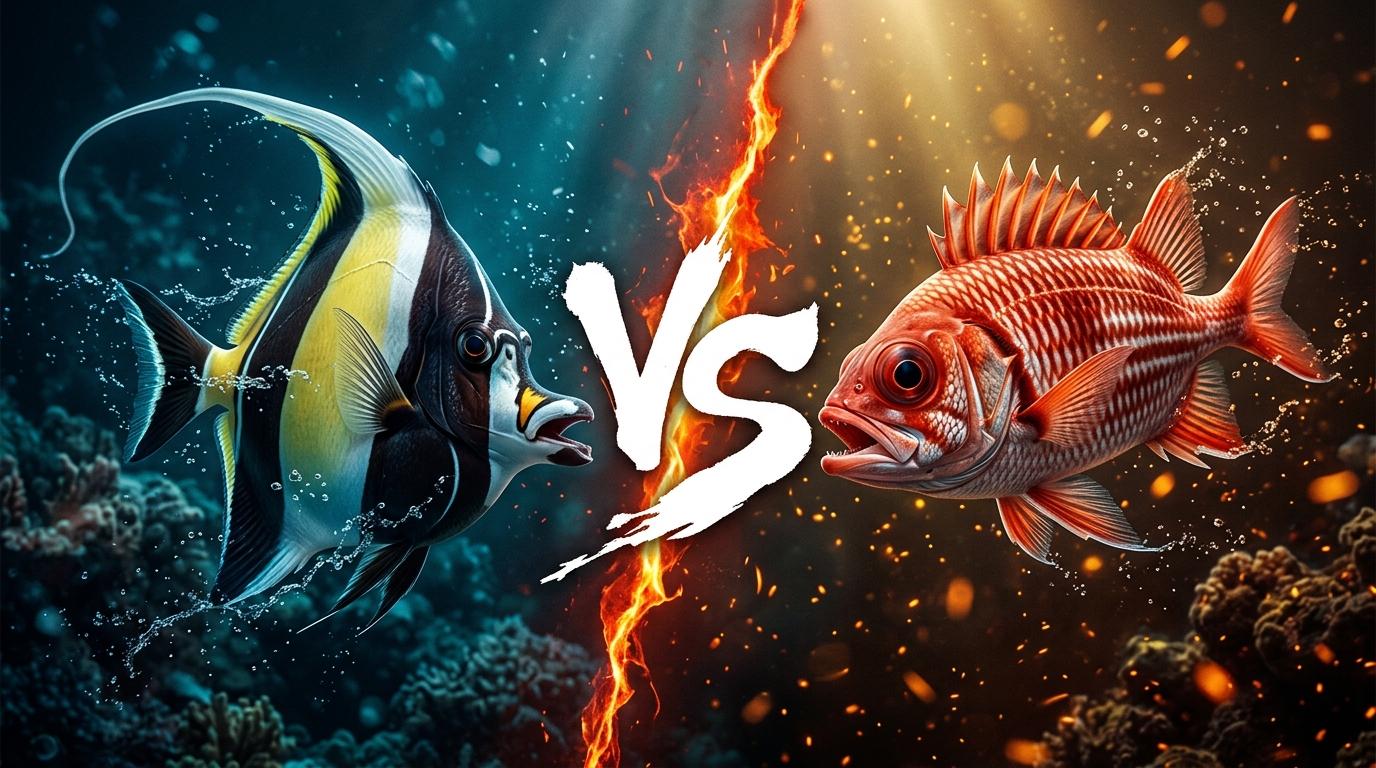
Moorish Idol vs Redcoat Squirrelfish: Who Actually Wins?
Moorish Idol vs Redcoat Squirrelfish: who wins a reef showdown? We compare size, spines, speed, and night-versus-day behavior to name a clear winner.
Moorish Idol vs Squirrelfish
Matchup winner
Squirrelfish
Quick verdict
Start with the direct answer, then use the structured comparison below to see what changes the outcome.
The Redcoat Squirrelfish wins this matchup clearly. It is the heavier, more muscular reef fish, typically reaching around 25–30 cm against the Moorish Idol's lighter, disc-thin build, and it carries the more serious defensive hardware: a stout, spiny dorsal fin and a sharp spine on each gill cover. It also brings faster burst acceleration from cave mouths and a more combative temperament around shelter. The Moorish Idol is a graceful, specialized grazer built for picking sponges from crevices. Its tall body and long dorsal streamer are designed for display and maneuvering, not for trading blows. In any contest over a ledge, hole, or overhang, the squirrelfish's mass, spines, and willingness to hold ground decide it.
Read the full explanation
Winner: Redcoat Squirrelfish. It is heavier, spinier, and more territorial around shelter.
Its sharp gill-cover spine and rigid dorsal spines make it costly to contest at close range.
The Moorish Idol's strengths are precision feeding and agile turning, not physical confrontation.
The idol only edges ahead in bright, open daytime water, where it can simply leave.
Reader vote
Who do you think wins?
Pick a side — no account needed. Results update live.
No votes yet — be the first to call it.
Editorial note
Why people disagree
The Moorish Idol looks bold and armored, with its tall fin, sharp snout, and small bony bumps over the eyes in adults. In practice that striking silhouette is mostly signal, not weaponry.
Close-range durability
A deeper, sturdier body absorbs bumps and nips that would push a flat-bodied idol off line.
Spine armament
Real defensive spines turn every close pass into a risk for the attacker. This is the matchup's decisive physical edge.
Burst acceleration
In a short reef clash, the first sharp lunge sets who holds the hole.
Read the full explanation +
Squirrelfish spend daylight hiding in caves, so many divers read them as timid. They are actually defensive specialists that become assertive when their shelter is challenged.
The two rarely compete directly. One is a daytime sponge-picker and the other a nocturnal crustacean hunter, so any 'fight' is really a question of who yields space.
Comparison FAQ
Short, direct answers to the next questions readers usually ask after the headline verdict.
Would a Moorish Idol beat a Redcoat Squirrelfish?+
No. The squirrelfish is larger and more robust, and it carries sharp gill-cover and dorsal spines. It would win any real confrontation, especially near shelter.
Which fish is stronger?+
The Redcoat Squirrelfish. It has more body mass, thicker musculature, and much better defensive armament than the thin, disc-shaped Moorish Idol.
Is the squirrelfish's spine dangerous?+
It is sharp enough to puncture skin and deter predators, so treat it with care. Handlers and anglers often get pricked by squirrelfish spines.
Why is the Moorish Idol still hard to catch or corner?+
Its tall, compressed body turns extremely fast through coral, and its daytime vision is sharp. It escapes far better than it fights, which makes it a frustrating target in open reef.
Do they actually fight in the wild?+
Rarely. They work different shifts, with idols active by day and squirrelfish by night. Conflict is usually brief and centers on shelter.
Head-to-head species stats
These are the same core AnimalDex stat dimensions used on the dedicated animal pages, pulled side by side so the matchup is faster to scan.
Moorish Idol
Tier CSquirrelfish
Tier BTrait-by-trait comparison
Only the categories that matter to this matchup are included. The goal is not filler stats, but the real design differences that change the result.
Thin, laterally compressed disc
Close-range durability
Squirrelfish
Thicker body with stiff, rough scales
Close-range durability
Squirrelfish
Flexible dorsal streamer; sharp mouth-corner spines only in juveniles
Spine armament
Squirrelfish
Sharp gill-cover spine plus rigid dorsal spines
Spine armament
Squirrelfish
Smooth cruising and quick pivots
Burst acceleration
Squirrelfish
Explosive dart from shelter
Burst acceleration
Squirrelfish
Elite tight turns through coral
Maneuver finesse
Moorish Idol
Good, but bulkier
Maneuver finesse
Moorish Idol
Roams widely and rarely defends a fixed spot
Shelter control
Squirrelfish
Holds caves and ledges, often in groups
Shelter control
Squirrelfish
Daylight-adapted vision
Low-light sensing
Squirrelfish
Huge eyes tuned for night
Low-light sensing
Squirrelfish
How the verdict forms
Verdict timeline
01 · Close-range durability
Squirrelfish
02 · Spine armament
Squirrelfish
03 · Burst acceleration
Squirrelfish
04 · Maneuver finesse
Moorish Idol
05 · Shelter control
Squirrelfish
06 · Low-light sensing
Squirrelfish
Change the conditions
Scenario breakdown
This is where shallow battle content usually fails. Terrain, spacing, timing, and engagement style can change the answer.
Scenario lean
Squirrelfish
Verdict confidence
82%
Squirrelfish holds the hole.
This is the squirrelfish's home terrain. It faces outward from the overhang, flares its spiny dorsal fin, and can lunge with gill-cover spines exposed. The idol gains nothing worth the risk by pushing in. Its body plan favors leaving over fighting, so it yields within seconds.
AnimalDex field profiles
Explore these animals
Moorish Idol
Zanclus cornutus
coral reef, lagoon, and tropical rocky coast
Squirrelfish
Sargocentron rubrum
reef wall, cave, and rocky tropical seafloor
Systems Intelligence & Hidden Purpose
See the animals behind this comparison as engineered biological systems: what each one is built to do, where it gains leverage, and why the matchup changes by scenario.
Specialized Hardware
long trailing dorsal filament, bold black-yellow-white pattern, and reef-face grazing behavior give the Moorish Idol a body plan tuned for its niche.
Systems Script
Moorish Idols operate through coral reef, lagoon, and tropical rocky coast. Their design links movement, feeding, shelter, and timing into one workable survival system.
Strategic Insight
In moving water, the best systems use flow, visibility, and depth instead of fighting every current.
Specialized Hardware
huge night-adapted eyes, spiny bright-red reef body, and cave-and-crevice schooling give the Squirrelfish a body plan tuned for its niche.
Systems Script
Squirrelfishs operate through reef wall, cave, and rocky tropical seafloor. Their design links movement, feeding, shelter, and timing into one workable survival system.
Strategic Insight
In moving water, the best systems use flow, visibility, and depth instead of fighting every current.
Final take
The Redcoat Squirrelfish is the clear winner. It is bigger and sturdier, it carries real spines, and it is built to hold contested shelter, which is exactly what reef 'fights' are about.
Read the full explanation
The Moorish Idol is not a fighter. It is a precision grazer whose best tactic is graceful disengagement. It wins only when the setting lets it avoid contact, and in any true head-to-head the squirrelfish takes it.
Collect both animals in AnimalDex
Track the species behind this matchup, compare their real traits, and build the rivalry into your AnimalDex collection.
Discussion
What do you think?
Share your reasoning with other readers. Be civil and stick to the animals.
Sign in to join the discussion.
Sign inNo comments yet. Start the conversation.