


Nine-banded Armadillo vs Pronghorn: Who Actually Wins?
Nine-banded armadillo vs pronghorn: who would win? We compare armor, digging, speed, size, horns, and hooves to name the clear winner and explain why the armadillo is still hard to finish.
Nine-banded Armadillo vs Pronghorn
Matchup winner
Pronghorn
Quick verdict
Start with the direct answer, then use the structured comparison below to see what changes the outcome.
The pronghorn wins, and it is not especially close. A healthy adult pronghorn weighs roughly 40–65 kg, about ten times the mass of a 3–7 kg nine-banded armadillo. It carries sharp, pointed hooves, and bucks carry forked horns used in real shoving duels. The armadillo's armor is genuine bony protection, but this species cannot roll into a sealed ball; only the three-banded armadillos can do that. Its soft belly stays exposed, and its main weapons are digging claws built for soil and insect nests, not for fighting a large ungulate. The pronghorn's catch is motivation, not ability. It is a grazer and browser with no reason to start this fight, and most real encounters would end with one animal ignoring the other. If the two are forced into a confrontation, though, size, reach, and hoof strikes decide it for the pronghorn.
Read the full explanation
Pronghorn wins: about 10x heavier, with sharp hooves and (in males) forked horns.
The armadillo's carapace blunts glancing blows, but nine-banded armadillos cannot fully roll up, so the belly stays vulnerable.
The armadillo's best 'win' is escape: a fast burrow dive, a thorny thicket, or a startle leap.
Neither animal is a predator of the other, so a real fight would be rare and defensive.
Reader vote
Who do you think wins?
Pick a side — no account needed. Results update live.
No votes yet — be the first to call it.
Editorial note
Why people disagree
Armor sounds decisive, but the nine-banded armadillo's shell covers the back and sides, not the belly, and it cannot seal itself the way a three-banded armadillo can.
Mass and reach
A tenfold mass gap means the pronghorn can strike downward while staying out of the armadillo's reach.
Striking weapons
The armadillo's claws and teeth are made for soil and insects. Hooves and horns are made to deliver force.
Close-range durability
Armor lets the armadillo shrug off glancing blows long enough to escape, which is its one real edge.
Read the full explanation +
The pronghorn's fame comes from speed, which makes some readers assume it is fragile. In fact it is a sturdy, hard-hoofed animal that defends itself and its fawns.
The armadillo can vanish underground in seconds, so some count 'it gets away' as a win. A fight result and a survival result are different questions.
Comparison FAQ
Short, direct answers to the next questions readers usually ask after the headline verdict.
Would a pronghorn beat a nine-banded armadillo in a fight?+
Yes. The pronghorn's size, reach, and sharp hooves would overwhelm the armadillo in any forced fight on open ground.
Which animal is stronger?+
The pronghorn, by a wide margin. At roughly 40–65 kg, it carries far more muscle and striking power than a 3–7 kg armadillo.
Can a nine-banded armadillo roll into a ball for protection?+
No. Only three-banded armadillos can fully roll up. The nine-banded armadillo's belly stays exposed, which is a big reason it loses this matchup.
Why is the armadillo still dangerous to underestimate?+
Its armor deflects glancing blows, it digs in within moments, it leaps straight up when startled, and it can slip into thorny brush. Together these let it escape attacks that would catch softer animals.
Do pronghorns and armadillos actually fight in the wild?+
Very rarely. Their ranges overlap in parts of the southern US and Mexico, but neither hunts the other. Contact would be brief and defensive.
How fast is a pronghorn compared to an armadillo?+
Pronghorns reach bursts near 88 km/h and can hold high speeds for long distances. Armadillos manage only short scrambles toward cover.
Head-to-head species stats
These are the same core AnimalDex stat dimensions used on the dedicated animal pages, pulled side by side so the matchup is faster to scan.
Nine-banded Armadillo
Tier CPronghorn
Tier BTrait-by-trait comparison
Only the categories that matter to this matchup are included. The goal is not filler stats, but the real design differences that change the result.
3–7 kg, low to the ground
Mass and reach
Pronghorn
40–65 kg, long-legged
Mass and reach
Pronghorn
Digging claws, weak bite with peg teeth
Striking weapons
Pronghorn
Sharp split hooves; forked horns on bucks
Striking weapons
Pronghorn
Bony carapace over back and sides
Close-range durability
Nine-banded Armadillo
Hide and fur, no armor
Close-range durability
Nine-banded Armadillo
Short scrambling dash
Open-ground speed
Pronghorn
Bursts near 88 km/h, sustained very fast running
Open-ground speed
Pronghorn
Rapid burrowing, vertical startle leap, can swim and cross water
Escape engineering
Nine-banded Armadillo
Long-distance running, wide-angle eyesight
Escape engineering
Nine-banded Armadillo
Strong nose, poor eyesight
Threat detection
Pronghorn
Exceptional long-range vision
Threat detection
Pronghorn
How the verdict forms
Verdict timeline
01 · Mass and reach
Pronghorn
02 · Striking weapons
Pronghorn
03 · Close-range durability
Nine-banded Armadillo
04 · Open-ground speed
Pronghorn
05 · Escape engineering
Nine-banded Armadillo
06 · Threat detection
Pronghorn
Change the conditions
Scenario breakdown
This is where shallow battle content usually fails. Terrain, spacing, timing, and engagement style can change the answer.
Scenario lean
Pronghorn
Verdict confidence
82%
Pronghorn controls the space and the strikes.
On open prairie with firm ground and no burrow nearby, the armadillo has nowhere to go. The pronghorn can approach, strike with its forehooves, and pull back, using its height and reach. Repeated hoof blows to an animal that cannot seal its belly end the contest.
AnimalDex field profiles
Explore these animals
Nine-banded Armadillo
Dasypus novemcinctus
Woodland, scrub, grassland edge, and semi-open country with soft ground.
Pronghorn
Antilocapra americana
prairie, desert grassland, sagebrush plain, and open steppe
Systems Intelligence & Hidden Purpose
See the animals behind this comparison as engineered biological systems: what each one is built to do, where it gains leverage, and why the matchup changes by scenario.
Specialized Hardware
Bony armor bands across the back, long pointed snout, and strong digging claws give the Nine-banded Armadillo a body plan tuned for its niche.
Systems Script
Nine-banded Armadillos operate in woodland, scrub, grassland edge, and semi-open country with soft ground. Their design helps them match food access, shelter, and timing inside that environment.
Strategic Insight
Light protection used well can be better than constant fighting.
Specialized Hardware
extreme long-distance speed, huge side-set eyes, and light open-country frame give the Pronghorn a body plan tuned for its niche.
Systems Script
Pronghorns operate through prairie, desert grassland, sagebrush plain, and open steppe Their design links movement, shelter, and feeding into one workable survival system.
Strategic Insight
When the landscape offers nowhere to hide, seeing early and moving fast become everything.
Final take
The pronghorn is the clear winner in a forced fight. It has about ten times the body mass, hard sharp hooves, horns on bucks, and the eyesight to control distance. The armadillo's carapace is real protection, but a nine-banded armadillo is not a sealed tank. Its belly stays open, and it has no weapon that can seriously hurt a large ungulate.
Read the full explanation
The armadillo's strength is escape, not combat. Next to soft soil or thorny cover, it can end the encounter on its own terms, and that is why it remains hard to finish. Judged purely as a fight, though, the prairie sprinter takes it.
Collect both animals in AnimalDex
Track the species behind this matchup, compare their real traits, and build the rivalry into your AnimalDex collection.
Related comparisons
Continue with nearby matchups to compare more real-world animal traits without dropping into junky who-wins filler.

Prairie Dog vs Pronghorn: Who Actually Wins?
The pronghorn wins, and it isn't close. An adult pronghorn weighs roughly 40–65 kg against a prairie dog's 0.7–1.4 kg, about 40 to 60 times heavier. It carries sharp, forward-hooking horn sheaths, hard cloven hooves, and a frame built for violent rutting clashes with other bucks. The black-tailed prairie dog is a sharp, socially sophisticated rodent with chisel incisors and one of the most information-rich alarm-call systems known in mammals. Every one of those tools is built to avoid a fight, not win one. In any frame where the two actually make contact, mass, reach, and hooves decide it in the pronghorn's favor. The prairie dog's only true victory condition is the burrow, which ends the encounter rather than winning it.
Read comparison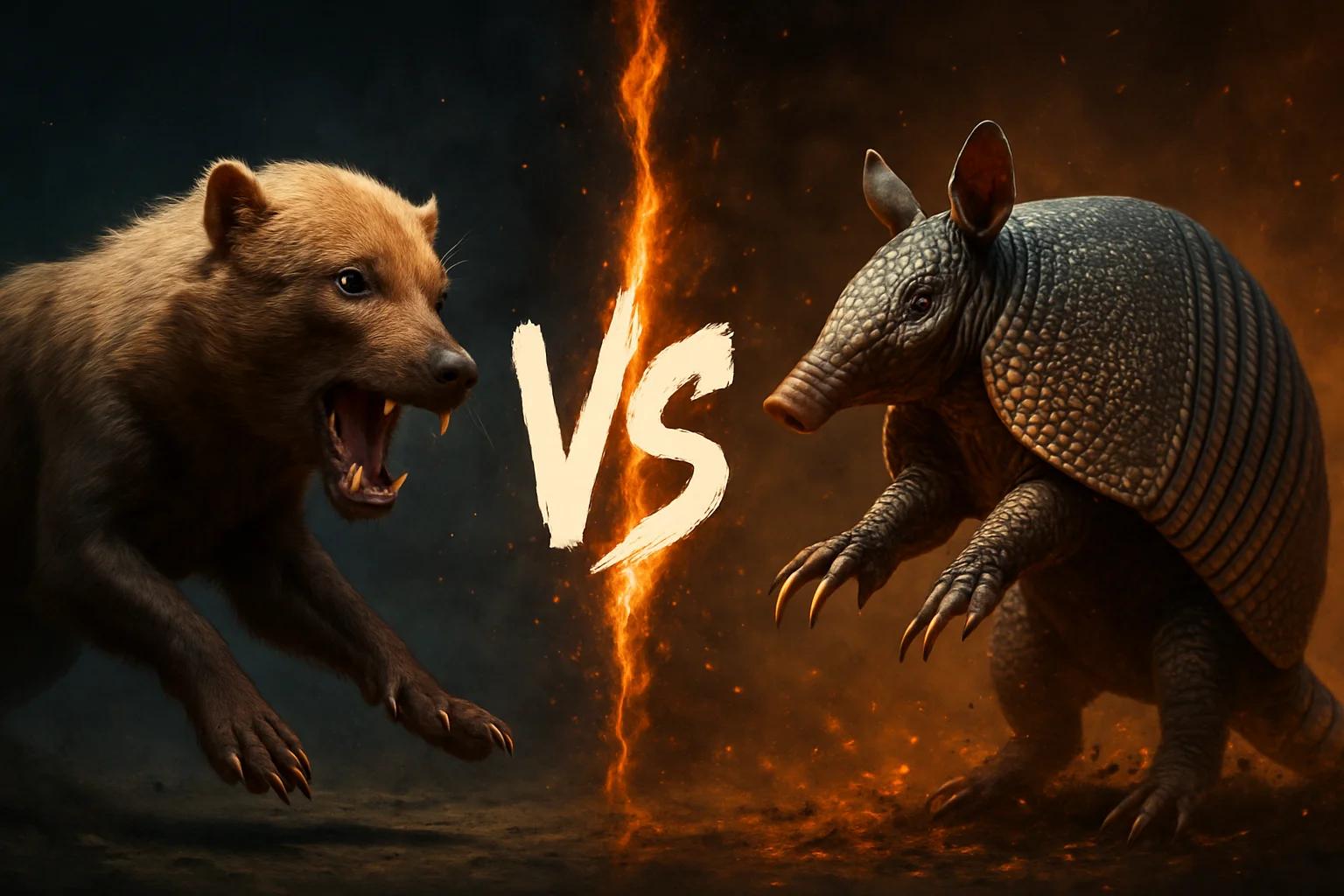
Bush Dog vs Nine-banded Armadillo: Who Actually Wins?
The bush dog wins. It is a compact, muscular canid built to hunt prey of its own size and larger: short legs for burrow work, strong jaws, sharp carnassial teeth, and real persistence. The nine-banded armadillo's armor is impressive, but it is not a sealed shell. Unlike the three-banded armadillo, Dasypus novemcinctus cannot roll into a closed ball. Its belly, legs, and the gaps around its head stay exposed. Its main defenses are a surprise vertical leap, a fast sprint to a burrow, and wedging itself into soil with its claws. Those tricks can buy time or a clean escape, but against a predator that follows prey underground and keeps working at it, they rarely end the contest. If the encounter is a true confrontation, the bush dog's bite and drive beat the armadillo's retreat strategy.
Read comparison
Discussion
What do you think?
Share your reasoning with other readers. Be civil and stick to the animals.
Sign in to join the discussion.
Sign inNo comments yet. Start the conversation.