

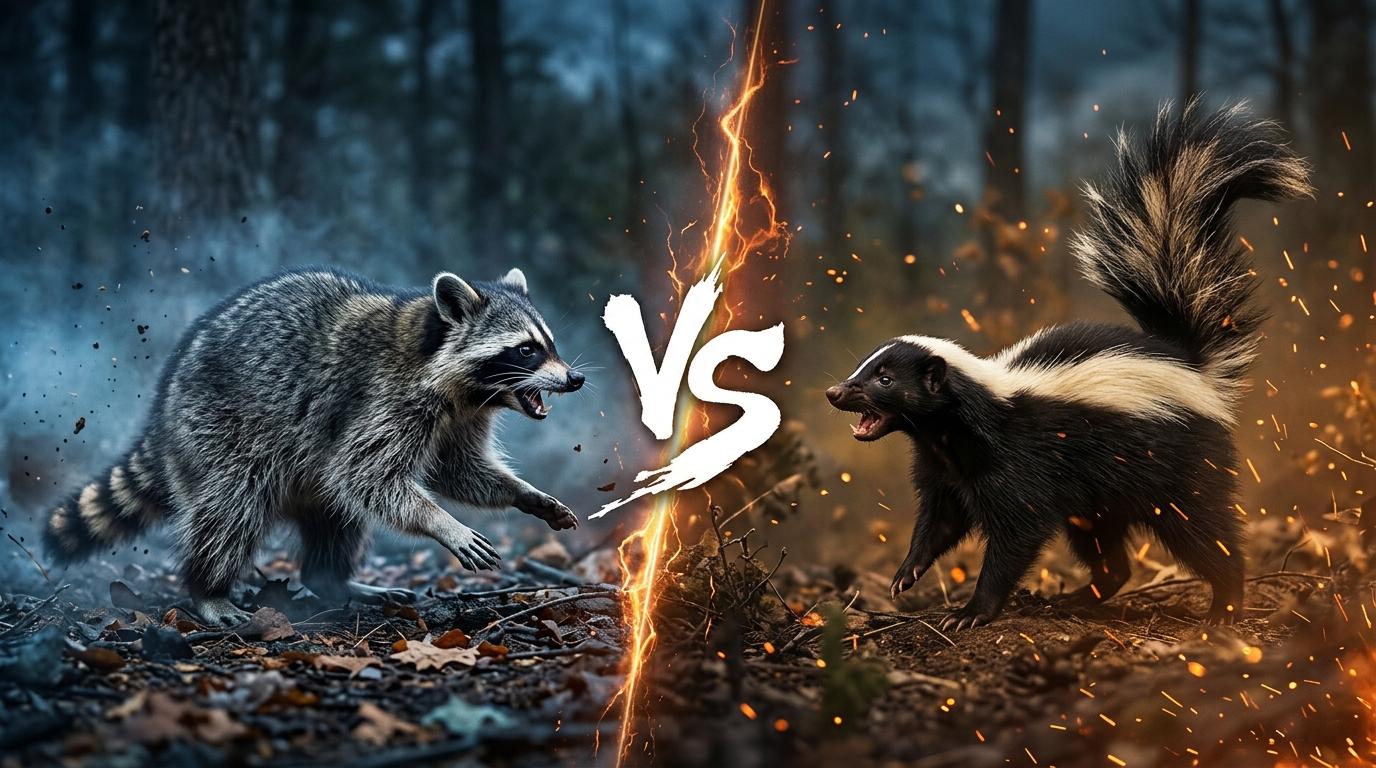
Raccoon vs Skunk: Who Actually Wins?
Common raccoon vs striped skunk: size, strength, spray defense, and intelligence compared. A biology-first verdict on who wins and why the skunk still earns respect.
North American Raccoon vs Striped Skunk
Matchup winner
North American Raccoon
Quick verdict
Start with the direct answer, then use the structured comparison below to see what changes the outcome.
The common raccoon wins a committed fight. An adult raccoon often weighs about 5–9 kg, which is roughly two to three times a typical striped skunk (around 2–4.5 kg). It brings a stronger bite, grappling forelimbs with dexterous hands, and noticeably better problem-solving. Once contact happens, the skunk has little physical answer to that mass and control. The catch is that the skunk is built so that contact rarely happens. Its musk spray can reach roughly 3 meters, and the sulfur-based thiols in it sting the eyes, can blind temporarily, and make a predator rethink the whole encounter. A raccoon that gets sprayed may break off, so many real encounters end in a standoff or a retreat rather than a decisive fight. Put the two in a forced, close-range scrap, though, and the raccoon's size, strength, and tactical flexibility carry it.
Read the full explanation
The raccoon wins a real fight thanks to roughly double the body mass, a stronger bite, and grappling hands.
The skunk's spray is an elite deterrent that can end the encounter before contact.
If the raccoon closes distance quickly or the skunk's musk is depleted, the skunk has few physical answers.
In the wild, most meetings end in avoidance or a stink-soaked retreat, not a death match.
Reader vote
Who do you think wins?
Pick a side — no account needed. Results update live.
No votes yet — be the first to call it.
Editorial note
Why people disagree
Spray-first thinkers argue the skunk 'wins' because the raccoon usually leaves. That counts as a deterrence win, not a combat win.
Body mass & frame
In small-carnivore fights, mass decides pinning, shoving, and who controls the clinch.
Close-range weaponry
The raccoon can grab, hold, and bite at the same time. The skunk's claws are built for digging, not fighting.
Chemical deterrence
This is the skunk's whole strategy: make the fight too costly to start.
Read the full explanation +
People underestimate how much bigger a raccoon is. Side by side, the size gap is decisive in physical contact.
Backyard sightings of the two sharing a cat bowl make them look evenly matched. Both are really tolerating each other to avoid costly fights.
Comparison FAQ
Short, direct answers to the next questions readers usually ask after the headline verdict.
Would a raccoon beat a skunk in a fight?+
Yes. In a committed close-range fight, the raccoon's greater weight, stronger bite, and grappling forepaws give it a clear edge.
Which is stronger, a raccoon or a skunk?+
The raccoon. It typically weighs two to three times as much and is far more muscular through the shoulders and forelimbs.
Why is a skunk still dangerous to a raccoon?+
Its spray can reach about 3 meters and causes intense eye pain and temporary blindness. That often forces the raccoon to retreat before any contact. Both species can also carry rabies, so bites are risky for both.
Do raccoons and skunks fight in the wild?+
Rarely seriously. They often share food sources with wary tolerance, because a fight costs the raccoon a spraying and costs the skunk a beating.
Does a raccoon ever get sprayed by a skunk?+
Yes. Raccoons that push too close can get sprayed, and it usually ends the encounter.
Head-to-head species stats
These are the same core AnimalDex stat dimensions used on the dedicated animal pages, pulled side by side so the matchup is faster to scan.
North American Raccoon
Tier CStriped Skunk
Tier CTrait-by-trait comparison
Only the categories that matter to this matchup are included. The goal is not filler stats, but the real design differences that change the result.
About 5–9 kg, stocky, thick-coated
Body mass & frame
North American Raccoon
About 2–4.5 kg, low and compact
Body mass & frame
North American Raccoon
Strong bite plus grasping, clawed forepaws
Close-range weaponry
North American Raccoon
Modest bite, digging claws built for grubbing
Close-range weaponry
North American Raccoon
None
Chemical deterrence
Striped Skunk
Aimed thiol spray reaching about 3 m, painful to the eyes
Chemical deterrence
Striped Skunk
Elite memory, manipulative, adaptable
Tactical problem-solving
North American Raccoon
Simple, reliable threat displays
Tactical problem-solving
North American Raccoon
Quick scrambler, excellent climber
Burst mobility
North American Raccoon
Slow waddle, relies on not needing to run
Burst mobility
North American Raccoon
Growls, hisses, bluff postures
Warning theater
Striped Skunk
Foot stamps, tail raise, handstands, the U-turn aim
Warning theater
Striped Skunk
How the verdict forms
Verdict timeline
01 · Body mass & frame
North American Raccoon
02 · Close-range weaponry
North American Raccoon
03 · Chemical deterrence
Striped Skunk
04 · Tactical problem-solving
North American Raccoon
05 · Burst mobility
North American Raccoon
06 · Warning theater
Striped Skunk
Change the conditions
Scenario breakdown
This is where shallow battle content usually fails. Terrain, spacing, timing, and engagement style can change the answer.
Scenario lean
North American Raccoon
Verdict confidence
82%
The raccoon closes before the spray lines up.
Tight cover shortens the distances involved and limits the skunk's chance to stamp, turn, and aim. A raccoon that commits at close range can grapple and bite with a large weight advantage. The skunk's defense depends on space and time to warn, so cover takes away its best tool.
AnimalDex field profiles
Explore these animals
North American Raccoon
Procyon lotor
Woodland, wetlands, farmland, suburbs, and city green spaces.
Striped Skunk
Mephitis mephitis
Woodland edge, grassland, farmland, suburbs, and mixed open habitats.
Systems Intelligence & Hidden Purpose
See the animals behind this comparison as engineered biological systems: what each one is built to do, where it gains leverage, and why the matchup changes by scenario.
Specialized Hardware
Black mask around the eyes, ringed tail, and dexterous front paws give the North American Raccoon a body plan tuned for its niche.
Systems Script
North American Raccoons operate in woodland, wetlands, farmland, suburbs, and city green spaces. Their design helps them match food access, shelter, and timing inside that environment.
Strategic Insight
Adaptability grows when curiosity and usable hands stay connected.
Specialized Hardware
Black fur with bold white stripes, fluffy tail carried high, and low waddling walk give the Striped Skunk a body plan tuned for its niche.
Systems Script
Striped Skunks operate in woodland edge, grassland, farmland, suburbs, and mixed open habitats. Their design helps them match food access, shelter, and timing inside that environment.
Strategic Insight
A clear warning can prevent a fight before it starts.
Final take
The common raccoon is the overall winner. It is bigger, stronger, quicker, and smarter, and those advantages decide any fight that reaches physical contact.
Read the full explanation
The striped skunk wins the argument over whether a fight should happen at all. Its spray and bold warning signals turn a size disadvantage into a strategy where predators often decide it isn't worth it. That is why the matchup feels closer than it is: the skunk rarely has to prove itself physically.
Collect both animals in AnimalDex
Track the species behind this matchup, compare their real traits, and build the rivalry into your AnimalDex collection.
Related comparisons
Continue with nearby matchups to compare more real-world animal traits without dropping into junky who-wins filler.

Ringtail vs Striped Skunk: Who Actually Wins?
The striped skunk wins this matchup overall. A ringtail is the better athlete: faster, more agile, and one of the best climbers in North America, able to rotate its hind feet and scramble up near-vertical rock. But a ringtail weighs roughly 0.8–1.1 kg, and a striped skunk often weighs 2–4 kg or more. The skunk also carries the most effective close-range deterrent of any small carnivore here: a sulfur-thiol musk it can aim accurately at a few meters. That spray can temporarily blind an opponent, make it gag, and drive it off. In any direct confrontation, the skunk's mass and chemical weapon decide things before agility can. The ringtail's real win condition is to leave, and it is very good at that. Escaping is not the same as winning, though.
Read comparison
Stoat vs Striped Skunk: Who Actually Wins?
The striped skunk wins most realistic encounters. A large striped skunk weighs roughly 2 to 4 kg. A male stoat usually weighs 200 to 350 g, which puts the skunk at about ten times the stoat's mass. That size gap matters because the stoat's killing method is a precise bite to the back of the skull, and it works best when the prey is small enough to pin. The skunk also brings a thick neck, loose fur, long digging claws, and the most effective chemical defense of any North American mammal. A spray to the face can blind and choke a small predator for long enough to end the contest. The stoat is faster and more aggressive, and it is known for taking rabbits several times its own weight. That record keeps this matchup closer than the numbers suggest. Against a calm adult skunk that faces its attacker and aims its spray, though, the stoat's speed buys it a few attempts rather than a likely kill.
Read comparison
Discussion
What do you think?
Share your reasoning with other readers. Be civil and stick to the animals.
Sign in to join the discussion.
Sign inNo comments yet. Start the conversation.