


Northern Walkingstick vs Wheel Bug: Who Actually Wins?
Northern Walkingstick vs Wheel Bug: a biology-first breakdown of size, camouflage, venomous bites, and predatory hardware, with a clear verdict on who wins.
Northern Walkingstick vs Wheel Bug
Matchup winner
Wheel Bug
Quick verdict
Start with the direct answer, then use the structured comparison below to see what changes the outcome.
The Wheel Bug wins, and it isn't especially close once contact happens. The Northern Walkingstick is longer, often 7–10 cm against the Wheel Bug's roughly 3–4 cm, and it is one of North America's best twig impersonators. But it is a leaf-eating herbivore with no bite worth fearing, no venom, and no chemical spray. The Wheel Bug is a dedicated assassin bug. It stalks slowly, grips with its forelegs, and drives a rigid beak into its prey to inject saliva that paralyzes it and begins breaking down tissue. Assassin bugs routinely take insects larger than themselves, including big caterpillars and other bulky, soft-bodied prey. The walkingstick's real defense is never being noticed. If that fails, its body plan has no answer to a predator built to subdue exactly that kind of target.
Read the full explanation
Wheel Bug wins: it is a true predator with a piercing, paralyzing beak.
The walkingstick is bigger but has no offensive weapons at all.
The walkingstick's best move is to stay undetected or drop a leg and escape.
Size advantage means little against an injected paralytic toxin.
Reader vote
Who do you think wins?
Pick a side — no account needed. Results update live.
No votes yet — be the first to call it.
Editorial note
Why people disagree
Size bias: the walkingstick looks two or three times bigger, so people assume it overpowers the smaller bug.
Lethal hardware
The fight is decided by who can disable the other. Only the Wheel Bug has a tool for that.
Body length and reach
Length helps the walkingstick look imposing and hold on to branches, but it brings no striking power.
Concealment skill
This is the walkingstick's one winning card: an ambush that never starts can't be lost.
Read the full explanation +
Camouflage confusion: winning hide-and-seek is a real survival skill, but it isn't the same as winning a fight.
Stat sheets that rate general dominance miss the fact that only one of these insects evolved to kill.
Comparison FAQ
Short, direct answers to the next questions readers usually ask after the headline verdict.
Would a Northern Walkingstick beat a Wheel Bug?+
No. In direct contact the Wheel Bug wins. The walkingstick has no weapons, and the Wheel Bug's beak injects a paralyzing saliva.
Which is stronger, the walkingstick or the Wheel Bug?+
The walkingstick is larger, but the Wheel Bug is far more capable in combat thanks to its grip, armor, and piercing beak.
Why is the walkingstick still hard to kill?+
Its twig camouflage makes it hard to spot in the first place, and it can shed legs or drop from foliage to escape.
Is the Wheel Bug dangerous to people?+
Its bite is very painful and can stay sore for days, so handle it with care. It isn't considered medically dangerous to most people.
Head-to-head species stats
These are the same core AnimalDex stat dimensions used on the dedicated animal pages, pulled side by side so the matchup is faster to scan.
Northern Walkingstick
Tier CWheel Bug
Tier DTrait-by-trait comparison
Only the categories that matter to this matchup are included. The goal is not filler stats, but the real design differences that change the result.
Chewing leaf mouthparts, no venom
Lethal hardware
Wheel Bug
Rigid piercing beak with paralytic saliva
Lethal hardware
Wheel Bug
Up to ~10 cm, long spindly legs
Body length and reach
Northern Walkingstick
~3–4 cm, compact and armored
Body length and reach
Northern Walkingstick
Elite twig mimicry, sways like wind-blown foliage
Concealment skill
Northern Walkingstick
Gray-brown, moderately cryptic
Concealment skill
Northern Walkingstick
None, it is a passive grazer
Ambush control
Wheel Bug
Slow, deliberate stalk-and-grab
Ambush control
Wheel Bug
Thin exoskeleton, can shed legs to escape
Close-range durability
Wheel Bug
Tough body with a cog-like armored crest
Close-range durability
Wheel Bug
Leg autotomy, freezing, dropping from foliage
Escape tools
Northern Walkingstick
Can fly, but rarely needs to retreat
Escape tools
Northern Walkingstick
How the verdict forms
Verdict timeline
01 · Lethal hardware
Wheel Bug
02 · Body length and reach
Northern Walkingstick
03 · Concealment skill
Northern Walkingstick
04 · Ambush control
Wheel Bug
05 · Close-range durability
Wheel Bug
06 · Escape tools
Northern Walkingstick
Change the conditions
Scenario breakdown
This is where shallow battle content usually fails. Terrain, spacing, timing, and engagement style can change the answer.
Scenario lean
Northern Walkingstick
Verdict confidence
82%
The walkingstick survives by never being found.
Among twigs and leaves, the walkingstick's mimicry and swaying motion can keep a visually hunting predator from ever registering it as prey. No detection means no attack. This is a survival win, not a combat win.
AnimalDex field profiles
Explore these animals
Northern Walkingstick
—
Habitat details are not published on a dedicated AnimalDex species page yet.
Species guide coming soon.
Wheel Bug
Arilus cristatus
woodland edge, garden, and shrub-filled field margin
Systems Intelligence & Hidden Purpose
See the animals behind this comparison as engineered biological systems: what each one is built to do, where it gains leverage, and why the matchup changes by scenario.
Specialized Hardware
gear-like crest on the thorax, piercing predatory beak, and stealthy branch-and-stem hunting give the Wheel Bug a body plan tuned for its niche.
Systems Script
Wheel Bugs operate through woodland edge, garden, and shrub-filled field margin. Their design links movement, feeding, shelter, and timing into one workable survival system.
Strategic Insight
Dense environments reward precision, patience, and the ability to read layered cover.
Final take
The Wheel Bug is the clear winner. Predatory hardware beats raw length, and the beak-and-paralyzing-saliva system is built to take down soft-bodied insects bigger than the bug itself.
Read the full explanation
The Northern Walkingstick doesn't lose evolution's game, though. Its whole strategy is to avoid the fight entirely, and in dense foliage that strategy works well.
Collect both animals in AnimalDex
Track the species behind this matchup, compare their real traits, and build the rivalry into your AnimalDex collection.
Related comparisons
Continue with nearby matchups to compare more real-world animal traits without dropping into junky who-wins filler.
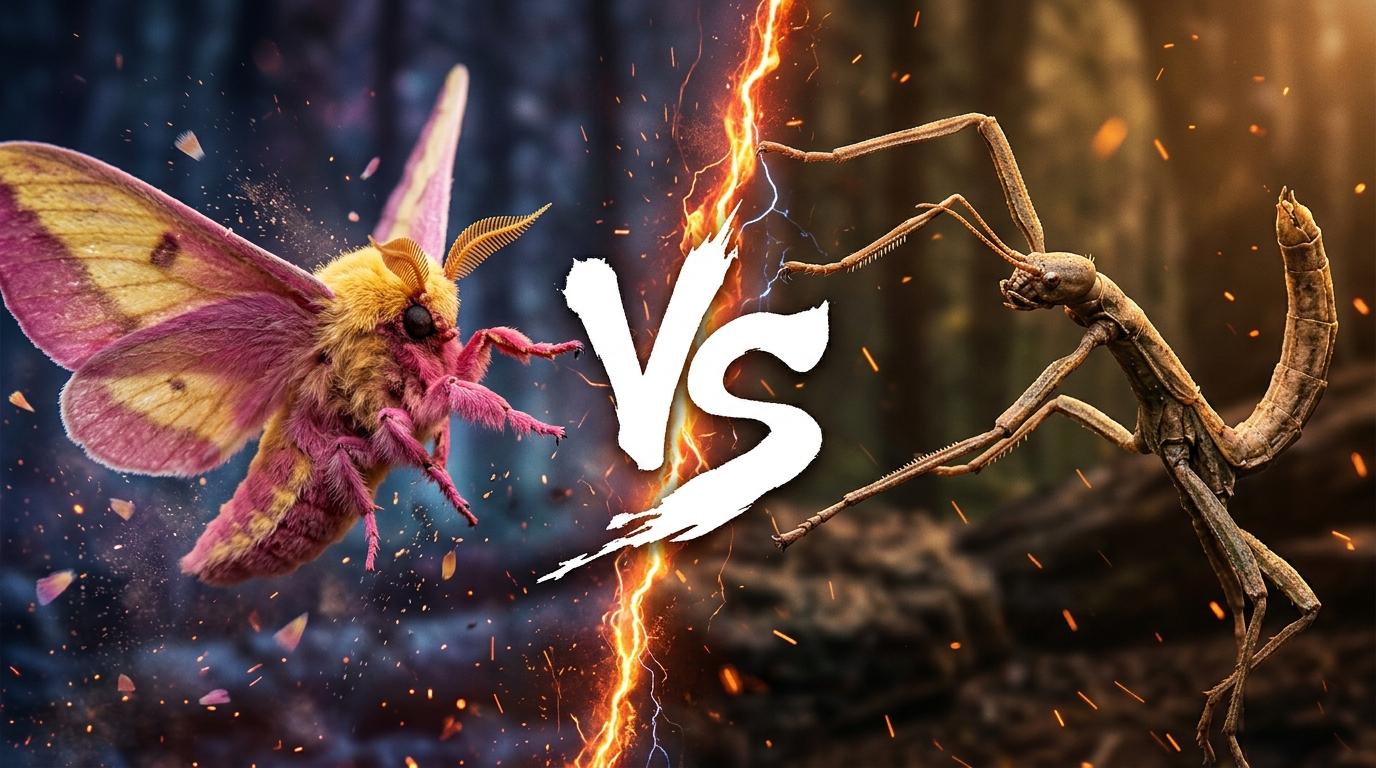
Rosy Maple Moth vs Northern Walkingstick: Who Actually Wins?
The Northern Walkingstick wins this matchup clearly. It is a much longer, heavier-bodied insect, often 7 to 9 cm long against a moth whose wings span roughly 3 to 5 cm. It has a tougher exoskeleton, clinging legs that lock onto bark and twigs, and a life built around staying put while the Rosy Maple Moth lives fast and fragile. The moth has no functional mouthparts as an adult and lives only about a week on its caterpillar reserves. Its scale-covered wings tear easily, and its only real move is flight. Neither species is a fighter. Both are plant-eaters that never evolved to attack, so any contest comes down to mass, grip, durability, and who can push the other off a branch. On every physical measure except getting away, the walkingstick holds the edge.
Read comparison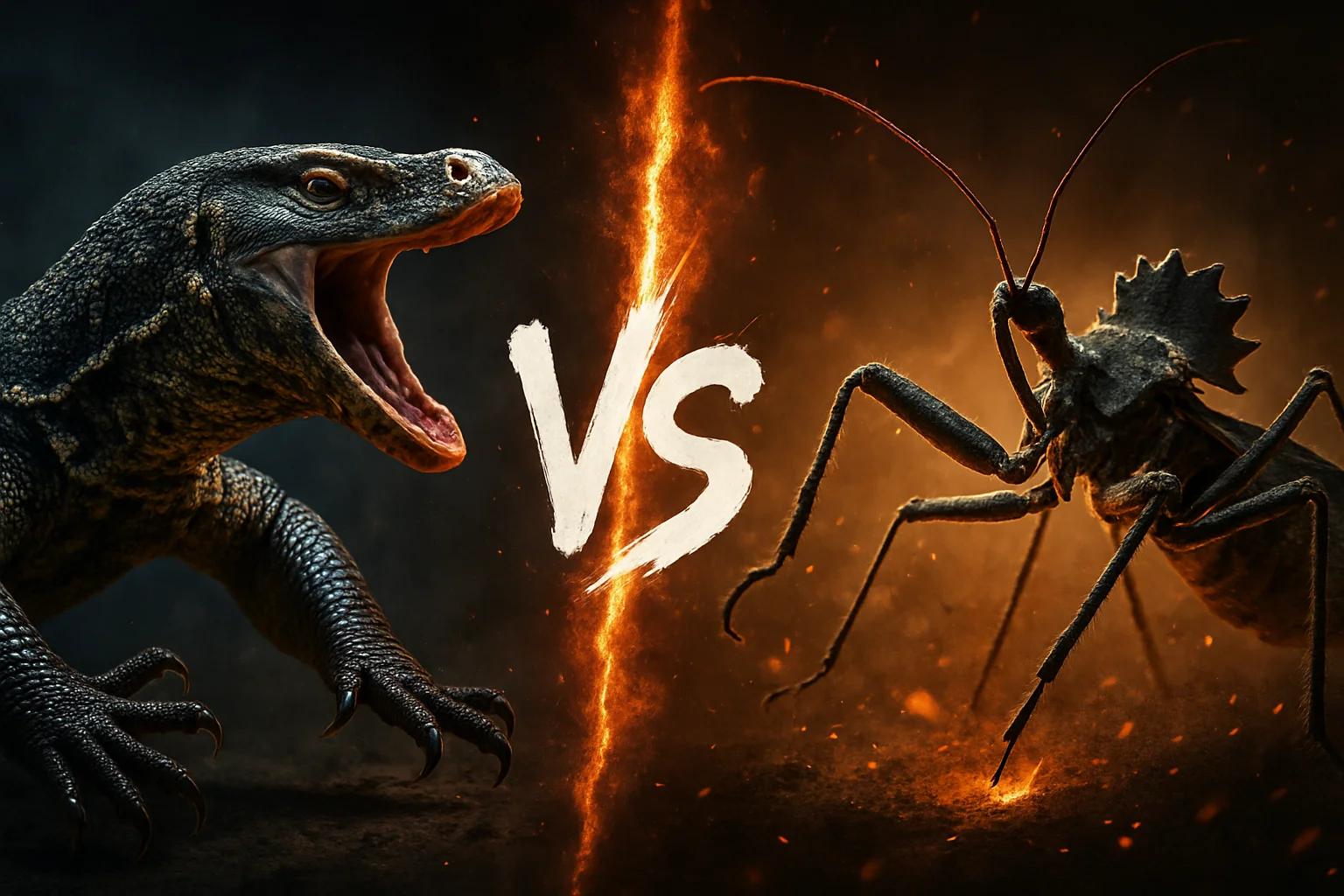
Water Monitor vs Wheel Bug: Who Actually Wins?
In a contest between the Water Monitor and the Wheel Bug, the Water Monitor emerges as the clear winner due to its superior size, dominance, and predatory capabilities. While the Wheel Bug has unique adaptations for ambushing smaller prey, the Water Monitor's larger size and strength allow it to overpower the Wheel Bug effectively.
Read comparison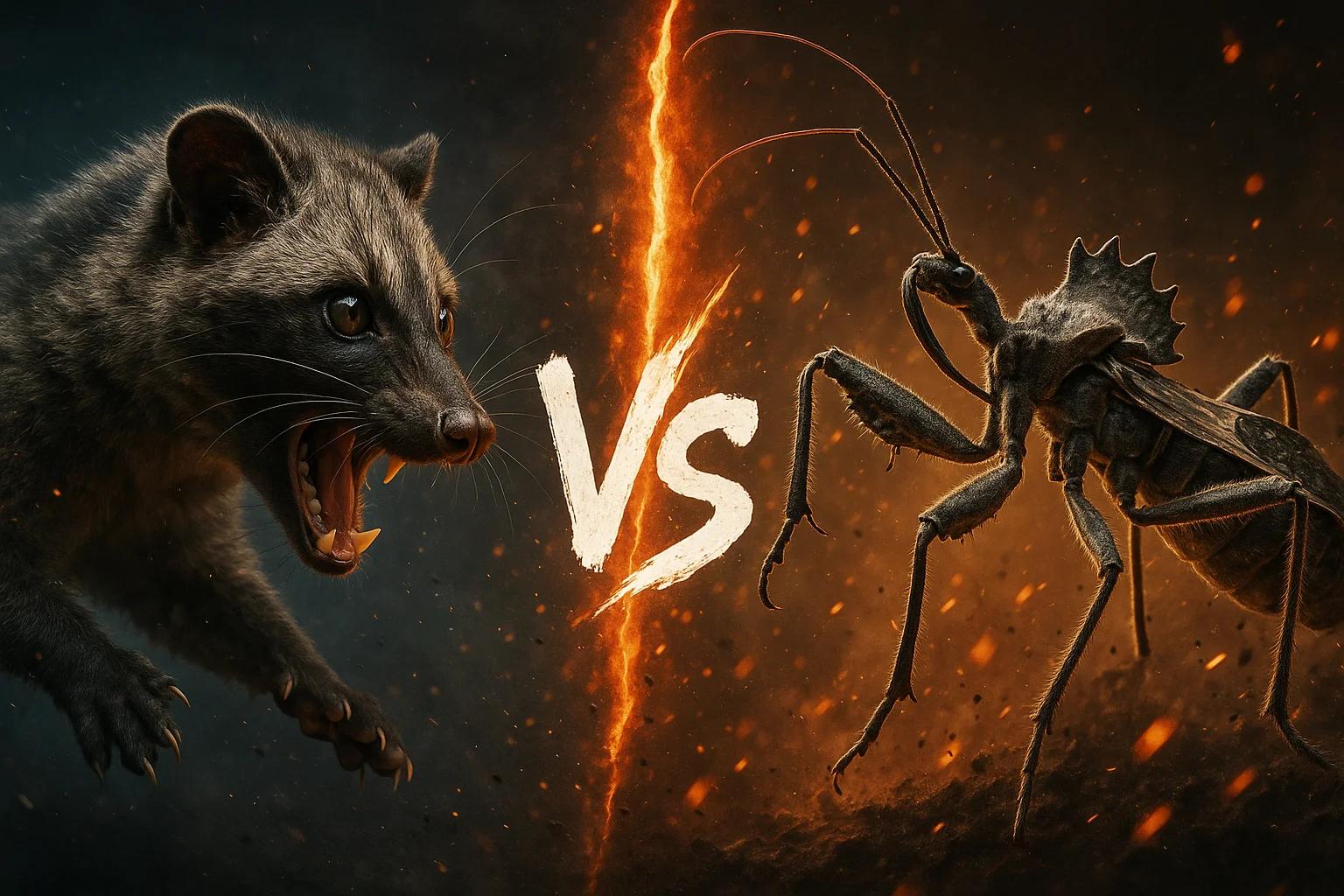
Asian Palm Civet vs Wheel Bug: Who Actually Wins?
The Asian Palm Civet emerges as the clear winner in this matchup. With its superior size, speed, and intelligence, it outmatches the Wheel Bug in almost every conceivable scenario. The civet's ability to navigate complex environments and its predatory instincts give it a decisive edge over the wheel bug, which relies heavily on its camouflage and stealth tactics.
Read comparison
Alligator Snapping Turtle vs Wheel Bug: Who Actually Wins?
The Alligator Snapping Turtle reigns supreme in this matchup, primarily due to its sheer size, defensive capabilities, and overwhelming force in a head-to-head confrontation. While the Wheel Bug is a master of stealth and precision with its proboscis, it simply cannot penetrate the turtle's robust defenses or withstand its powerful bite.
Read comparison
Discussion
What do you think?
Share your reasoning with other readers. Be civil and stick to the animals.
Sign in to join the discussion.
Sign inNo comments yet. Start the conversation.