

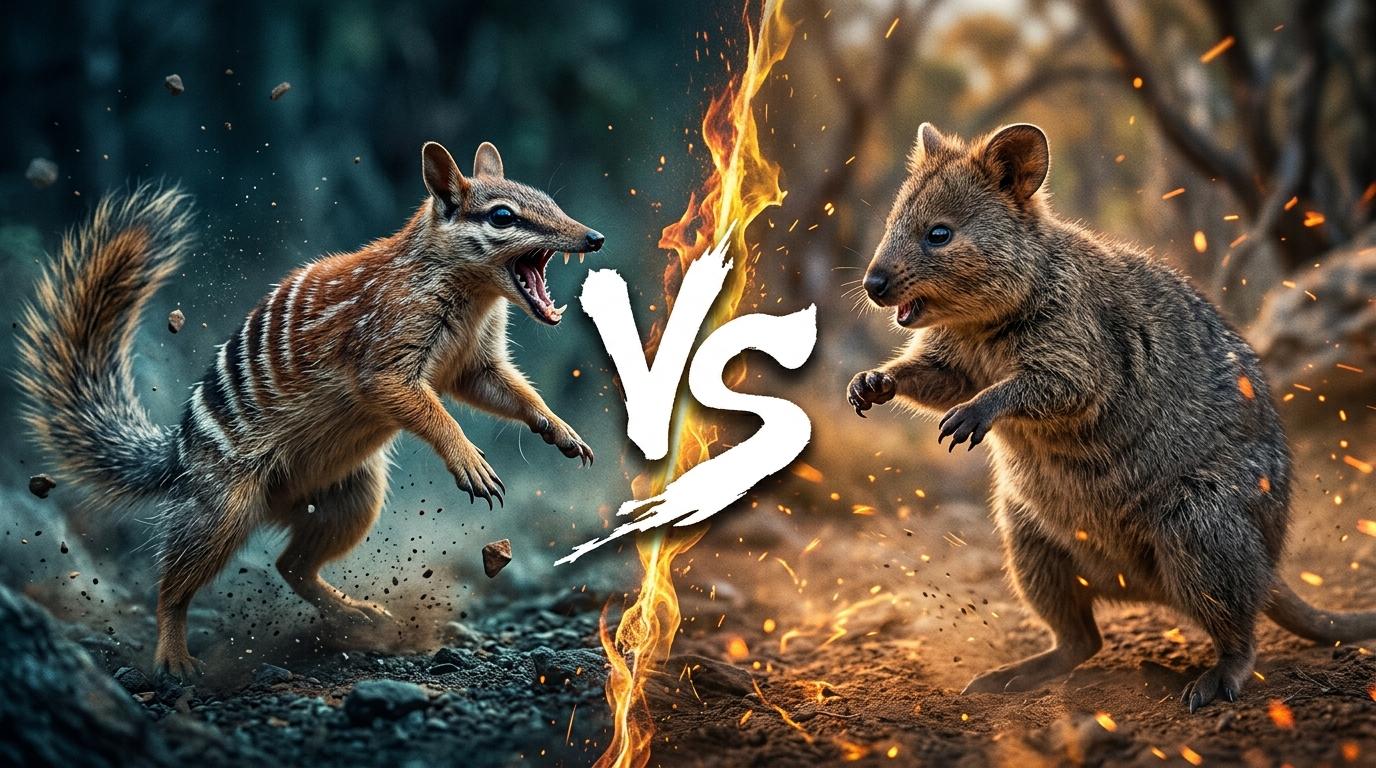
Numbat vs Quokka: Who Actually Wins?
Numbat vs quokka: a biology-first look at two Western Australian marsupials. We compare size, bite, kicks, speed and cover use to explain why the quokka wins most matchups.
Numbat vs Quokka
Matchup winner
Quokka
Quick verdict
Start with the direct answer, then use the structured comparison below to see what changes the outcome.
The quokka wins. At roughly 2.5–5 kg it outweighs a 500–700 g numbat about five to one, and weight is the deciding factor in almost any contact between small mammals. The quokka is a compact wallaby with strong hind legs, a solid body and sharp incisors built for clipping tough vegetation. The numbat is a fast, alert termite specialist. Its digging claws are useful and it can bolt into a hollow log in seconds, but its jaw is weak and its many small peg-like teeth are made for termites, not combat. The numbat's real advantage is escape, not damage. In a forced encounter the quokka's mass, shoving power and kicks win. In a chase the numbat usually gets away, which is a survival win, not a fight win.
Read the full explanation
Quokka wins overall, mainly because it weighs about 4–7 times more than a numbat.
The numbat's weak jaw and termite-eating teeth give it almost no way to hurt a larger animal.
The numbat is quick, alert and knows where every refuge is, so it often escapes rather than loses.
These two rarely meet in the wild. Quokkas favour dense, moist scrub and Rottnest Island, while numbats live in eucalypt woodland.
Reader vote
Who do you think wins?
Pick a side — no account needed. Results update live.
No votes yet — be the first to call it.
Editorial note
Why people disagree
Quokkas look like smiling plush toys, so people underestimate a muscular wallaby that kicks and bites when cornered.
Body mass advantage
A five-fold weight gap means the quokka can shove, pin and absorb hits the numbat cannot.
Explosive power
Hopping legs double as kicking weapons and give the quokka strong launches over short distances.
Bite and weaponry
The numbat's mouth is a termite-gathering tool, while the quokka's incisors can actually nip.
Read the full explanation +
Numbats look fierce with their bold stripes and digging claws, but their whole body plan is tuned for termites, not fighting.
Some people score escape as winning. By that standard the numbat often wins, but in a forced contest mass decides it.
Comparison FAQ
Short, direct answers to the next questions readers usually ask after the headline verdict.
Would a numbat beat a quokka in a fight?+
No. The quokka weighs roughly five times more and has strong kicking legs. The numbat would try to flee or hide rather than fight.
Which is stronger, a numbat or a quokka?+
The quokka. As a small wallaby it has powerful hindquarters and a denser body. The numbat's strength is concentrated in its digging forelimbs.
Is a numbat dangerous at all?+
Only mildly when cornered. It can scratch with its claws and put on a hissing display, and its speed and quick retreat into logs make it hard to catch. Its weak jaw limits any real damage.
Are quokkas aggressive?+
Usually not, but they can bite and kick when handled or crowded, and they defend shelter sites from rivals.
Do numbats and quokkas meet in the wild?+
Rarely. Both live in southwestern Australia, but quokkas favour dense, moist scrub and islands such as Rottnest, while numbats live in eucalypt woodland.
Head-to-head species stats
These are the same core AnimalDex stat dimensions used on the dedicated animal pages, pulled side by side so the matchup is faster to scan.
Numbat
Tier DQuokka
Tier CTrait-by-trait comparison
Only the categories that matter to this matchup are included. The goal is not filler stats, but the real design differences that change the result.
About 500–700 g, slender
Body mass advantage
Quokka
About 2.5–5 kg, stocky
Body mass advantage
Quokka
Quick bursts, light frame
Explosive power
Quokka
Spring-loaded macropod hind legs
Explosive power
Quokka
Weak jaw, tiny peg teeth, long tongue
Bite and weaponry
Quokka
Sharp grazing incisors, kicks
Bite and weaponry
Quokka
Diurnal, constantly scanning, freezes or bolts
Threat detection
Numbat
Mostly crepuscular, relies on thick cover
Threat detection
Numbat
Uses hollow logs and burrows sized to its body
Refuge mastery
Numbat
Uses dense thickets and runways
Refuge mastery
Numbat
Fragile, small frame
Close-range durability
Quokka
Dense body, thick fur, tough hindquarters
Close-range durability
Quokka
How the verdict forms
Verdict timeline
01 · Body mass advantage
Quokka
02 · Explosive power
Quokka
03 · Bite and weaponry
Quokka
04 · Threat detection
Numbat
05 · Refuge mastery
Numbat
06 · Close-range durability
Quokka
Change the conditions
Scenario breakdown
This is where shallow battle content usually fails. Terrain, spacing, timing, and engagement style can change the answer.
Scenario lean
Numbat
Verdict confidence
82%
Numbat survives by vanishing
In woodland full of fallen hollow logs, the numbat's best move is to retreat into a gap the quokka physically can't follow. Being small becomes an advantage here. The numbat 'wins' only in the sense that the contest never happens.
AnimalDex field profiles
Explore these animals
Numbat
Myrmecobius fasciatus
Open woodland, dry forest, and shrubland with fallen logs and termite colonies.
Quokka
Setonix brachyurus
Shrubland, grassland, woodland edge, and island scrub habitats.
Systems Intelligence & Hidden Purpose
See the animals behind this comparison as engineered biological systems: what each one is built to do, where it gains leverage, and why the matchup changes by scenario.
Specialized Hardware
Reddish body with white back stripes, long pointed snout, and bushy tail give the Numbat a body plan tuned for its niche.
Systems Script
Numbats operate in open woodland, dry forest, and shrubland with fallen logs and termite colonies. Their design helps them match food access, shelter, and timing inside that environment.
Strategic Insight
A small specialist can stay alive by owning one precise job very well.
Specialized Hardware
Small hopping body with short tail, rounded face and small ears, and brown-gray fur with compact frame give the Quokka a body plan tuned for its niche.
Systems Script
Quokkas operate in shrubland, grassland, woodland edge, and island scrub habitats. Their design helps them match food access, shelter, and timing inside that environment.
Strategic Insight
Some small systems survive by protecting the safe pockets where they can still function well.
Final take
The quokka is the clear winner of numbat vs quokka. It is the heavier, sturdier animal and the only one of the two built to deliver force. The numbat is a precision termite harvester: fast, watchful and loyal to its refuges, but nearly unarmed.
Read the full explanation
The numbat's answer to danger is avoidance, and in the wild that strategy works well against animals it can't fight. Put the two in a forced encounter, though, and mass decides it in the quokka's favour.
Collect both animals in AnimalDex
Track the species behind this matchup, compare their real traits, and build the rivalry into your AnimalDex collection.
Related comparisons
Continue with nearby matchups to compare more real-world animal traits without dropping into junky who-wins filler.

Quokka vs Tasmanian Devil: Who Actually Wins?
The Tasmanian devil wins, and it isn't especially close. It is roughly twice the quokka's weight, with a dense, muscular, low-slung build. Its bite is among the strongest of any living mammal relative to body size, and its jaws are built to crunch bone at carcasses. The quokka is a small grazing wallaby with no real weapons beyond scratching forepaws, kicking hind feet and a modest bite. It has no instinct for sustained combat. In any contact fight the devil's crushing jaws and appetite for scuffles decide things fast. The quokka's only real path to 'winning' is not fighting at all: it can bound away through dense scrub tunnels faster and more nimbly than the stocky devil can follow.
Read comparison
Numbat vs Tasmanian Devil: Who Actually Wins?
The Tasmanian devil wins, and it isn't close. An adult devil weighs roughly 6–12 kg against a numbat's 400–700 g, so it holds about a 15-to-20-fold mass advantage. It also carries one of the strongest bites relative to body size of any living mammal, plus heavy shoulders and a temperament built around contested carcasses. The numbat is a specialist termite eater with a long sticky tongue, peg-like teeth and almost no offensive weaponry. Its real strengths are daytime alertness, quick dashes and a habit of bolting into hollow logs. That makes it hard to catch, but it has no way to win a fight. In any scenario where contact happens, the devil decides it.
Read comparison
Discussion
What do you think?
Share your reasoning with other readers. Be civil and stick to the animals.
Sign in to join the discussion.
Sign inNo comments yet. Start the conversation.