

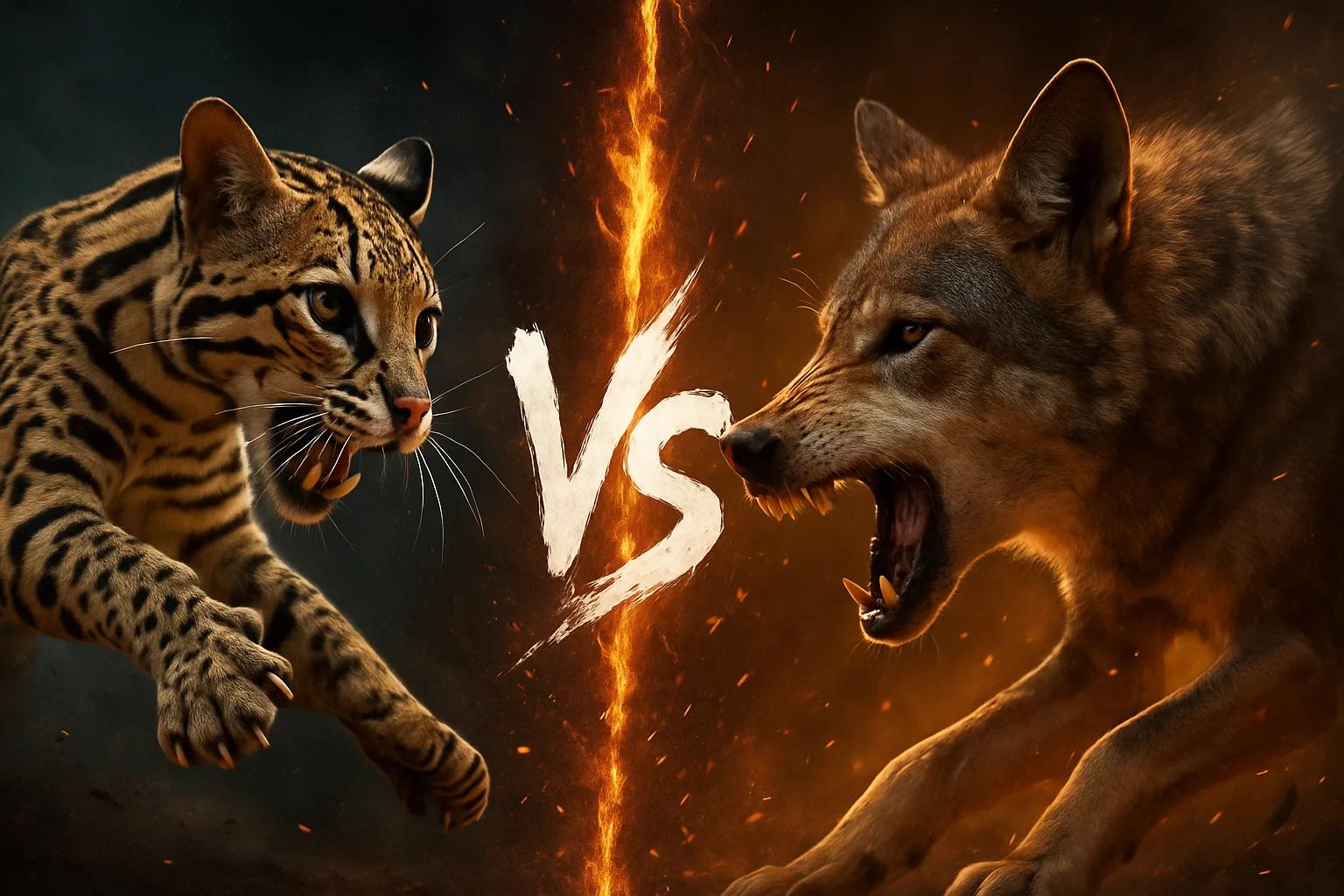
Ocelot vs Red Wolf: Who Actually Wins?
Ocelot vs red wolf: a biology-first breakdown of size, bite, stamina, and fighting style to show who wins and why the ocelot still deserves respect.
Ocelot vs Red Wolf
Matchup winner
Red Wolf
Quick verdict
Start with the direct answer, then use the structured comparison below to see what changes the outcome.
The red wolf wins this matchup most of the time. A red wolf typically weighs 20–35 kg against an ocelot's 8–16 kg, so the wolf usually carries about twice the mass. It also brings a longer reach, a sustained crushing bite, and the endurance of a canid built to wear prey down over distance. The ocelot is the more agile and better-armed animal per kilogram. It has retractable claws, a grappling forelimb build, and a precise killing bite, and in dense cover it can land fast, damaging strikes. But a one-on-one fight rewards mass, staying power, and the ability to keep pressing, and those are the wolf's strengths. The ocelot's best realistic outcome is to injure the wolf and escape up a tree. It rarely forces the wolf to quit while staying on the ground.
Read the full explanation
Winner: Red Wolf, mainly because it has roughly double the ocelot's body mass.
The ocelot is the better grappler with sharper weapons, but it can't absorb a sustained attack from a canid this size.
In thick cover or near trees, the ocelot can hurt the wolf and escape.
In open ground or a drawn-out fight, the wolf's stamina and reach decide it.
Reader vote
Who do you think wins?
Pick a side — no account needed. Results update live.
No votes yet — be the first to call it.
Editorial note
Why people disagree
Cat claws look decisive. People assume retractable claws and a feline grappling style beat any dog, but at a 2:1 weight gap, armament rarely makes up for mass.
Body mass & frame
Mass controls who gets knocked down, pinned, and worn out. A doubled weight class is the single biggest factor in a small-carnivore fight.
Close-range weaponry
The ocelot carries more tools per kilogram. It can strike with four clawed limbs and its teeth, while the wolf fights mostly mouth-first.
Ambush control
If the ocelot chooses the moment, it can open with a surprise strike. Wolves are rarely caught completely off guard, though.
Read the full explanation +
The red wolf is often underrated. It is smaller than a gray wolf, but it is still a true wolf with pursuit stamina and a strong bite, not a coyote.
Habitat changes the story. In vine-choked forest with escape trees, the ocelot plays a different game, and many debates mix up 'winning' with 'escaping alive.'
Comparison FAQ
Short, direct answers to the next questions readers usually ask after the headline verdict.
Would an ocelot beat a red wolf?+
Usually not. The red wolf wins most encounters because of its size and stamina. The ocelot's best outcome is injuring the wolf and escaping into dense cover or up a tree.
Which is stronger, an ocelot or a red wolf?+
The red wolf is stronger in absolute terms because it is about twice as heavy. The ocelot is stronger relative to its body size, especially in its forelimbs and grip.
Why is the ocelot still dangerous to a red wolf?+
An ocelot has sharp retractable claws, fast reflexes, and a precise bite, and it can fight from angles a wolf can't easily defend. Its claws can cause serious face and eye injuries, which is a big reason predators tend to avoid each other.
Do ocelots and red wolves meet in the wild?+
Rarely, if at all today. Wild red wolves survive mainly in eastern North Carolina, while ocelots live from South Texas through Latin America. This matchup is a biology comparison, not a common real-world encounter.
Head-to-head species stats
These are the same core AnimalDex stat dimensions used on the dedicated animal pages, pulled side by side so the matchup is faster to scan.
Ocelot
Tier BRed Wolf
Tier ATrait-by-trait comparison
Only the categories that matter to this matchup are included. The goal is not filler stats, but the real design differences that change the result.
8–16 kg, compact and low-slung
Body mass & frame
Red Wolf
20–35 kg, long-legged and deep-chested
Body mass & frame
Red Wolf
Retractable claws plus a precise neck or skull bite
Close-range weaponry
Ocelot
Long canines and a crushing, hold-and-shake bite
Close-range weaponry
Ocelot
Elite stalker that excels in low light and dense cover
Ambush control
Ocelot
Tests and pursues rather than hides
Ambush control
Ocelot
Short explosive bursts that fade quickly
Staying power
Red Wolf
Built for long trotting pursuit with high aerobic capacity
Staying power
Red Wolf
Climbs, twists, and fights from awkward angles
Agility & escape routes
Ocelot
Fast on the ground but cannot climb
Agility & escape routes
Ocelot
Light frame that is vulnerable to crushing bites
Close-range durability
Red Wolf
Thicker neck and ruff on a larger body
Close-range durability
Red Wolf
How the verdict forms
Verdict timeline
01 · Body mass & frame
Red Wolf
02 · Close-range weaponry
Ocelot
03 · Ambush control
Ocelot
04 · Staying power
Red Wolf
05 · Agility & escape routes
Ocelot
06 · Close-range durability
Red Wolf
Change the conditions
Scenario breakdown
This is where shallow battle content usually fails. Terrain, spacing, timing, and engagement style can change the answer.
Scenario lean
Ocelot
Verdict confidence
82%
The ocelot hurts the wolf and gets away.
In dense thicket with trees close by, the ocelot controls the range. It can strike from cover, rake with its claws, and climb out before the wolf's mass comes into play. This counts as a win on its own terms: the ocelot survives and deters the wolf. It is not a knockout.
AnimalDex field profiles
Explore these animals
Ocelot
Leopardus pardalis
Tropical forest, thorn scrub, mangrove edge, and dense brush habitats.
Red Wolf
Canis rufus
coastal prairie, pine savannah, and marsh edge
Systems Intelligence & Hidden Purpose
See the animals behind this comparison as engineered biological systems: what each one is built to do, where it gains leverage, and why the matchup changes by scenario.
Specialized Hardware
Golden coat with chain-like rosettes, white underside and marked face, and medium cat size with strong tail give the Ocelot a body plan tuned for its niche.
Systems Script
Ocelots operate in tropical forest, thorn scrub, mangrove edge, and dense brush habitats. Their design helps them match food access, shelter, and timing inside that environment.
Strategic Insight
Beauty becomes strategic when pattern and background match perfectly.
Specialized Hardware
slim reddish canid frame, long-legged wetland stride, and pair-and-pack territory calling give the Red Wolf a body plan tuned for its niche.
Systems Script
Red Wolfs operate through coastal prairie, pine savannah, and marsh edge. Their design links movement, feeding, shelter, and timing into one workable survival system.
Strategic Insight
Where water controls movement, position and timing often matter more than speed.
Final take
The red wolf is the overall winner. This is not because the ocelot is weak. It is because roughly 2:1 mass, a crushing bite, and canid endurance are hard to overcome in a straight fight.
Read the full explanation
The ocelot is the more specialized killer pound for pound. Give it cover, darkness, and a tree, and it becomes a dangerous, hard-to-pin opponent that can leave a wolf bleeding. But the question is who wins, and in most realistic setups the wolf is the one left standing on the ground.
Collect both animals in AnimalDex
Track the species behind this matchup, compare their real traits, and build the rivalry into your AnimalDex collection.
Related comparisons
Continue with nearby matchups to compare more real-world animal traits without dropping into junky who-wins filler.

Ocelot vs Ringtail: Who Actually Wins?
The ocelot wins, and the gap is wide. An adult ocelot typically weighs 8–15 kg against a ringtail's roughly 0.7–1.4 kg, so the cat carries about ten times the mass. It also brings the full felid predator toolkit: retractable hooked claws, a short powerful jaw built for killing bites, and real experience taking prey up to the ringtail's size, including small mammals, opossums, rodents and birds. The ringtail is a fast, extraordinarily agile climber with sharp teeth and a fierce defensive temperament. Those traits matter most in escape, not in a contest. In any committed encounter the ocelot's grappling power and lethal bite decide it quickly. The ringtail's best result is not a win. It is getting out through the rocks or treetops before the cat can pin it.
Read comparison
Jaguarundi vs Ocelot: Who Actually Wins?
The ocelot wins. An adult ocelot typically weighs 8–15 kg against the jaguarundi's 3.5–9 kg. It has a broader skull, a heavier jaw built for crushing, and thick forelimbs with big paws suited to grappling and pinning. The jaguarundi is a lean, low-slung, weasel-shaped cat. It is quick, active in daylight, and a sharp opportunist, but its body is built to slip through grass and catch small prey, not to trade blows with a heavier cat. In a committed close-range fight, the ocelot's mass, bite, and grip decide it. The jaguarundi's best result is a fast exit, not a win.
Read comparison
Discussion
What do you think?
Share your reasoning with other readers. Be civil and stick to the animals.
Sign in to join the discussion.
Sign inNo comments yet. Start the conversation.