

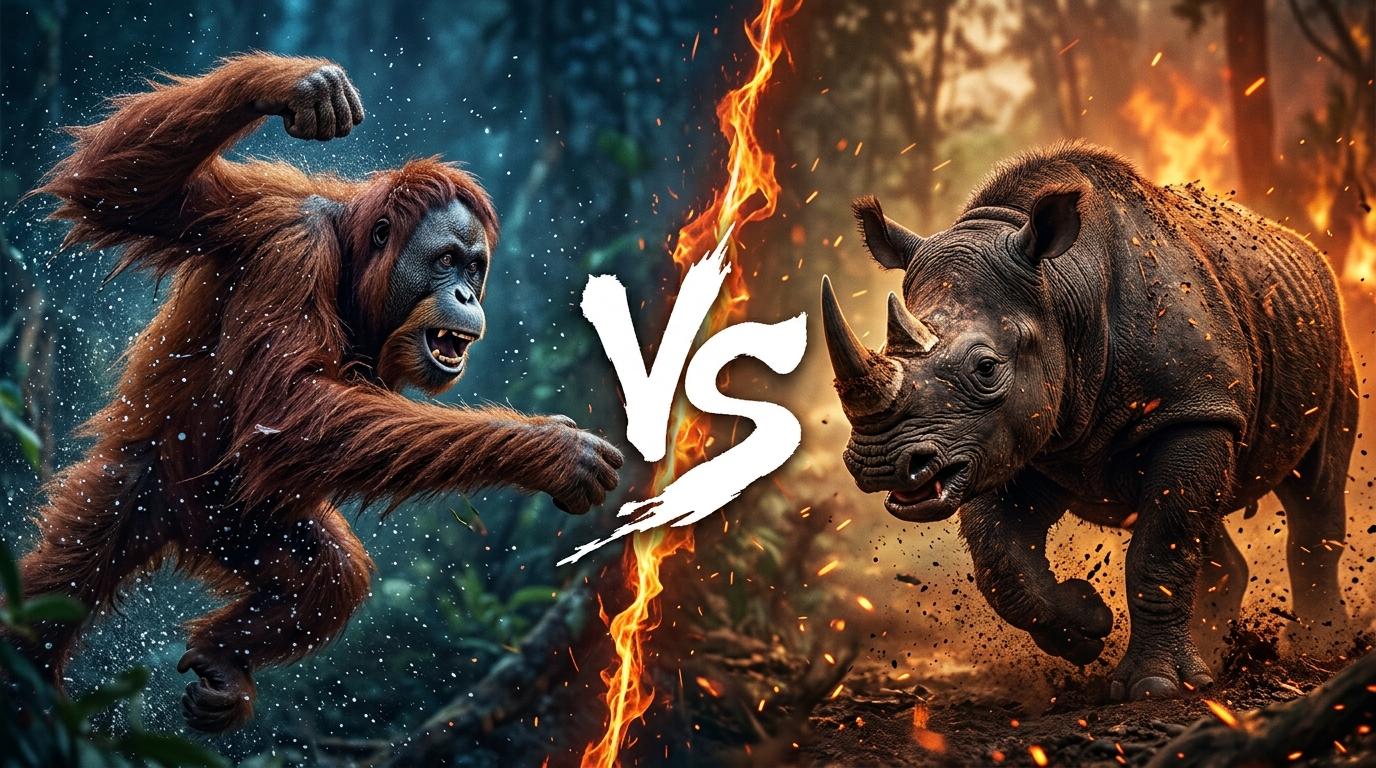
Orangutan vs Sumatran Rhinoceros: Who Actually Wins?
Orangutan vs Sumatran rhino: a biology-first breakdown of strength, size, armor, and behavior to show which Sumatran rainforest giant comes out on top.
Orangutan vs Sumatran Rhinoceros
Matchup winner
Sumatran Rhinoceros
Quick verdict
Start with the direct answer, then use the structured comparison below to see what changes the outcome.
The Sumatran rhinoceros wins, and it is not especially close. Even as the smallest living rhino, an adult weighs roughly 500–950 kg against a large male orangutan's 80–100 kg, so the rhino brings close to ten times the mass. It also has thick skin, a front horn, sharp lower incisors it uses as tusks in real fights, and a low, powerful frame built for shoving through dense forest. The orangutan is extraordinarily strong for its size and far more intelligent, with a long reach and a crushing grip, but nothing in its anatomy can stop a charging half-ton animal. The orangutan's real advantage is escape: it lives in the canopy, and the rhino cannot follow. In any frame where both animals are forced to commit on the ground, the rhino's mass, armor, and weaponry decide it.
Read the full explanation
Sumatran rhino wins any committed ground confrontation through overwhelming mass and natural weapons.
Orangutans are pound-for-pound powerhouses, but they are outweighed roughly 6–10x.
The orangutan's best move is to climb, and in the trees it is untouchable.
In the wild these two share forests and essentially never fight; both are critically endangered.
Reader vote
Who do you think wins?
Pick a side — no account needed. Results update live.
No votes yet — be the first to call it.
Editorial note
Why people disagree
People hear 'smallest rhino' and picture something small. A Sumatran rhino still outweighs a big orangutan many times over.
Raw mass
Mass drives momentum and impact. Nearly a tenfold gap means the rhino absorbs blows and delivers force on a scale the ape cannot match.
Natural weapons
Sumatran rhinos slash with their lower incisors in real disputes, so they have true fighting tools backed by body weight.
Close-range durability
The orangutan's bites and grabs struggle to cause serious damage through rhino hide, while one rhino strike can seriously injure the ape.
Read the full explanation +
Ape-strength myths inflate the orangutan. Its grip and pulling power are elite, but strength does not cancel a mass gap this large.
Fans of the orangutan count tree escape as a win. Escaping is survival, not victory.
Comparison FAQ
Short, direct answers to the next questions readers usually ask after the headline verdict.
Would an orangutan beat a Sumatran rhino?+
No. In a ground fight the Sumatran rhino wins because of its huge weight advantage, thick skin, horns, and slashing lower incisors. The orangutan's best outcome is climbing away.
Is an orangutan stronger than a Sumatran rhino?+
Pound for pound, the orangutan's upper body and grip are exceptional. In total force, though, the rhino is far stronger because it weighs roughly 6–10 times more.
Who would win, orangutan vs rhino?+
The rhino wins on the ground. The orangutan only 'wins' if it escapes into the trees, where the rhino can't reach it.
Why is the orangutan still dangerous?+
A large male orangutan has long canines, a powerful bite, and a crushing grip that can seriously injure predators or humans. It is dangerous, just badly outmatched by a half-ton armored animal.
Do orangutans and Sumatran rhinos live together?+
Historically their ranges overlapped in the rainforests of Sumatra and Borneo. They use different layers of the forest, so real conflict is extremely unlikely.
Is the Sumatran rhino aggressive?+
It is usually shy and solitary, but it can charge and slash with its incisors when it feels threatened or is defending wallows and mates.
Head-to-head species stats
These are the same core AnimalDex stat dimensions used on the dedicated animal pages, pulled side by side so the matchup is faster to scan.
Orangutan
Tier ASumatran Rhinoceros
Tier BTrait-by-trait comparison
Only the categories that matter to this matchup are included. The goal is not filler stats, but the real design differences that change the result.
~30–100 kg, arboreal build
Raw mass
Sumatran Rhinoceros
~500–950 kg, compact barrel body
Raw mass
Sumatran Rhinoceros
Long canines, powerful bite, grasping hands
Natural weapons
Sumatran Rhinoceros
Two horns plus sharp tusk-like lower incisors
Natural weapons
Sumatran Rhinoceros
Long hair over muscle; little natural armor
Close-range durability
Sumatran Rhinoceros
Thick hide and a heavy skeleton
Close-range durability
Sumatran Rhinoceros
Elite pulling strength and hook-like grip
Grip and upper-body power
Orangutan
No grasping ability; power comes from the neck and legs
Grip and upper-body power
Orangutan
Tool use, planning, learned forest knowledge
Tactical intelligence
Orangutan
Solid sensory awareness, simpler behavior
Tactical intelligence
Orangutan
Fully arboreal; can leave the ground at will
Terrain escape
Orangutan
Ground-bound, though agile in thick brush and steep terrain
Terrain escape
Orangutan
How the verdict forms
Verdict timeline
01 · Raw mass
Sumatran Rhinoceros
02 · Natural weapons
Sumatran Rhinoceros
03 · Close-range durability
Sumatran Rhinoceros
04 · Grip and upper-body power
Orangutan
05 · Tactical intelligence
Orangutan
06 · Terrain escape
Orangutan
Change the conditions
Scenario breakdown
This is where shallow battle content usually fails. Terrain, spacing, timing, and engagement style can change the answer.
Scenario lean
Sumatran Rhinoceros
Verdict confidence
82%
Rhino by a wide margin.
On the ground the orangutan loses its main tool, mobility in the trees, and moves awkwardly on its knuckles and fists. The rhino's low center of gravity, horn, and slashing incisors let it pin, gore, or trample. Mass beats grip strength here.
AnimalDex field profiles
Explore these animals
Orangutan
Pongo spp.
Lowland rainforest, peat swamp forest, hill forest, and mixed tropical canopy systems.
Sumatran Rhinoceros
Dicerorhinus sumatrensis
mountain rainforest, lowland forest, and muddy mineral lick corridor
Systems Intelligence & Hidden Purpose
See the animals behind this comparison as engineered biological systems: what each one is built to do, where it gains leverage, and why the matchup changes by scenario.
Specialized Hardware
Long, powerful arms, hook-like hands and feet, strong spatial memory, and an unusually long learning period make orangutans high-capacity canopy navigation and problem-solving hardware.
Systems Script
Orangutans disperse seeds, prune movement routes through the canopy, and help maintain forest regeneration over long timescales. Their niche rewards cognition, patience, and memory more than constant aggression.
Strategic Insight
Complex environments do not always reward speed first. Sometimes the edge comes from learning slowly enough that the model actually holds.
Final take
The Sumatran rhinoceros is the clear winner of a committed fight. Even as the smallest rhino on Earth, it carries armor, real weapons, and roughly ten times the orangutan's weight. That combination turns any ground confrontation into a mismatch.
Read the full explanation
The orangutan is not a pushover. It is one of the strongest primates for its size and one of the smartest animals in the rainforest. Its genius is choosing not to fight: it uses the canopy as a fortress and leaves the ground to animals built for it.
Both species are critically endangered, and the Sumatran rhino may number fewer than 50 individuals. In reality, the biggest threat to both is the loss of the forest they share, not each other.
Collect both animals in AnimalDex
Track the species behind this matchup, compare their real traits, and build the rivalry into your AnimalDex collection.
Related comparisons
Continue with nearby matchups to compare more real-world animal traits without dropping into junky who-wins filler.

Orangutan vs Sumatran Tiger: Who Actually Wins?
The Sumatran tiger wins decisively in any real fight. It is the smallest living tiger subspecies, yet a typical adult male (roughly 100–140 kg) still outweighs a flanged male orangutan (about 80–90 kg). More importantly, the tiger is built to kill large mammals. It has dagger-length canines, retractable claws, a neck-and-throat bite, and ambush instincts refined on deer and wild boar. The orangutan is enormously strong for its size and has a serious bite. But its strength evolved for hanging, climbing, and bending branches, not for grappling a predator. The two species share the forests of Sumatra, and that coexistence is the strongest evidence. Sumatran orangutans spend far less time on the ground than Bornean orangutans, a difference often linked to tiger predation risk. The orangutan's real winning move is to stay in the canopy, where the fight never starts.
Read comparison
Malayan Tapir vs Orangutan: Who Actually Wins?
The Malayan tapir wins a realistic ground encounter, and mass is the main reason. An adult Malayan tapir typically weighs about 250–320 kg and can exceed 500 kg. A large wild flanged male orangutan weighs roughly 80–90 kg, and females are about half that. The orangutan is pound-for-pound one of the strongest animals in the forest, with a crushing grip, long arms, and a serious bite. But it is built for hanging and climbing, not for bracing against a charging, thick-skinned animal three to five times its weight. The tapir's barrel body, tough nape hide, forward shoves, and surprisingly damaging bite give it the decisive edge on the forest floor. The orangutan's real counter is terrain: if a tree is within reach, it does not need to win, because it can simply leave upward.
Read comparison
Discussion
What do you think?
Share your reasoning with other readers. Be civil and stick to the animals.
Sign in to join the discussion.
Sign inNo comments yet. Start the conversation.