

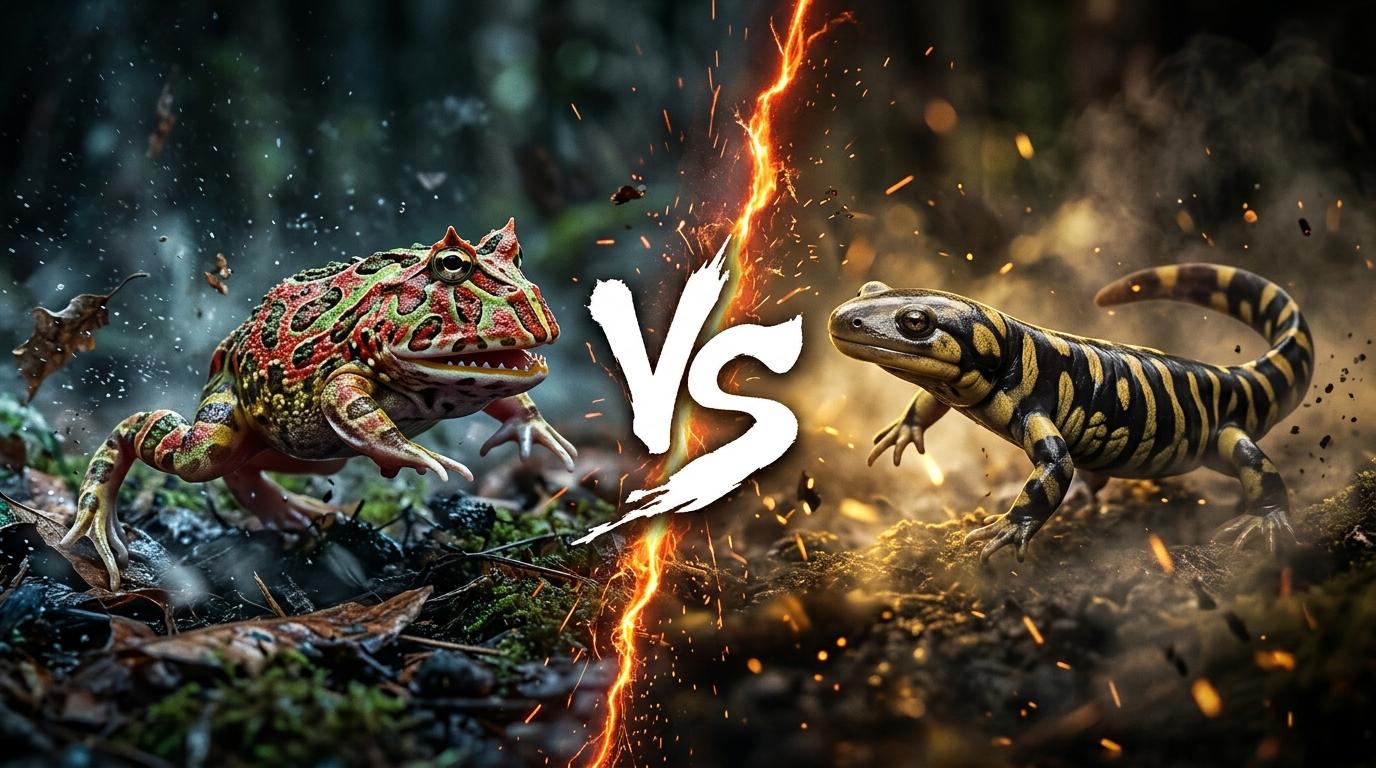
Ornate Horned Frog vs Tiger Salamander: Who Actually Wins?
Ornate horned frog vs tiger salamander: an evidence-based look at gape, bite, body length, and ambush tactics, with a clear winner and scenario-by-scenario breakdown.
Ornate Horned Frog vs Tiger Salamander
Matchup winner
Ornate Horned Frog
Quick verdict
Start with the direct answer, then use the structured comparison below to see what changes the outcome.
The Ornate Horned Frog wins this matchup. The Tiger Salamander is longer, heavier-tailed, and scores slightly higher on raw size and dominance, but the horned frog is built for exactly this kind of fight. Its huge, heavily armed mouth is lined with fang-like projections on the lower jaw and backed by a skull and jaw muscles that let it clamp down and hold on. It routinely ambushes and swallows prey that approaches its own body size, including other frogs and amphibians. A tiger salamander is a capable predator of worms, insects, and small vertebrates, but its smaller mouth and slow, grab-and-gulp feeding style are not designed to wrestle free from a vise-like bite. If the frog lands the first strike from cover, which is its entire life strategy, the salamander's extra length mostly means more body for the frog to anchor onto.
Read the full explanation
Winner: Ornate Horned Frog, mainly because of its enormous gape and locking bite.
The Tiger Salamander has the edge in length and endurance, but not in fight-ending tools.
Horned frogs are specialist ambushers that commonly eat other amphibians.
In open ground with no ambush, the salamander has a better chance of walking away than of winning.
Reader vote
Who do you think wins?
Pick a side — no account needed. Results update live.
No votes yet — be the first to call it.
Editorial note
Why people disagree
Size stats can mislead. The salamander can be noticeably longer, but much of that length is tail. The frog is nearly all head, jaw, and muscle.
Gape and bite control
In amphibian fights, whoever can seize and hold the other's body usually decides the outcome. The frog's mouth is a trap, while the salamander's is a fork.
Ambush control
The frog chooses when the fight starts. A salamander wandering past cover walks straight into the frog's preferred terms.
Body length and reach
The extra length makes the salamander harder to swallow whole and gives it leverage to thrash. That raises the frog's effort but doesn't remove its grip.
Read the full explanation +
Some readers picture a fair, alert standoff. In reality, horned frogs win by striking first from a buried position, and that strike usually settles the encounter.
Tiger salamanders are tough, slippery, and mildly distasteful, and that does make them harder to swallow. That is a real defense, but it isn't a winning weapon.
Comparison FAQ
Short, direct answers to the next questions readers usually ask after the headline verdict.
Would an Ornate Horned Frog beat a Tiger Salamander?+
Yes, in most scenarios. The frog's huge gape, fast ambush strike, and gripping jaws let it seize and control the salamander, especially when it attacks from cover.
Which is stronger, the horned frog or the tiger salamander?+
The tiger salamander can be longer and has more total body length to thrash with. The horned frog has far more effective strength where it counts, in jaw power and bite control.
Do horned frogs really eat other amphibians?+
Yes. Horned frogs are known for eating frogs, lizards, rodents, and large invertebrates, often prey close to their own size.
Why is the Tiger Salamander still dangerous in this matchup?+
Its slippery skin and mild distasteful secretions can make predators let go, and its long body is hard to swallow. If the frog's first strike fails or slips, the salamander has a good chance of escaping, and in open ground it can avoid the fight entirely.
Could a Tiger Salamander eat a horned frog?+
Only a very small juvenile frog. Adult horned frogs are far too wide and heavily built for a salamander's mouth.
Do these two species live in the same place?+
No. The ornate horned frog is South American and the tiger salamander is North American, so this matchup is hypothetical.
Head-to-head species stats
These are the same core AnimalDex stat dimensions used on the dedicated animal pages, pulled side by side so the matchup is faster to scan.
Ornate Horned Frog
Tier CTiger Salamander
Tier DTrait-by-trait comparison
Only the categories that matter to this matchup are included. The goal is not filler stats, but the real design differences that change the result.
Mouth nearly as wide as body, fang-like jaw projections
Gape and bite control
Ornate Horned Frog
Small teeth, modest gape built for worms and insects
Gape and bite control
Ornate Horned Frog
Buries in leaf litter or mud and strikes in a split second
Ambush control
Ornate Horned Frog
Forages actively, mostly at night, often in burrows
Ambush control
Ornate Horned Frog
Squat, roughly 10–14 cm in large females
Body length and reach
Tiger Salamander
Often 15–20 cm, occasionally over 30 cm
Body length and reach
Tiger Salamander
Dense, heavy-bodied, hard to dislodge
Close-range durability
Tiger Salamander
Thick, slippery skin with mild distasteful secretions
Close-range durability
Tiger Salamander
Lightning lunge from a stationary crouch
Explosive power
Ornate Horned Frog
Slow, deliberate movement with short bursts
Explosive power
Ornate Horned Frog
Sit-and-wait specialist, low pursuit ability
Stamina and mobility
Tiger Salamander
Steady walker, better at sustained movement
Stamina and mobility
Tiger Salamander
How the verdict forms
Verdict timeline
01 · Gape and bite control
Ornate Horned Frog
02 · Ambush control
Ornate Horned Frog
03 · Body length and reach
Tiger Salamander
04 · Close-range durability
Tiger Salamander
05 · Explosive power
Ornate Horned Frog
06 · Stamina and mobility
Tiger Salamander
Change the conditions
Scenario breakdown
This is where shallow battle content usually fails. Terrain, spacing, timing, and engagement style can change the answer.
Scenario lean
Ornate Horned Frog
Verdict confidence
82%
The frog's home ground, and a clear frog win.
Half-buried with only its eyes showing, the horned frog lets prey come to it. A salamander foraging along the ground triggers the strike reflex, and the frog lunges and clamps onto the head or forebody. Once it has that grip, its jaws and backward-facing projections hold on while it works the prey further into its mouth. The salamander's thrashing and skin secretions may slow the process, but this is the exact scenario the frog evolved for.
AnimalDex field profiles
Explore these animals
Ornate Horned Frog
Ceratophrys ornata
wet grassland, marsh edge, and seasonal floodplain
Tiger Salamander
Ambystoma tigrinum
grassland, open woodland, farmland, and seasonal pond systems
Systems Intelligence & Hidden Purpose
See the animals behind this comparison as engineered biological systems: what each one is built to do, where it gains leverage, and why the matchup changes by scenario.
Specialized Hardware
huge mouth and broad head, leaf-litter camouflage, and still ambush sitting give the Ornate Horned Frog a body plan tuned for its niche.
Systems Script
Ornate Horned Frogs operate through wet grassland, marsh edge, and seasonal floodplain. Their design links movement, feeding, shelter, and timing into one workable survival system.
Strategic Insight
Where water controls movement, position and timing often matter more than speed.
Specialized Hardware
bold yellow-and-black markings, burrowing land phase, and pond-breeding life cycle give the Tiger Salamander a body plan tuned for its niche.
Systems Script
Tiger Salamanders operate through grassland, open woodland, farmland, and seasonal pond systems Their design links movement, shelter, and feeding into one workable survival system.
Strategic Insight
A system can stay resilient by spreading its life across different habitats and times.
Final take
The Ornate Horned Frog is the overall winner because this matchup rewards the ability to end a fight with one bite, and that is the frog's defining trait. Its mouth is wide, armed, and built to hold, and its whole hunting strategy is designed to start encounters on its own terms.
Read the full explanation
The Tiger Salamander isn't helpless. Its length, slippery skin, mild secretions, and steadier mobility give it real ways to escape or avoid a fight. Still, those are survival tools rather than winning tools. In most realistic frames, especially wherever there is cover, the frog strikes first and the salamander is left trying to get free.
One reality check: these animals never meet in the wild. Ornate horned frogs live in the grasslands of Argentina, Uruguay, and southern Brazil, while tiger salamanders range across North America. This comparison is a thought experiment based on anatomy and behavior, not on observed encounters.
Collect both animals in AnimalDex
Track the species behind this matchup, compare their real traits, and build the rivalry into your AnimalDex collection.
Related comparisons
Continue with nearby matchups to compare more real-world animal traits without dropping into junky who-wins filler.
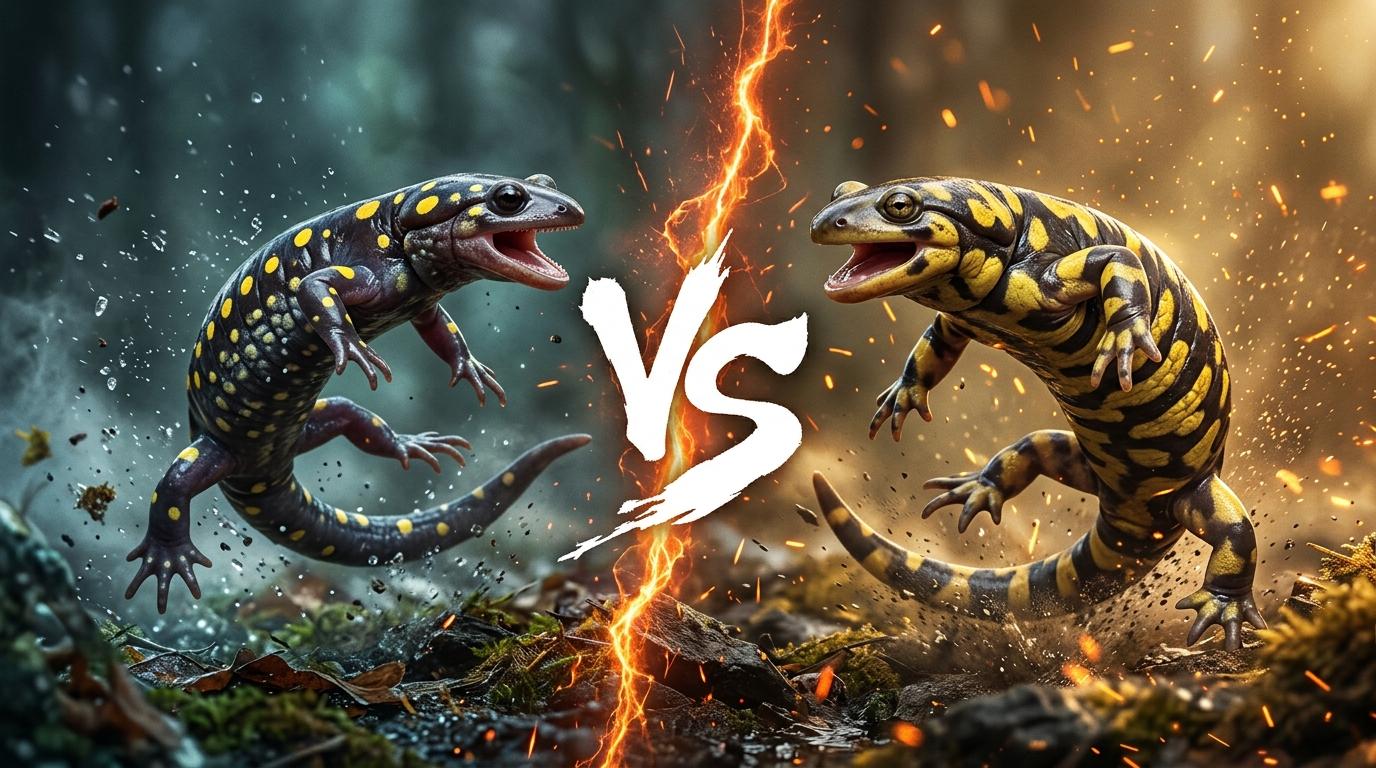
Spotted Salamander vs Tiger Salamander: Who Actually Wins?
The Tiger Salamander wins. Both are mole salamanders in the genus Ambystoma, so this is a close family matchup, but the tiger salamander is the bigger animal. Adults commonly reach 15–21 cm and sometimes more, while spotted salamanders usually measure 15–20 cm. Tiger salamanders also have broader heads, wider gapes and a famously indiscriminate appetite. Some larvae even develop into cannibal morphs that eat other salamanders. The spotted salamander's real weapons are defensive. Granular glands concentrated on its back and tail secrete a bitter, noxious fluid that discourages predators. That deters an attacker without overpowering it. In a direct contest of size, gape and willingness to bite, the tiger salamander controls the encounter.
Read comparison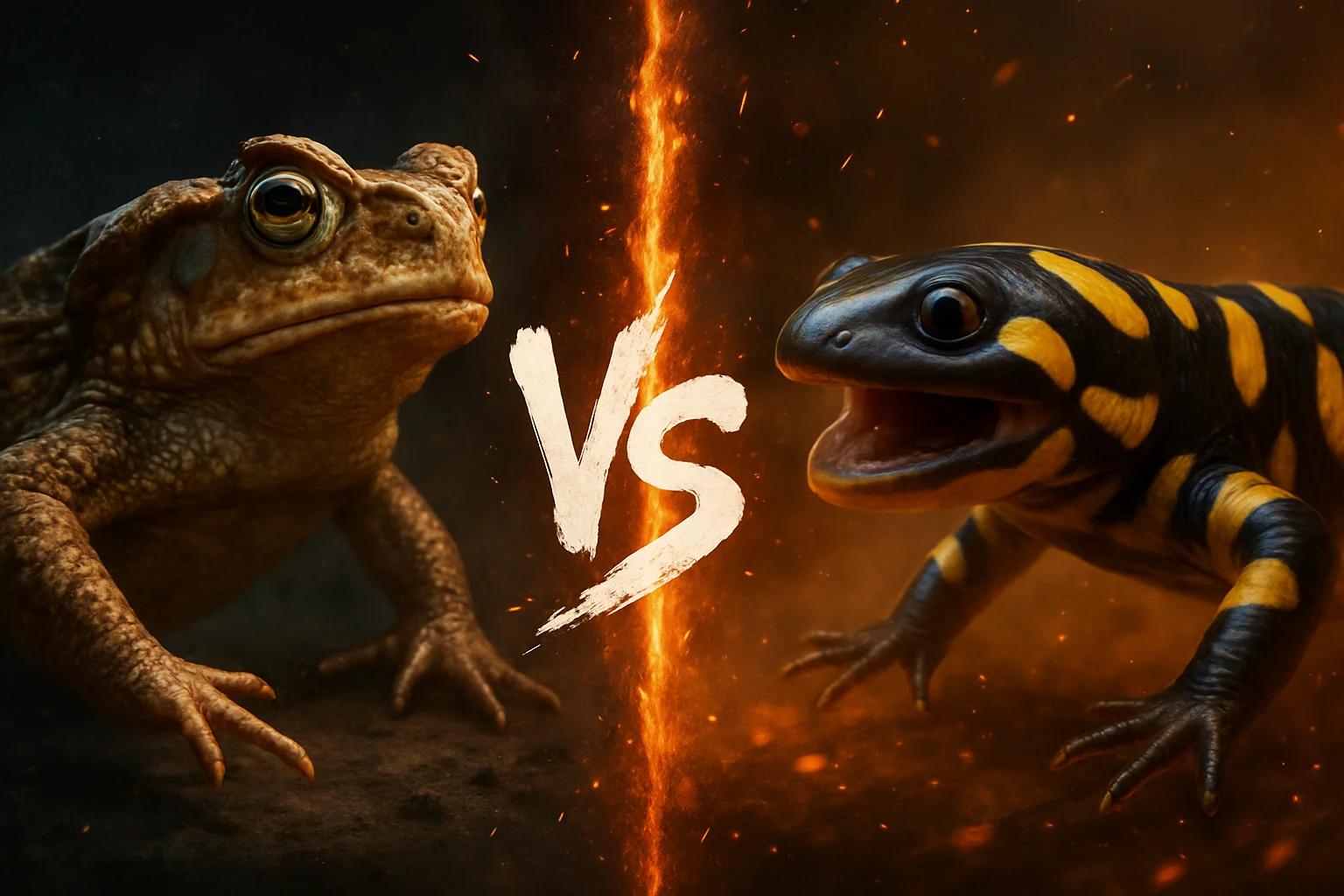
Cane Toad vs Tiger Salamander: Who Actually Wins?
The cane toad wins. In a straight confrontation, the tiger salamander is the more active predator: it has a wide mouth, a strong lunge, and a habit of swallowing whatever fits. The cane toad's advantage is that it doesn't need to win the fight at all. Its parotoid glands are loaded with bufadienolide toxins, which act on the heart. Any predator that bites or tries to swallow an adult toad takes in that poison, and many vertebrates that try die from it. A big adult cane toad is also bulkier and harder to swallow than anything a tiger salamander normally eats. The salamander is quicker to strike and better at ambushing small prey. The toad holds the outcome, though, because a bite costs the salamander more than it costs the toad.
Read comparison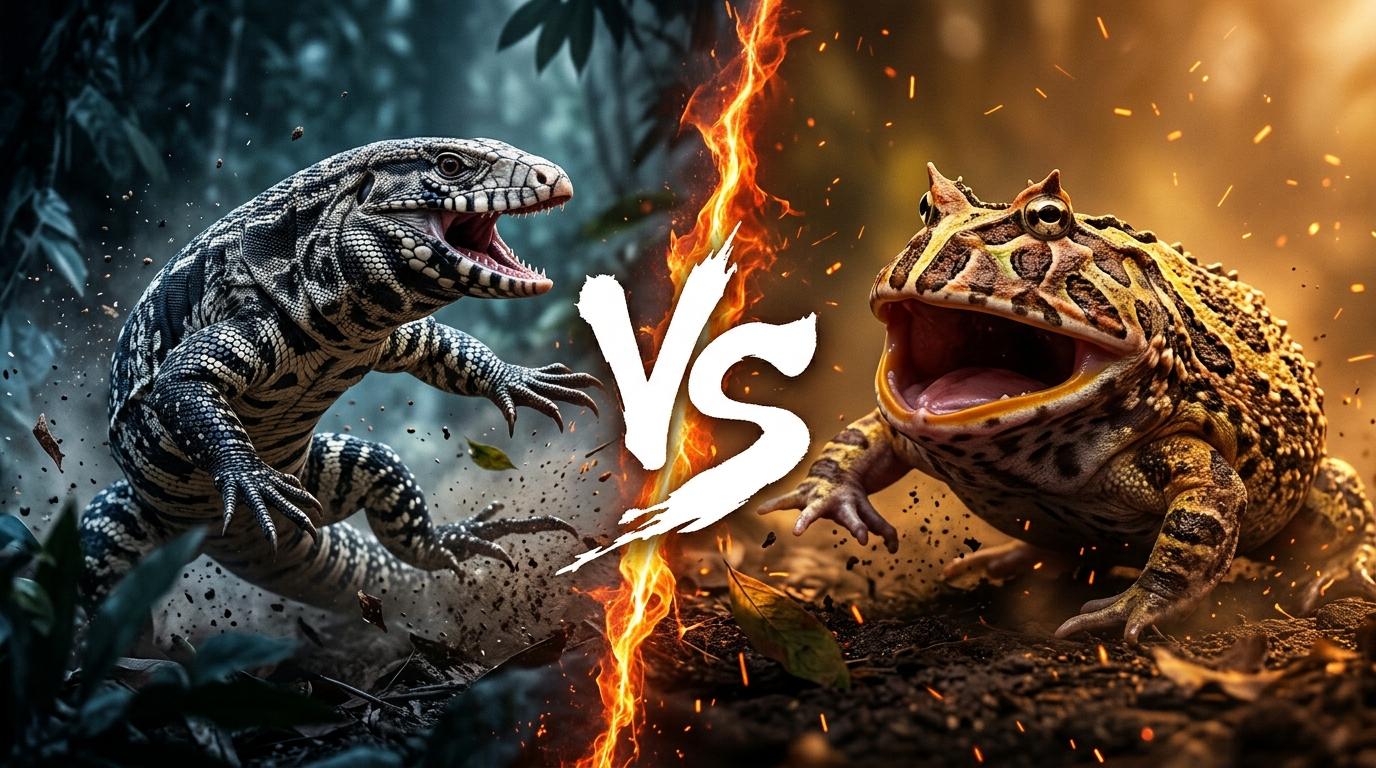
Argentine Black and White Tegu vs Ornate Horned Frog: Who Actually Wins?
The Argentine black and white tegu wins, and it isn't close. An adult tegu can reach about 1.2–1.4 m and 5–8 kg or more. It combines muscular jaws, crushing rear teeth, armored scales, sharp claws and active foraging intelligence. An ornate horned frog is roughly a 10–14 cm, half-kilo-class sit-and-wait predator. Its whole game depends on prey wandering within one lunge of its enormous mouth. The frog's gape and aggressive bite are real, and it can latch onto anything that fits. A tegu does not fit. In the wild, tegus are opportunistic omnivores that readily eat frogs, eggs and small animals. They are wide-ranging, alert, and built to find, flip and crush exactly the kind of buried, slow-moving prey a horned frog represents. The frog gets one surprise bite at best. The tegu gets the whole encounter.
Read comparison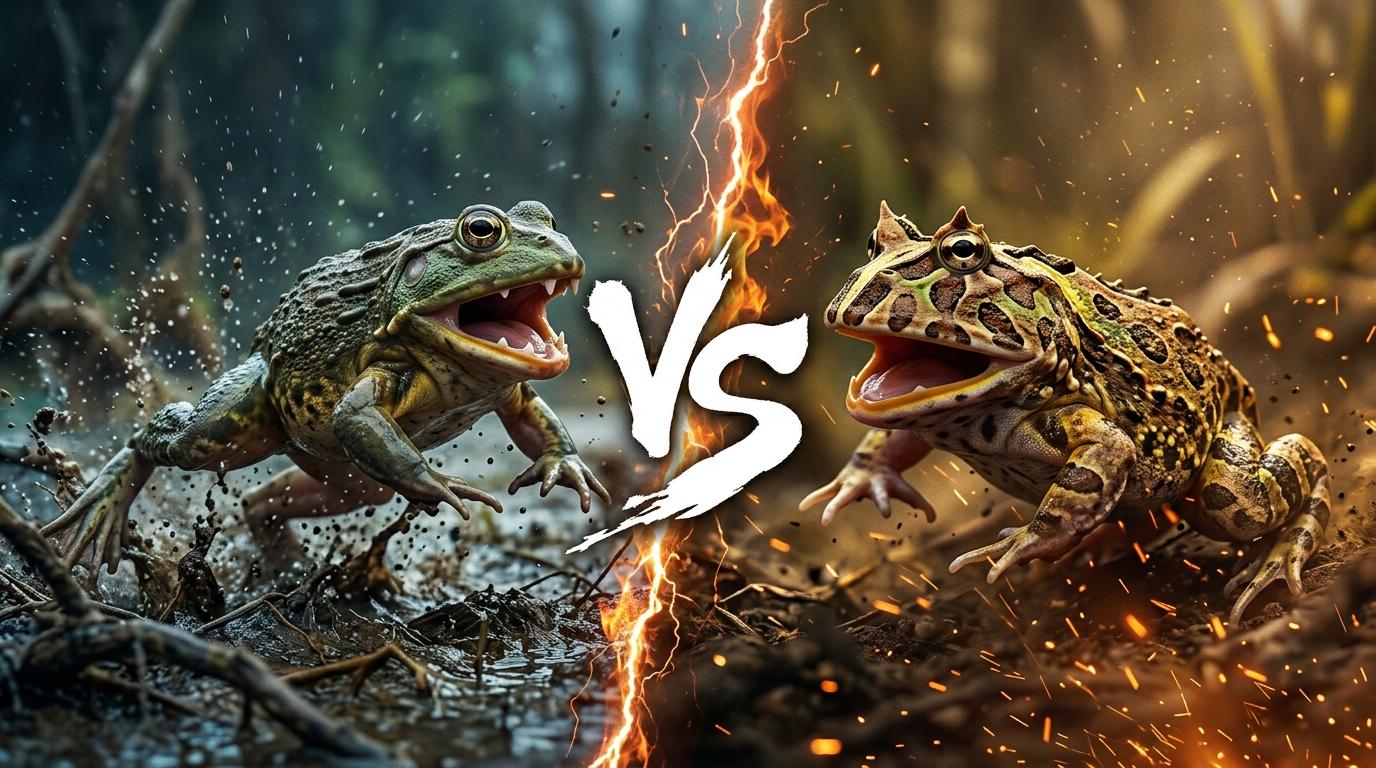
African Bullfrog vs Ornate Horned Frog: Who Actually Wins?
The African bullfrog wins, and it is not especially close. Males of Pyxicephalus adspersus can pass 1 kg and reach over 20 cm in length. They have bony, tooth-like odontoid projections on the lower jaw and a temperament built for guarding tadpoles against predators. The ornate horned frog is a superb sit-and-wait ambusher with a huge gape and a stubborn grip. At roughly 10–14 cm and a few hundred grams at most, though, it is giving up several times its own mass. Horned frogs routinely try to swallow prey too large for them. Against a bullfrog, that boldness becomes a liability, because the bigger frog can bite back, shove, pin, and potentially swallow it.
Read comparison
Discussion
What do you think?
Share your reasoning with other readers. Be civil and stick to the animals.
Sign in to join the discussion.
Sign inNo comments yet. Start the conversation.