

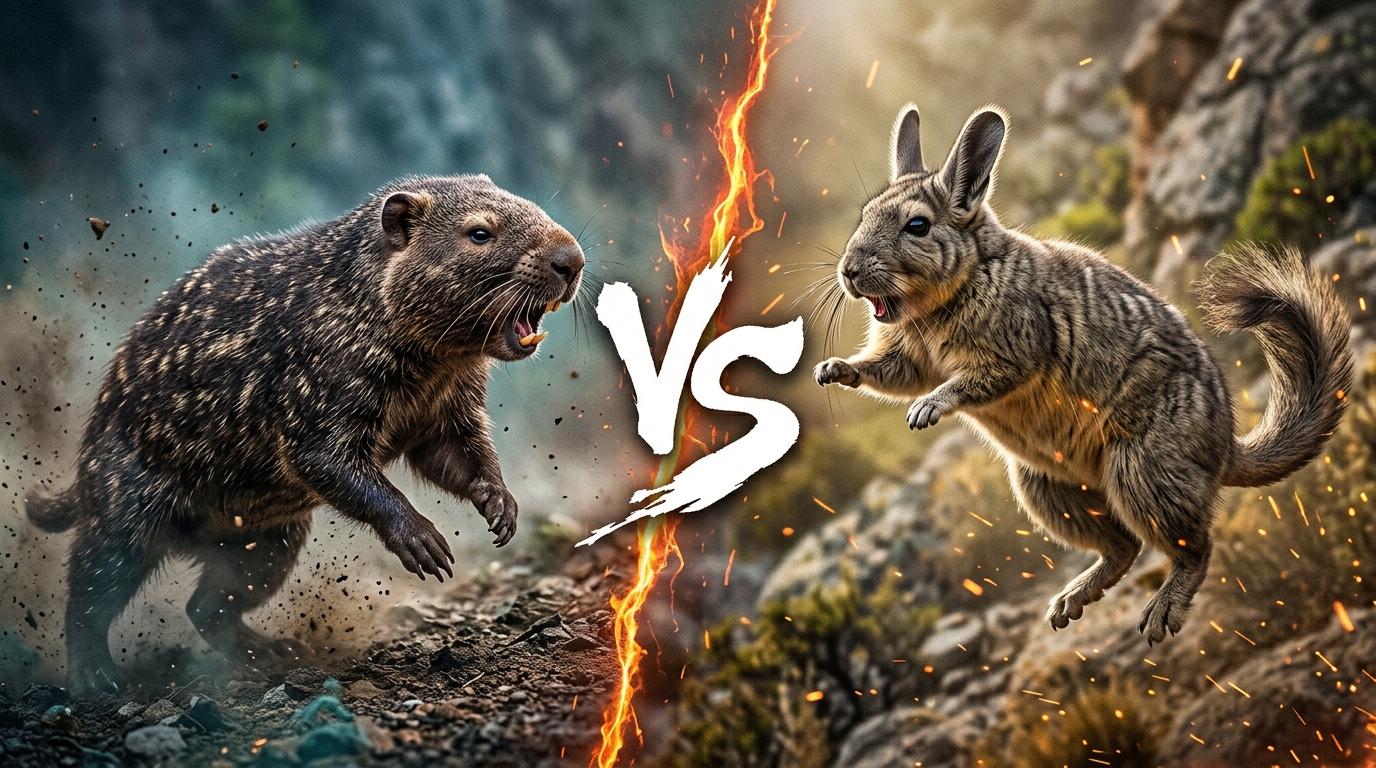
Pacarana vs Southern Viscacha: Who Actually Wins?
Pacarana vs southern viscacha: who would win? A biology-first breakdown of size, bite, agility, and terrain shows why the heavyweight pacarana takes the edge.
Pacarana vs Southern Viscacha
Matchup winner
Pacarana
Quick verdict
Start with the direct answer, then use the structured comparison below to see what changes the outcome.
The pacarana wins this rodent showdown. An adult pacarana (Dinomys branickii) typically weighs about 10–15 kg, several times the 1.5–3 kg southern viscacha (Lagidium viscacia). Its stocky build, broad skull, heavy incisors, and strong clawed forefeet give it a decisive close-range advantage. The southern viscacha is faster, sharper-eyed, and far better at sprinting and leaping across Andean rock, so it wins any contest that is really about escaping. Once the encounter becomes physical, though, mass and bite force dominate, and the slow, deliberate pacarana holds the cards. This is a hypothetical matchup: the pacarana lives in humid forested foothills of the western Amazon and Andes, while the viscacha lives on high, rocky Andean slopes.
Read the full explanation
Pacarana wins a physical confrontation, mainly through a large weight advantage and a heavier bite.
Southern viscacha is quicker and more agile and would usually escape rather than fight.
On boulder fields and cliffs, the viscacha controls the encounter by refusing to engage.
Overall edge: pacarana, about 78% confidence.
Reader vote
Who do you think wins?
Pick a side — no account needed. Results update live.
No votes yet — be the first to call it.
Editorial note
Why people disagree
AnimalDex speed and dominance scores favor the viscacha, but those indexes reward agility and alertness, not raw body mass.
Body mass and frame
In fights between rodents, mass multiplies both pushing power and bite damage. The size gap here is large.
Incisor damage
Rodents fight with their teeth, and the pacarana's jaws are built on a much bigger platform.
Explosive agility
Agility lets the viscacha choose whether a fight happens at all.
Read the full explanation +
The pacarana's calm, slow-moving reputation makes people underestimate it. A cornered 12 kg rodent with big incisors is a serious opponent.
Viscacha fans picture the fight on rocks, where escape counts as a win. Pacarana fans picture a contained clash, where weight decides it.
Comparison FAQ
Short, direct answers to the next questions readers usually ask after the headline verdict.
Would a pacarana beat a southern viscacha in a fight?+
Yes. In a direct physical fight, the pacarana's much larger size and heavier bite would very likely win.
Which is stronger, the pacarana or the southern viscacha?+
The pacarana is far stronger. It can weigh 10–15 kg, compared with roughly 1.5–3 kg for the viscacha.
Why is the southern viscacha still dangerous to underestimate?+
Its speed, alertness, and skill on rocky terrain mean it can avoid a fight entirely. If cornered, it can still deliver sharp bites.
Do pacaranas and viscachas meet in the wild?+
Rarely, if at all. Pacaranas live in humid forested foothills, while southern viscachas live on high, dry, rocky Andean slopes, so their habitats barely overlap.
Head-to-head species stats
These are the same core AnimalDex stat dimensions used on the dedicated animal pages, pulled side by side so the matchup is faster to scan.
Pacarana
Tier BSouthern Viscacha
Tier CTrait-by-trait comparison
Only the categories that matter to this matchup are included. The goal is not filler stats, but the real design differences that change the result.
About 10–15 kg, stocky, up to roughly 1 m long including tail
Body mass and frame
Pacarana
About 1.5–3 kg, slender with a long tail
Body mass and frame
Pacarana
Broad skull with heavy, gnawing incisors
Incisor damage
Pacarana
Small chinchillid incisors suited to grasses
Incisor damage
Pacarana
Slow, waddling gait
Explosive agility
Southern Viscacha
Rapid hops and long leaps between rocks
Explosive agility
Southern Viscacha
Nocturnal, mostly solitary or in small family groups
Threat detection
Southern Viscacha
Colony sentinels that give alarm whistles
Threat detection
Southern Viscacha
Thick body and strong clawed forefeet
Close-range durability
Pacarana
Light frame with dense, soft fur
Close-range durability
Pacarana
Forest floor, burrows, and rock crevices
Terrain mastery
Southern Viscacha
Expert on cliffs and boulder fields
Terrain mastery
Southern Viscacha
How the verdict forms
Verdict timeline
01 · Body mass and frame
Pacarana
02 · Incisor damage
Pacarana
03 · Explosive agility
Southern Viscacha
04 · Threat detection
Southern Viscacha
05 · Close-range durability
Pacarana
06 · Terrain mastery
Southern Viscacha
Change the conditions
Scenario breakdown
This is where shallow battle content usually fails. Terrain, spacing, timing, and engagement style can change the answer.
Scenario lean
Pacarana
Verdict confidence
82%
Pacarana wins in a confined space.
In a burrow mouth or dense undergrowth, the viscacha cannot use its leaping ability. Contact becomes unavoidable, and the pacarana's weight and incisors overwhelm a much smaller opponent.
AnimalDex field profiles
Explore these animals
Pacarana
Dinomys branickii
cloud forest, rocky ravine, and humid mountain slope
Southern Viscacha
Lagidium viscacia
rocky highland, dry slope, and Andean scrub
Systems Intelligence & Hidden Purpose
See the animals behind this comparison as engineered biological systems: what each one is built to do, where it gains leverage, and why the matchup changes by scenario.
Specialized Hardware
heavy spotted rodent body, blunt broad muzzle, and slow cliffside climbing give the Pacarana a body plan tuned for its niche.
Systems Script
Pacaranas operate through cloud forest, rocky ravine, and humid mountain slope. Their design links movement, feeding, shelter, and timing into one workable survival system.
Strategic Insight
In steep terrain, balance and route control matter more than brute force.
Specialized Hardware
long-plumed tail, soft dense mountain fur, and colony life among rocks give the Southern Viscacha a body plan tuned for its niche.
Systems Script
Southern Viscachas operate through rocky highland, dry slope, and Andean scrub. Their design links movement, feeding, shelter, and timing into one workable survival system.
Strategic Insight
Harsh places reward efficiency, timing, and bodies that waste very little.
Final take
The pacarana is the overall winner. Rodent confrontations reward mass and incisor power, and the pacarana has several times the viscacha's body weight.
Read the full explanation
The southern viscacha's real strength is not fighting. It survives through vigilance, colony alarm calls, and rock-hopping escapes, so on its home cliffs it would almost never be caught. In any encounter that becomes physical, however, the pacarana wins.
Collect both animals in AnimalDex
Track the species behind this matchup, compare their real traits, and build the rivalry into your AnimalDex collection.
Discussion
What do you think?
Share your reasoning with other readers. Be civil and stick to the animals.
Sign in to join the discussion.
Sign inNo comments yet. Start the conversation.