


Poison Dart Frog vs Red-eyed Tree Frog: Who Actually Wins?
Poison dart frog vs red-eyed tree frog: which rainforest frog wins? Compare toxins, size, speed, defenses and behavior to see why the dart frog takes it.
Poison Dart Frog vs Red-eyed Tree Frog
Matchup winner
Poison Dart Frog
Quick verdict
Start with the direct answer, then use the structured comparison below to see what changes the outcome.
The poison dart frog wins this matchup. The red-eyed tree frog is longer and leggier, but neither frog is built to fight, so the deciding factor is chemistry. Many dart frogs carry potent alkaloid skin toxins, and the most toxic, like Phyllobates terribilis, rank among the most poisonous animals known. The red-eyed tree frog's defense is mostly a startle trick: it flashes its red eyes and bright flanks to buy a split second for escape. Its skin peptides are mild by comparison. In any contact-based contest, the frog whose skin punishes touch holds the decisive edge. Dart frogs are also boldly active by day, defend territories, and will wrestle rivals of their own species, while the red-eyed tree frog is a nocturnal escape artist that avoids confrontation.
Read the full explanation
Winner: Poison Dart Frog, because its toxic skin makes physical contact costly.
The red-eyed tree frog is larger but relies on startle displays and fleeing, not deterrence.
Dart frogs are diurnal, territorial and used to wrestling rivals, so they have real contact experience.
Neither frog actually preys on the other. This is a defense-system comparison, not a hunt.
Reader vote
Who do you think wins?
Pick a side — no account needed. Results update live.
No votes yet — be the first to call it.
Editorial note
Why people disagree
Size bias: the red-eyed tree frog is noticeably bigger and longer-limbed, so people assume it would dominate a tiny dart frog.
Chemical deterrence
When fighting means touching skin, toxicity is the closest thing either frog has to a weapon.
Body size and reach
Its extra mass and reach could let the tree frog shove or pin the dart frog in a pure grapple.
Territorial grit
Willingness to engage matters. The dart frog is wired for contests, while the tree frog is wired to leave.
Read the full explanation +
Toxicity varies: dart frog potency ranges from deadly to nearly harmless, and captive-bred dart frogs lose most toxins without their wild ant-and-mite diet.
Both are 'warning-colored', but only one backs its bright colors with serious chemistry. The red-eyed tree frog's flash is closer to a bluff.
Comparison FAQ
Short, direct answers to the next questions readers usually ask after the headline verdict.
Would a poison dart frog beat a red-eyed tree frog?+
Yes. In most realistic contact scenarios, the dart frog's toxic skin and territorial behavior give it the win, even though it is smaller.
Which frog is stronger?+
The red-eyed tree frog is physically bigger and has stronger leaping legs. However, raw strength matters less here than chemical defense.
Is the red-eyed tree frog poisonous?+
Only mildly. Its skin peptides are weak compared with dart frog alkaloids. Its bright colors and red eyes work mainly as a startle display.
Why is the red-eyed tree frog still dangerous to tangle with?+
It is hard to catch rather than harmful. Its sudden color flash, long leaps and canopy skills make it a frustrating target that escapes before most predators commit to an attack.
Are captive poison dart frogs toxic?+
Generally not. Their toxins come from a wild diet of ants and mites, so captive-bred frogs are largely harmless.
Head-to-head species stats
These are the same core AnimalDex stat dimensions used on the dedicated animal pages, pulled side by side so the matchup is faster to scan.
Poison Dart Frog
Tier DRed-eyed Tree Frog
Tier BTrait-by-trait comparison
Only the categories that matter to this matchup are included. The goal is not filler stats, but the real design differences that change the result.
Alkaloid toxins from its diet, lethal in some species
Chemical deterrence
Poison Dart Frog
Mild skin peptides
Chemical deterrence
Poison Dart Frog
Mostly 1.5–4 cm
Body size and reach
Red-eyed Tree Frog
Roughly 5–7 cm, long limbs
Body size and reach
Red-eyed Tree Frog
Defends territories and wrestles rivals
Territorial grit
Poison Dart Frog
Non-confrontational and calls at night
Territorial grit
Poison Dart Frog
Quick hops on the leaf litter
Escape kit
Red-eyed Tree Frog
Startle flash plus powerful arboreal leaps
Escape kit
Red-eyed Tree Frog
Capable climber, mostly on the ground
Vertical control
Red-eyed Tree Frog
Elite toe-pad climber
Vertical control
Red-eyed Tree Frog
Boldly active by day
Daylight confidence
Poison Dart Frog
Sleeps by day with eyes and colors hidden
Daylight confidence
Poison Dart Frog
How the verdict forms
Verdict timeline
01 · Chemical deterrence
Poison Dart Frog
02 · Body size and reach
Red-eyed Tree Frog
03 · Territorial grit
Poison Dart Frog
04 · Escape kit
Red-eyed Tree Frog
05 · Vertical control
Red-eyed Tree Frog
06 · Daylight confidence
Poison Dart Frog
Change the conditions
Scenario breakdown
This is where shallow battle content usually fails. Terrain, spacing, timing, and engagement style can change the answer.
Scenario lean
Poison Dart Frog
Verdict confidence
82%
Dart frog home turf.
On leaf litter in daylight, the dart frog is in its element: alert, territorial and chemically armored. The tree frog is out of habitat and lacks a fitting defense. Any grappling exposes it to the dart frog's skin alkaloids.
AnimalDex field profiles
Explore these animals
Poison Dart Frog
Dendrobatidae
Humid tropical forest, leaf litter, mossy ground, and stream-edge microhabitats.
Red-eyed Tree Frog
Agalychnis callidryas
Lowland rainforest, wet secondary growth, and forest-edge ponds with overhanging vegetation.
Systems Intelligence & Hidden Purpose
See the animals behind this comparison as engineered biological systems: what each one is built to do, where it gains leverage, and why the matchup changes by scenario.
Specialized Hardware
Skin alkaloid defenses, bright warning coloration, and precise moisture dependence make poison dart frogs compact hardware for high-risk tropical floor systems.
Systems Script
They help regulate small invertebrate populations while translating chemical defense into a public signal. Their whole design says the strongest deterrent is one your environment can recognize instantly.
Strategic Insight
If you must defend a small footprint, make the cost of testing you obvious.
Specialized Hardware
Adhesive toe pads, bright concealed eye color, and leaf-resting camouflage make this frog arboreal hardware built for hiding until surprise becomes useful.
Systems Script
Red-eyed tree frogs operate in canopy-edge moisture systems where stillness is the main budget saver and sudden contrast buys escape time. They use visibility strategically, not constantly.
Strategic Insight
Not every capability belongs in your default state. Some advantages work best when revealed late.
Final take
The poison dart frog wins because it is the only one of the two with a defense that holds up under contact. The red-eyed tree frog's brilliant design is aimed at escaping a predator's first strike, not at outlasting a rival.
Read the full explanation
Give the tree frog the night canopy and it will simply be gone. On the ground, near a resource, or in a forced encounter, the dart frog's toxic skin and territorial temperament make it the clear favorite.
Collect both animals in AnimalDex
Track the species behind this matchup, compare their real traits, and build the rivalry into your AnimalDex collection.
Related comparisons
Continue with nearby matchups to compare more real-world animal traits without dropping into junky who-wins filler.
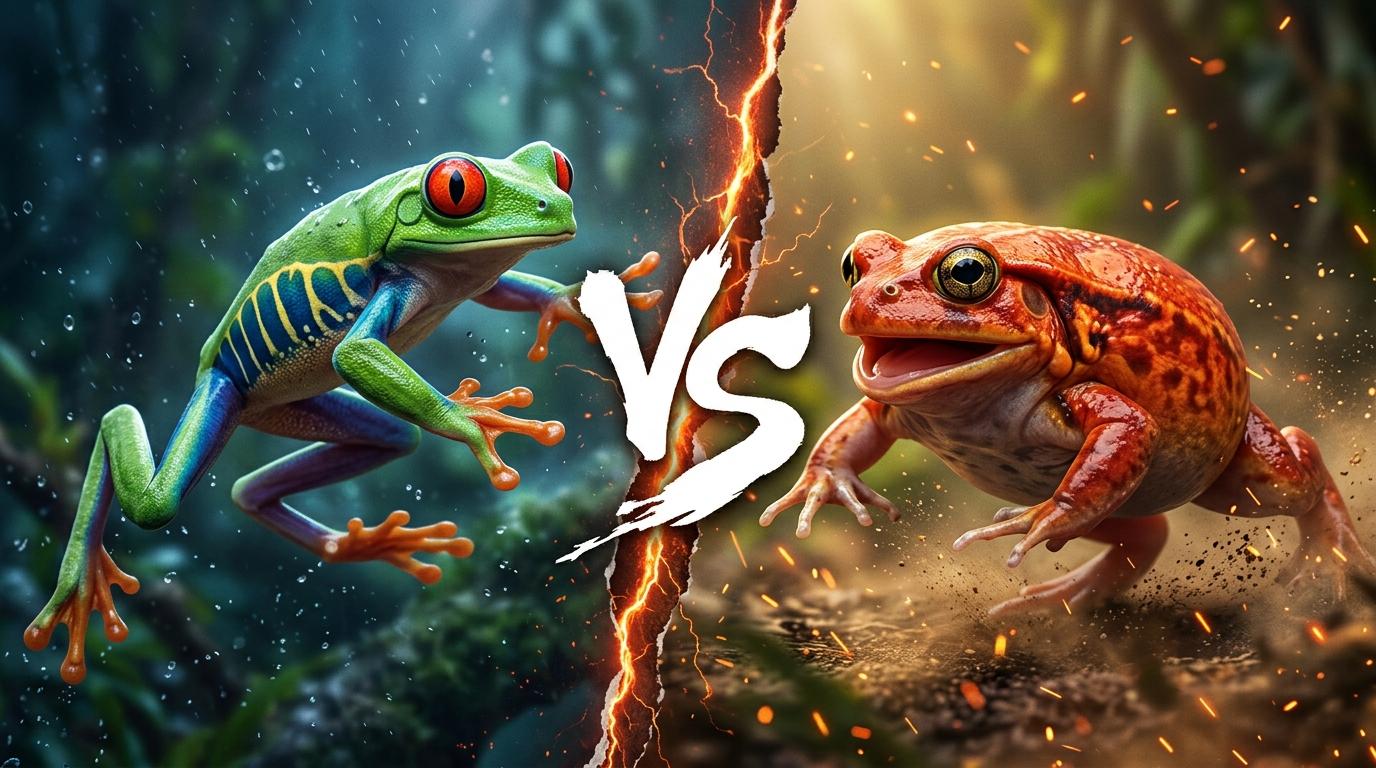
Red-eyed Tree Frog vs Tomato Frog: Who Actually Wins?
The Tomato Frog wins this matchup. At roughly 9–10 cm and often several times the body mass of a 5–7 cm Red-eyed Tree Frog, the Madagascan Tomato Frog brings a heavy, wide-mouthed frame. Its ground-level confidence and a sticky, gluey skin secretion can gum up an attacker's mouth and eyes. Frogs don't really 'fight' in the predator sense. What decides a contact standoff between them is who can displace, outlast, or deter the other, and mass plus chemical deterrence beats agility here. The Red-eyed Tree Frog's real gifts are startle coloration, sticky toe pads and explosive leaping. Those are superb tools for escaping, but they do little to win a contested patch of ground. If the tree frog gets a branch and a head start, it simply leaves. If it has to stand its ground, the Tomato Frog holds the space.
Read comparison
Discussion
What do you think?
Share your reasoning with other readers. Be civil and stick to the animals.
Sign in to join the discussion.
Sign inNo comments yet. Start the conversation.