

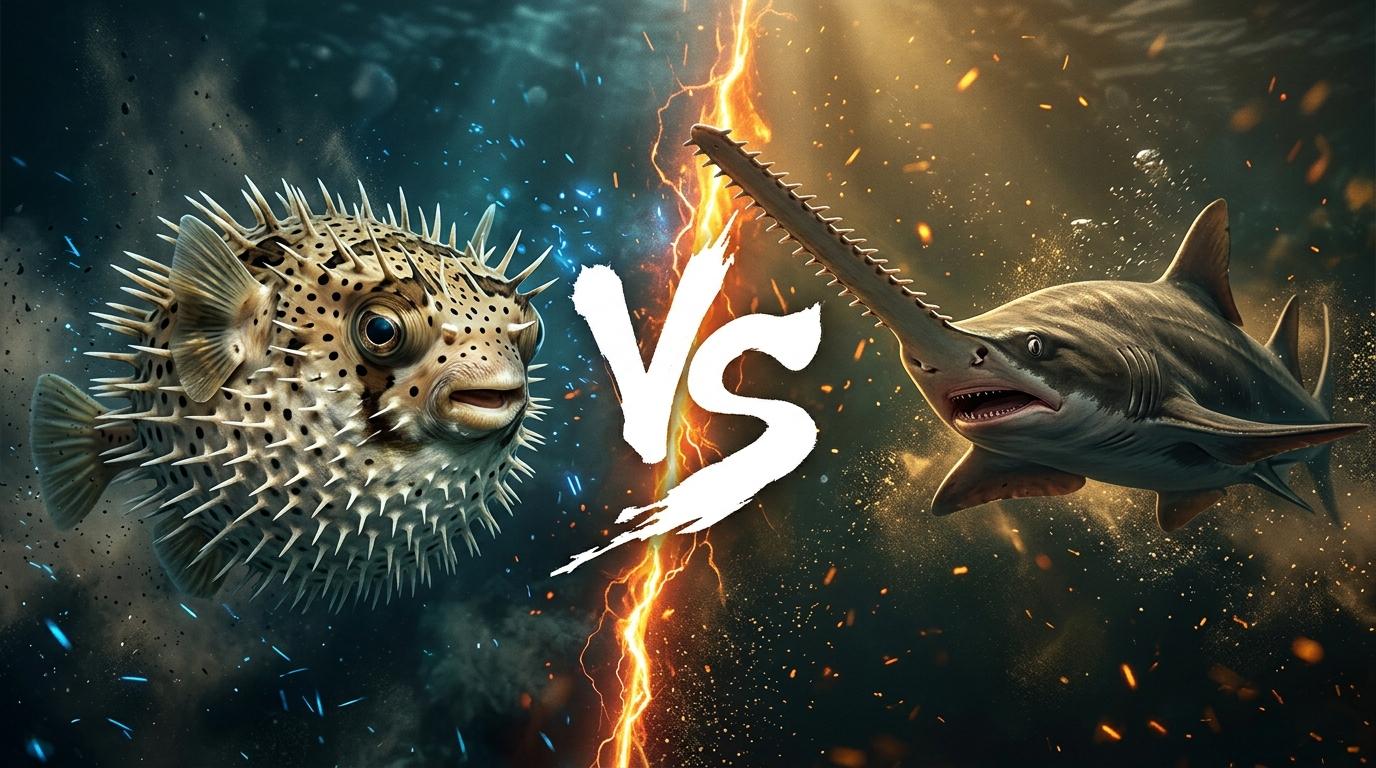
Spot-fin Porcupinefish vs Smalltooth Sawfish: Who Actually Wins?
Spot-fin porcupinefish vs smalltooth sawfish: a biology-first breakdown of size, weaponry, defense and behavior to settle who would win, and why the spiny puffer stays dangerous.
Porcupinefish vs Smalltooth Sawfish
Matchup winner
Smalltooth Sawfish
Quick verdict
Start with the direct answer, then use the structured comparison below to see what changes the outcome.
The smalltooth sawfish wins, and it is not especially close. An adult Pristis pectinata can stretch past 5 meters, and its rostrum, a flattened saw lined with tooth-like denticles and packed with electroreceptors, is built to detect and slash small fish in the water column and pin them to the seabed. The spot-fin porcupinefish tops out around 70–90 cm. Its whole survival plan is to inflate into a spiny ball and carry tetrodotoxin that punishes anything that swallows it. That plan works against predators that bite and gulp. The sawfish does not have to do either. It can strike, stun and reposition prey with its saw, and if the puffer stays inflated and dangerous, the sawfish can simply leave it alone. The porcupinefish can make itself unappealing, but it cannot impose an outcome on an animal fifteen to twenty-five times its length.
Read the full explanation
Winner: Smalltooth Sawfish, with a massive size edge and a rostrum built for hitting prey.
The porcupinefish's defense is inflation, spines and toxin. It deters predators but cannot defeat them.
The sawfish's saw lets it strike without biting, so it never has to put spines in its mouth.
In most realistic encounters, the sawfish either dominates the exchange or decides the puffer isn't worth the trouble.
Reader vote
Who do you think wins?
Pick a side — no account needed. Results update live.
No votes yet — be the first to call it.
Editorial note
Why people disagree
Toxin hype: people assume tetrodotoxin makes the porcupinefish unbeatable. Poison only works if the attacker eats it, and the sawfish doesn't have to.
Explosive power
The sawfish turns body mass into a sideways strike. The puffer's main 'move' is to stop moving and swell up.
Size and mass
An order-of-magnitude size gap decides most marine confrontations before they start.
Weapon reach
The puffer's beak is made for snails and crabs. The saw is made for hitting moving animals at range.
Read the full explanation +
'Spiky ball' logic: inflation defeats gape-limited predators, but a 5-meter ray with a slashing rostrum doesn't need to fit the fish in its mouth.
Rarity sympathy: the sawfish is critically endangered, so some readers picture it as fragile. In a physical matchup, it is the heavyweight by a huge margin.
Comparison FAQ
Short, direct answers to the next questions readers usually ask after the headline verdict.
Would a spot-fin porcupinefish beat a smalltooth sawfish?+
No. The sawfish wins in nearly every realistic setting. The porcupinefish can only survive by hiding and inflating, not by defeating the sawfish.
Which is stronger, a porcupinefish or a sawfish?+
The sawfish, by a massive margin. It can exceed 5 meters and several hundred kilograms, while the porcupinefish rarely passes 90 cm.
Is the porcupinefish's poison a threat to the sawfish?+
Only if the sawfish eats it. Tetrodotoxin is a deterrent against predators that swallow it, and the sawfish can strike with its rostrum or simply ignore the fish.
Why is the porcupinefish still dangerous even though it loses?+
Inflation, sharp spines and potent tetrodotoxin make it painful or even lethal for predators that try to swallow it. Any attacker that commits to biting pays a real price.
How does a sawfish use its saw in a fight?+
It swipes the rostrum sideways to slash and stun prey, then pins it against the seabed. The electroreceptors along the saw help it aim, even in murky water.
Do these two species actually meet in the wild?+
Their ranges can overlap in warm western Atlantic coastal waters, including Florida, but direct confrontations are unlikely. Sawfish mainly target small schooling fish, and porcupinefish shelter on reefs.
Head-to-head species stats
These are the same core AnimalDex stat dimensions used on the dedicated animal pages, pulled side by side so the matchup is faster to scan.
Porcupinefish
Tier CSmalltooth Sawfish
Tier BTrait-by-trait comparison
Only the categories that matter to this matchup are included. The goal is not filler stats, but the real design differences that change the result.
Short bursts; sluggish once inflated
Explosive power
Smalltooth Sawfish
Powerful lateral saw swipes driven by a big body
Explosive power
Smalltooth Sawfish
Up to ~90 cm, a few kilograms
Size and mass
Smalltooth Sawfish
Up to ~5+ m, several hundred kilograms
Size and mass
Smalltooth Sawfish
Beak-like fused teeth for crushing shells
Weapon reach
Smalltooth Sawfish
Toothed rostrum used to slash, stun and pin prey
Weapon reach
Smalltooth Sawfish
Inflation plus erect spines; very hard to swallow
Close-range durability
Porcupinefish
Tough skin and large frame, but the rostrum can tangle
Close-range durability
Porcupinefish
Tetrodotoxin in organs and skin
Chemical deterrence
Porcupinefish
None
Chemical deterrence
Porcupinefish
Good eyesight for hunting at night on the reef
Sensory targeting
Smalltooth Sawfish
Electroreceptor-dense rostrum that senses buried and hidden prey
Sensory targeting
Smalltooth Sawfish
How the verdict forms
Verdict timeline
01 · Explosive power
Smalltooth Sawfish
02 · Size and mass
Smalltooth Sawfish
03 · Weapon reach
Smalltooth Sawfish
04 · Close-range durability
Porcupinefish
05 · Chemical deterrence
Porcupinefish
06 · Sensory targeting
Smalltooth Sawfish
Change the conditions
Scenario breakdown
This is where shallow battle content usually fails. Terrain, spacing, timing, and engagement style can change the answer.
Scenario lean
Porcupinefish
Verdict confidence
82%
The porcupinefish holds its ground by wedging in and inflating.
Tight cover cancels the sawfish's long rostrum and wide swings, and a porcupinefish inflated inside a crevice is nearly impossible to pull out. The sawfish can't land a clean strike and has no reason to keep trying. This counts as a survival win for the puffer, not a defeat of the sawfish.
AnimalDex field profiles
Explore these animals
Porcupinefish
Diodon hystrix
coral reef, seagrass flat, and rocky coastal sea
Smalltooth Sawfish
Pristis pectinata
estuary, seagrass flat, mangrove edge, and warm coastal water
Systems Intelligence & Hidden Purpose
See the animals behind this comparison as engineered biological systems: what each one is built to do, where it gains leverage, and why the matchup changes by scenario.
Specialized Hardware
inflatable spiny body, beak-like crushing jaws, and reef-crevice sheltering give the Porcupinefish a body plan tuned for its niche.
Systems Script
Porcupinefishs operate through coral reef, seagrass flat, and rocky coastal sea. Their design links movement, feeding, shelter, and timing into one workable survival system.
Strategic Insight
In moving water, the best systems use flow, visibility, and depth instead of fighting every current.
Specialized Hardware
saw-like toothy snout, shallow coastal movement, and bottom-hunting glide give the Smalltooth Sawfish a body plan tuned for its niche.
Systems Script
Smalltooth Sawfishs operate through estuary, seagrass flat, mangrove edge, and warm coastal water Their design links movement, shelter, feeding, and survival into one workable system.
Strategic Insight
Unique tools can become vulnerable when the whole operating space shrinks.
Final take
The Smalltooth Sawfish is the clear overall winner. It brings huge size, a ranged strike weapon and superior senses, and it fully controls whether a confrontation happens at all. The porcupinefish's toolkit is excellent, but it is designed to make predators regret swallowing it, and the sawfish's main weapon works without swallowing anything.
Read the full explanation
The puffer's best result is survival: wedged in cover, inflated, spines out, until the sawfish moves on. That is a real biological achievement, but in a who-would-win frame it is a draw-by-avoidance at best, while the sawfish wins every open contest.
The irony is that the stronger animal is the one in trouble. Smalltooth sawfish are critically endangered, mostly because their saws tangle in fishing nets. In the wild, the real threat to the sawfish isn't a spiny puffer. It's us.
Collect both animals in AnimalDex
Track the species behind this matchup, compare their real traits, and build the rivalry into your AnimalDex collection.
Discussion
What do you think?
Share your reasoning with other readers. Be civil and stick to the animals.
Sign in to join the discussion.
Sign inNo comments yet. Start the conversation.