

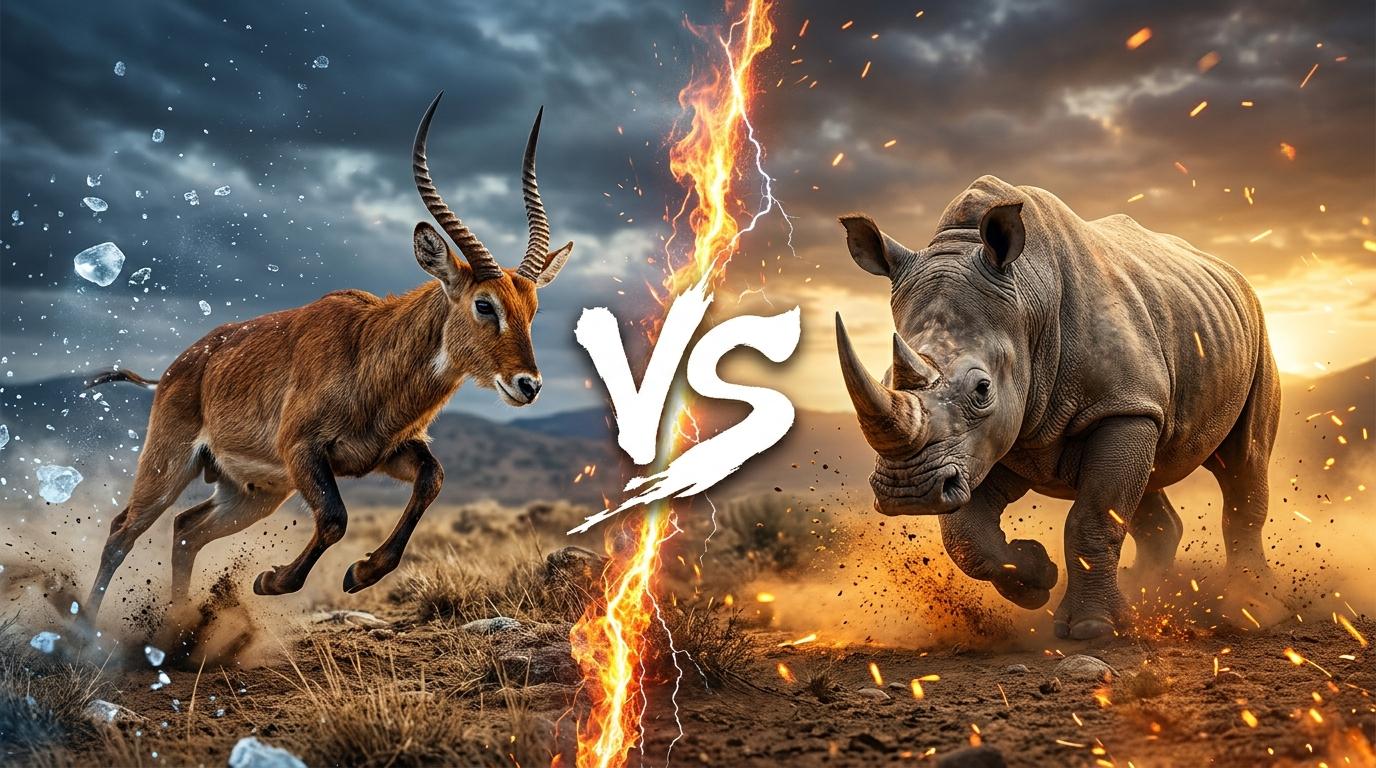
Puku vs White Rhinoceros: Who Actually Wins?
Puku vs white rhino: a nimble floodplain antelope against a 2,000+ kg grazing giant. See who wins, why, and where the puku still holds the edge.
Puku vs White Rhinoceros
Matchup winner
White Rhinoceros
Quick verdict
Start with the direct answer, then use the structured comparison below to see what changes the outcome.
The white rhinoceros wins, and it is not close in a direct confrontation. An adult white rhino weighs roughly 1,800–2,500 kg against a puku's 60–90 kg, which is a mass gap of more than twenty to one. The rhino also carries a front horn that can exceed 60 cm, a thick dermal shield, and the ability to charge at around 40 km/h over short bursts. The puku is a wetland-edge antelope built for vigilance, quick acceleration and escape. Only males carry horns, and those are ridged and used mainly in ritual sparring with other puku. Whenever the question is who controls the space, the rhino owns it. The puku's real victory condition is never fighting at all: it reads the threat early and leaves.
Read the full explanation
White rhino wins decisively: over 20x the mass, a weapon horn and armor-grade skin.
Puku's horns are built for sparring with rivals, not for damaging a 2-tonne pachyderm.
Puku 'wins' only by avoidance. It is faster to react and more agile on soft floodplain ground.
Neither animal hunts the other, so real encounters end in displacement, not combat.
Reader vote
Who do you think wins?
Pick a side — no account needed. Results update live.
No votes yet — be the first to call it.
Editorial note
Why people disagree
Speed fans point out that the puku is quicker and more agile, but outrunning an opponent is escape, not winning a fight.
Raw mass and momentum
Momentum decides collisions, and the rhino's mass turns any contact into a one-sided impact.
Explosive power
The puku accelerates nimbly, but the rhino's burst carries several tonnes of force behind a horn.
Close-range durability
The puku cannot meaningfully wound the rhino, while a single rhino strike can be fatal to the antelope.
Read the full explanation +
White rhinos are grazers with a calmer temperament than black rhinos, so some readers assume they would not engage. When pressed, cornered or guarding a calf, they charge hard.
Horned antelope look dangerous, but puku horns evolved for head-to-head contests with other puku, not for penetrating thick rhino hide.
Comparison FAQ
Short, direct answers to the next questions readers usually ask after the headline verdict.
Would a puku beat a white rhino in a fight?+
No. The white rhino weighs over twenty times more, carries a large horn and has thick protective skin. A puku has no realistic way to injure it.
Which is stronger, a puku or a white rhinoceros?+
The white rhinoceros, by an enormous margin. It is one of the heaviest land mammals on Earth, and its shoving and charging power far exceeds anything an antelope can produce.
Why is the puku still dangerous?+
Male puku have sharp, ridged horns and will fight seriously with rivals during territorial contests, so they can injure animals of similar size. Against a rhino their real power is evasion: fast reactions and alarm whistles that keep them out of reach.
Do puku and white rhinos actually meet in the wild?+
Their ranges overlap only in limited areas, and puku themselves have a patchy distribution. Where large grazers and floodplain antelope share ground, encounters end with the smaller animal stepping aside.
Is a white rhino aggressive?+
White rhinos are generally calmer than black rhinos, but they will charge when threatened, surprised or protecting a calf.
Head-to-head species stats
These are the same core AnimalDex stat dimensions used on the dedicated animal pages, pulled side by side so the matchup is faster to scan.
Puku
Tier BWhite Rhinoceros
Tier BTrait-by-trait comparison
Only the categories that matter to this matchup are included. The goal is not filler stats, but the real design differences that change the result.
~60–90 kg, light-framed
Raw mass and momentum
White Rhinoceros
~1,800–2,500 kg, barrel-bodied
Raw mass and momentum
White Rhinoceros
Sharp bounding takeoff
Explosive power
White Rhinoceros
Ground-shaking charge near 40 km/h
Explosive power
White Rhinoceros
Thin hide, fragile legs
Close-range durability
White Rhinoceros
Thick dermal armor, dense skeleton
Close-range durability
White Rhinoceros
Ridged male horns for ritual sparring
Weaponry
White Rhinoceros
Massive front horn, shoving power
Weaponry
White Rhinoceros
Quick pivots, at home on wet ground
Evasion and agility
Puku
Heavy turning circle
Evasion and agility
Puku
Keen vigilance and alarm whistles
Threat detection
Puku
Poor eyesight, strong smell and hearing
Threat detection
Puku
How the verdict forms
Verdict timeline
01 · Raw mass and momentum
White Rhinoceros
02 · Explosive power
White Rhinoceros
03 · Close-range durability
White Rhinoceros
04 · Weaponry
White Rhinoceros
05 · Evasion and agility
Puku
06 · Threat detection
Puku
Change the conditions
Scenario breakdown
This is where shallow battle content usually fails. Terrain, spacing, timing, and engagement style can change the answer.
Scenario lean
White Rhinoceros
Verdict confidence
82%
Rhino wins at close range.
In reeds or dense grass, sightlines shrink and the puku loses its early-warning advantage. If they meet suddenly, the rhino's short charge and horn reach dominate. Cover removes the distance the puku needs to escape.
AnimalDex field profiles
Explore these animals
Puku
Kobus vardonii
floodplain grassland, marsh edge, and river valley
White Rhinoceros
Ceratotherium simum
Open grassland, savannah, floodplain, and lightly wooded grazing country with access to water and wallows.
Systems Intelligence & Hidden Purpose
See the animals behind this comparison as engineered biological systems: what each one is built to do, where it gains leverage, and why the matchup changes by scenario.
Specialized Hardware
golden marshland coat, heavy hindquarters, and wet grass sprinting give the Puku a body plan tuned for its niche.
Systems Script
Pukus operate through floodplain grassland, marsh edge, and river valley. Their design links movement, feeding, shelter, and timing into one workable survival system.
Strategic Insight
Where water controls movement, position and timing often matter more than speed.
Specialized Hardware
Square grazing lip, heavy neck support, thick skin, and horn-forward charge mechanics make white rhinoceroses bulk-feeding hardware built for open ground.
Systems Script
White rhinoceroses convert large grass volumes into megaherbivore pressure across savannah systems. They reshape short-grass structure, path use, and wallow zones while forcing the landscape to make room for body scale.
Strategic Insight
Scale is powerful when it is paired with a simple repeatable operating loop. Do the basic high-value action well enough, and the whole environment starts bending around it.
Final take
The white rhinoceros is the clear winner. Mass, armor and a true defensive weapon make it nearly untouchable for an antelope the size of a large dog. Very few animals on its range are a serious threat to an adult; humans and poaching are its real danger.
Read the full explanation
The puku's strength is a different kind of intelligence: vigilance, alarm calls and quick, early exits. It survives by never accepting the rhino's terms. In biology that is a winning strategy, even if it would lose any head-to-head contest.
Collect both animals in AnimalDex
Track the species behind this matchup, compare their real traits, and build the rivalry into your AnimalDex collection.
Related comparisons
Continue with nearby matchups to compare more real-world animal traits without dropping into junky who-wins filler.
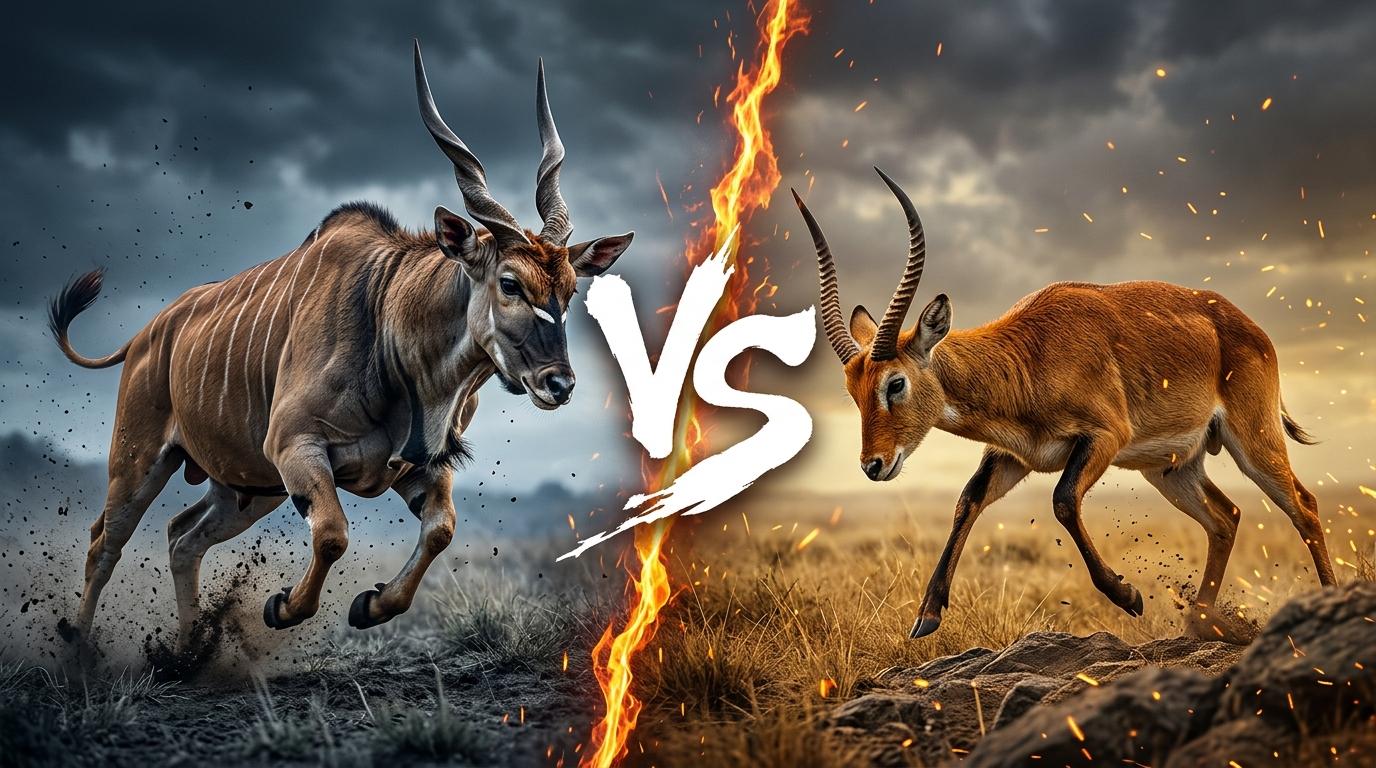
Giant Eland vs Puku: Who Actually Wins?
The giant eland wins, and it isn't close. Africa's largest antelope can stand around 1.5–1.8 m at the shoulder and weigh well over 600 kg, with bulls sometimes approaching a tonne. The puku is a compact wetland antelope of roughly 60–90 kg. The eland carries long, tightly spiraled horns on both sexes and a heavy neck and dewlap built for shoving contests. The puku's advantages are sprint acceleration, agility through floodplain grass, and an instinct to break off and flee. Those keep it alive but don't help it win a contest of force. In any confrontation where contact happens, the eland's mass and horn reach end the exchange almost immediately. The puku's real victory condition is leaving.
Read comparison
Discussion
What do you think?
Share your reasoning with other readers. Be civil and stick to the animals.
Sign in to join the discussion.
Sign inNo comments yet. Start the conversation.