

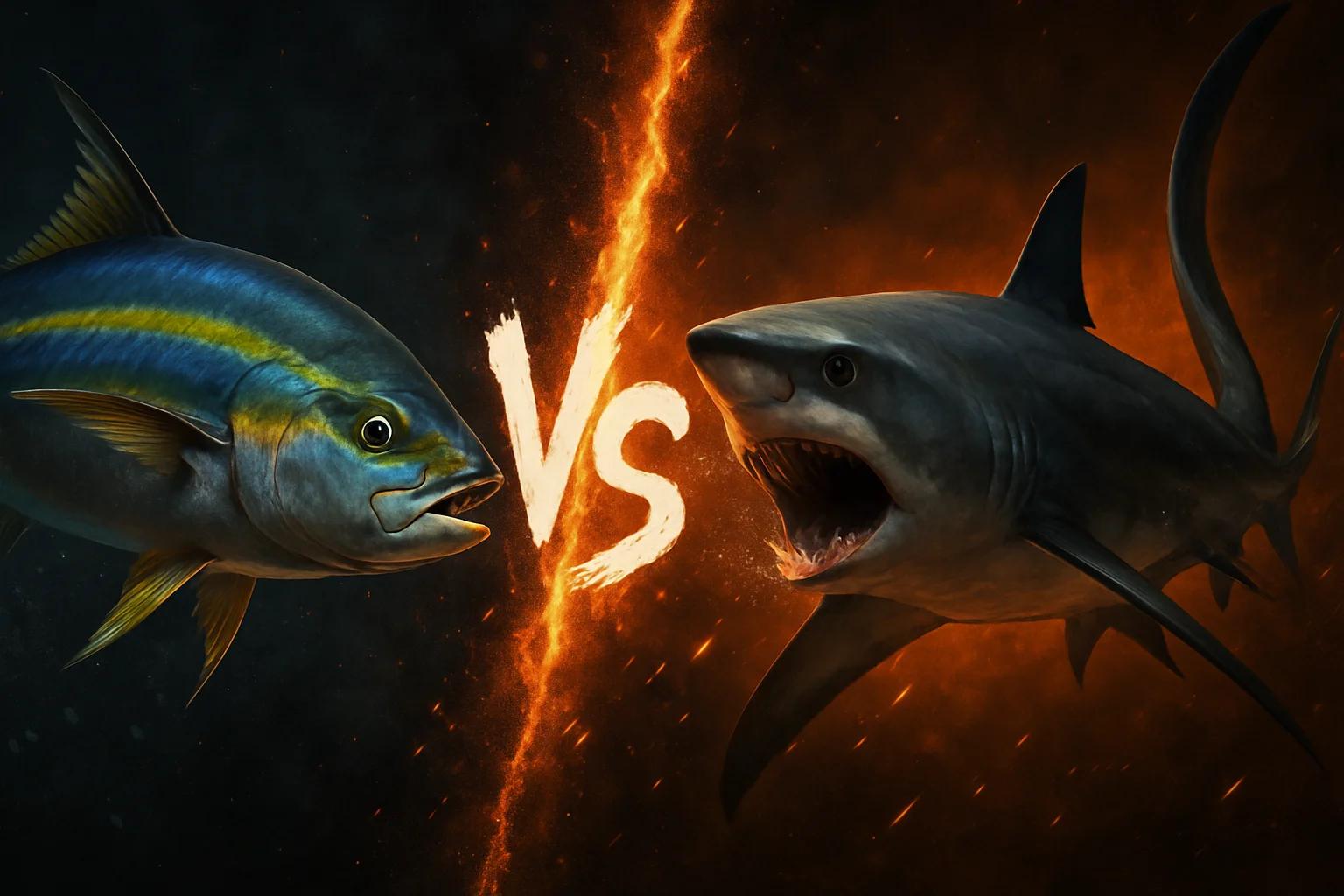
Rainbow Runner vs Thresher Shark: Who Actually Wins?
Rainbow runner vs thresher shark: a sleek pelagic jack against a tail-whipping shark several times its size. See who wins, why, and when the smaller fish escapes.
Rainbow Runner vs Thresher Shark
Matchup winner
Thresher Shark
Quick verdict
Start with the direct answer, then use the structured comparison below to see what changes the outcome.
The thresher shark wins, and decisively. A common thresher (Alopias vulpinus) can exceed 5 meters and several hundred kilograms. About half that length is a scythe-shaped upper tail lobe that it snaps overhead to stun schooling fish. The rainbow runner (Elagatis bipinnulata) is a fast, streamlined jack that usually measures well under a meter. Its weapons are speed, endurance and the school, none of which can hurt a large shark. In this pairing the rainbow runner is closer to the thresher's prey profile than its rival. Its only real victory condition is escape: breaking contact through acceleration, schooling confusion or nearby floating cover before the tail strike lands.
Read the full explanation
Thresher shark wins: it has a huge size advantage plus a purpose-built stunning tail.
Rainbow runners are schooling pelagic fish, exactly the kind of prey threshers specialize in.
The rainbow runner's best outcome is escape, not victory.
Speed is close in short bursts, but the thresher doesn't need to chase. It needs one tail whip.
Reader vote
Who do you think wins?
Pick a side — no account needed. Results update live.
No votes yet — be the first to call it.
Editorial note
Why people disagree
Speed fans see the rainbow runner's torpedo body and assume it can outmaneuver anything. Agility only buys distance, though, and it can't inflict damage.
Explosive power
The thresher turns raw power into a weapon. The runner can only spend its power on flight.
Size and mass
An order-of-magnitude mass gap ends most contests before tactics matter.
Burst speed and evasion
This is the runner's lifeline, and the only way it ever 'wins.'
Read the full explanation +
Threshers have small mouths and a shy reputation, so some readers underrate how lethal the tail strike is against fish-sized targets.
Matchups like this blur the line between 'fight' and 'predation.' Asking who wins really means asking whether the runner gets away.
Comparison FAQ
Short, direct answers to the next questions readers usually ask after the headline verdict.
Would a rainbow runner beat a thresher shark?+
No. The thresher is many times heavier and has a tail designed to stun fish. The rainbow runner has no weapon that can seriously harm it.
Which is stronger, a rainbow runner or a thresher shark?+
The thresher shark, by a huge margin. It has far more body mass, a tougher frame and a muscular tail that delivers powerful strikes.
Is a rainbow runner faster than a thresher shark?+
In short, agile bursts it can be competitive or quicker to turn. The thresher is also very fast and can breach, though, and its tail reach cancels out small speed differences.
Why is the rainbow runner still hard to catch?+
Its streamlined body, quick acceleration, schooling behavior and habit of staying near floating cover make it a slippery target. It can't hurt the shark, but it can make the hunt fail.
Do thresher sharks eat fish like rainbow runners?+
Threshers specialize in schooling pelagic fish and squid. Fast midwater fish fit their prey profile, though they mostly target smaller schooling species.
Head-to-head species stats
These are the same core AnimalDex stat dimensions used on the dedicated animal pages, pulled side by side so the matchup is faster to scan.
Rainbow Runner
Tier CThresher Shark
Tier CTrait-by-trait comparison
Only the categories that matter to this matchup are included. The goal is not filler stats, but the real design differences that change the result.
Sharp acceleration from a forked tail
Explosive power
Thresher Shark
Overhead tail whip strong enough to stun fish
Explosive power
Thresher Shark
Typically under 1 m, a few kilograms
Size and mass
Thresher Shark
Up to 5+ m, hundreds of kilograms
Size and mass
Thresher Shark
Slender, hydrodynamic, built for sprints and sustained cruising
Burst speed and evasion
Rainbow Runner
Fast, capable of breaching, but less nimble in tight turns
Burst speed and evasion
Rainbow Runner
No meaningful offensive weapon against large animals
Strike control
Thresher Shark
Tail used to slap, herd and disable schooling prey
Strike control
Thresher Shark
Tight schools confuse predators
Group defense
Thresher Shark
Sometimes hunts in pairs and herds bait balls
Group defense
Thresher Shark
Light frame, little armor
Close-range durability
Thresher Shark
Tough skin, large robust body
Close-range durability
Thresher Shark
How the verdict forms
Verdict timeline
01 · Explosive power
Thresher Shark
02 · Size and mass
Thresher Shark
03 · Burst speed and evasion
Rainbow Runner
04 · Strike control
Thresher Shark
05 · Group defense
Thresher Shark
06 · Close-range durability
Thresher Shark
Change the conditions
Scenario breakdown
This is where shallow battle content usually fails. Terrain, spacing, timing, and engagement style can change the answer.
Scenario lean
Thresher Shark
Verdict confidence
82%
Thresher shark controls the space.
In open pelagic water there's nowhere to hide. The thresher can close in, circle and deliver an overhead tail strike. The runner's sprint delays the outcome, but over repeated passes the predator with more mass and a longer reach wins.
AnimalDex field profiles
Explore these animals
Rainbow Runner
Elagatis bipinnulata
reef edge, offshore current, and tropical bluewater
Thresher Shark
Alopias vulpinus
open ocean, continental shelf edge, and bluewater current
Systems Intelligence & Hidden Purpose
See the animals behind this comparison as engineered biological systems: what each one is built to do, where it gains leverage, and why the matchup changes by scenario.
Specialized Hardware
electric blue and yellow stripes, narrow fast-swimming body, and schooling pursuit give the Rainbow Runner a body plan tuned for its niche.
Systems Script
Rainbow Runners operate through reef edge, offshore current, and tropical bluewater. Their design links movement, feeding, shelter, and timing into one workable survival system.
Strategic Insight
In moving water, the best systems use flow, visibility, and depth instead of fighting every current.
Specialized Hardware
whip-like upper tail lobe, sleek blue-gray body, and tail-slap hunting give the Thresher Shark a body plan tuned for its niche.
Systems Script
Thresher Sharks operate through open ocean, continental shelf edge, and bluewater current. Their design links movement, feeding, shelter, and timing into one workable survival system.
Strategic Insight
In moving water, the best systems use flow, visibility, and depth instead of fighting every current.
Final take
The thresher shark wins this matchup clearly. It is far larger, tougher and equipped with one of the ocean's most unusual hunting tools: a tail that works as a whip against exactly the kind of fast, schooling fish the rainbow runner is.
Read the full explanation
The rainbow runner still deserves respect. It's a superbly engineered open-ocean sprinter, and its survival depends on never letting a fight start. Near drifting cover or inside a well-timed school scatter, it can win the only contest that matters to it: getting away.
Collect both animals in AnimalDex
Track the species behind this matchup, compare their real traits, and build the rivalry into your AnimalDex collection.
Related comparisons
Continue with nearby matchups to compare more real-world animal traits without dropping into junky who-wins filler.
Giant Moray vs Rainbow Runner: Who Actually Wins?
The giant moray wins any real confrontation. At up to roughly 3 m and over 30 kg, Gymnothorax javanicus is a heavy, thick-bodied reef predator. It has a second set of pharyngeal jaws that drag prey down its throat, and its hunting style is built on seizing and holding. The rainbow runner is a sleek, fast jack of open blue water, usually under a metre long and a few kilograms. It wins on speed, stamina and escape, but it has no weapon that can hurt a moray, and its whole survival strategy is to avoid contact. Once a runner comes within striking range of a moray's crevice, the size difference, bite force and gripping jaws decide the outcome quickly. The runner's only reliable 'win' is never engaging at all.
Read comparison
Discussion
What do you think?
Share your reasoning with other readers. Be civil and stick to the animals.
Sign in to join the discussion.
Sign inNo comments yet. Start the conversation.