

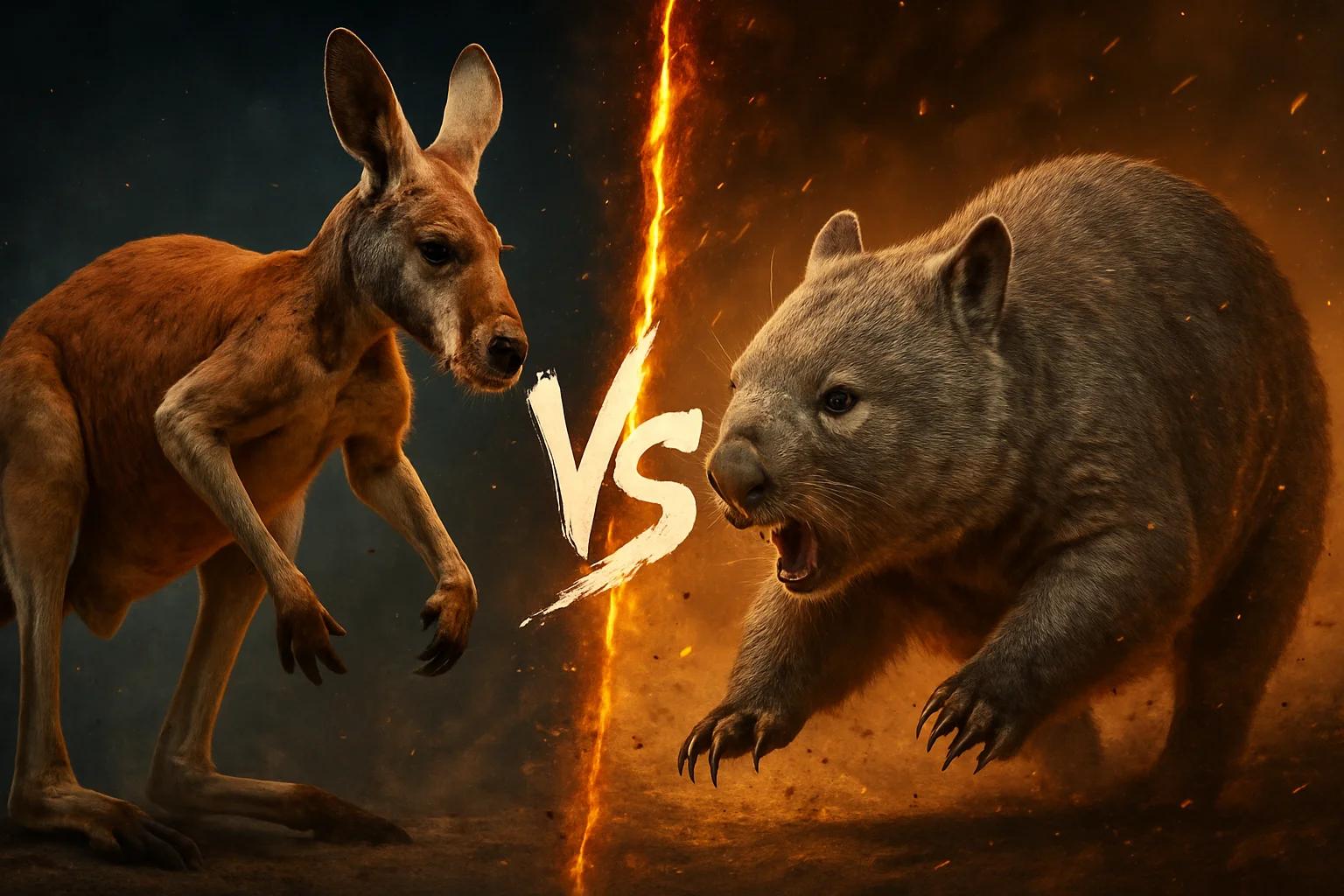
Red Kangaroo vs Southern Hairy-nosed Wombat: Who Actually Wins?
Red kangaroo vs southern hairy-nosed wombat: who would win? A biology-first breakdown of size, kicks, armor, burrows and the scenarios that decide it.
Red Kangaroo vs Southern Hairy-nosed Wombat
Matchup winner
Red Kangaroo
Quick verdict
Start with the direct answer, then use the structured comparison below to see what changes the outcome.
The red kangaroo wins this matchup overall. A large male red kangaroo can weigh around 85 kg and stand taller than most people, against a southern hairy-nosed wombat of roughly 19–32 kg. That size gap is decisive. The kangaroo also brings tail-braced double kicks with clawed hind feet, gripping forearms and serious speed. The wombat is no pushover. It is a dense, low-slung digging machine with a tough rump and powerful forelimbs. Next to its burrow it can make any intruder pay. But in open terrain it has no real way to stop a bigger, faster animal that can strike from range and leave whenever it wants. The kangaroo controls distance and timing. The wombat can only control its doorway.
Read the full explanation
Red kangaroo wins most realistic encounters thanks to roughly 3x body mass, reach and kicking power.
The wombat's best weapons are defensive: a toughened rump, a low center of gravity and burrow-blocking.
Away from its warren the wombat is slow over distance and can't threaten an upright kangaroo's vitals.
At a burrow entrance the wombat flips the script, but that is a stalemate the kangaroo can simply walk away from.
Reader vote
Who do you think wins?
Pick a side — no account needed. Results update live.
No votes yet — be the first to call it.
Editorial note
Why people disagree
Wombats have a viral reputation for being 'indestructible', so their defensive armor gets mistaken for fighting dominance.
Explosive power
The kangaroo can deliver high-energy strikes from a stable tripod stance. The wombat's power is built for moving soil, not for hitting.
Size and reach
Reach lets the kangaroo strike first and keep the wombat's head and forelimbs away from its body.
Close-range durability
The wombat soaks up punishment better than almost any animal its size, which is why it often survives encounters it can't win.
Read the full explanation +
Wombats can sprint surprisingly fast in short bursts, which leads people to underestimate the kangaroo's sustained mobility advantage.
Neither animal hunts the other, so 'winning' really means who controls the encounter, and that depends heavily on whether a burrow is nearby.
Comparison FAQ
Short, direct answers to the next questions readers usually ask after the headline verdict.
Would a red kangaroo beat a southern hairy-nosed wombat in a fight?+
Yes, in most realistic scenarios. The kangaroo is about three times heavier, far taller and armed with powerful clawed kicks, while the wombat is built mainly for defense.
Which animal is stronger?+
In total force output the red kangaroo is stronger thanks to its size and leg muscles. Pound for pound, the wombat's forelimbs and shoving power are impressive, built for digging through hard soil.
Why is the wombat still dangerous even though it loses?+
Its rump is a tough, cartilage-backed shield. It has a powerful bite and a low, heavy build that is hard to knock over. At a burrow it can crush or block intruders, so any attacker risks injury for very little reward.
Can a wombat outrun a kangaroo?+
Only very briefly. Wombats can sprint around 40 km/h in short bursts, but red kangaroos are faster and can keep up high speeds over much longer distances.
Do kangaroos and wombats fight in the wild?+
Rarely. They are both herbivores and occasionally share grazing areas. Encounters usually end with displacement or retreat, not a sustained fight.
Head-to-head species stats
These are the same core AnimalDex stat dimensions used on the dedicated animal pages, pulled side by side so the matchup is faster to scan.
Red Kangaroo
Tier CSouthern Hairy-nosed Wombat
Tier CTrait-by-trait comparison
Only the categories that matter to this matchup are included. The goal is not filler stats, but the real design differences that change the result.
Tail-braced double hind-leg kicks
Explosive power
Red Kangaroo
Short shoving charges and digging force
Explosive power
Red Kangaroo
Up to ~85 kg, tall upright frame
Size and reach
Red Kangaroo
~19–32 kg, compact and low
Size and reach
Red Kangaroo
Muscular but exposed belly when kicking
Close-range durability
Southern Hairy-nosed Wombat
Dense build, tough rump shield
Close-range durability
Southern Hairy-nosed Wombat
Fast, efficient hopping over long distance
Mobility control
Red Kangaroo
Short bursts, slow over open ground
Mobility control
Red Kangaroo
Open plains specialist
Terrain leverage
Southern Hairy-nosed Wombat
Warren architect with home-turf tunnels
Terrain leverage
Southern Hairy-nosed Wombat
Males box and kick rivals regularly
Combat experience
Red Kangaroo
Territorial scuffles and biting at warrens
Combat experience
Red Kangaroo
How the verdict forms
Verdict timeline
01 · Explosive power
Red Kangaroo
02 · Size and reach
Red Kangaroo
03 · Close-range durability
Southern Hairy-nosed Wombat
04 · Mobility control
Red Kangaroo
05 · Terrain leverage
Southern Hairy-nosed Wombat
06 · Combat experience
Red Kangaroo
Change the conditions
Scenario breakdown
This is where shallow battle content usually fails. Terrain, spacing, timing, and engagement style can change the answer.
Scenario lean
Red Kangaroo
Verdict confidence
82%
Kangaroo dominates.
On flat semi-arid plains the kangaroo's reach, speed and kicks all apply at once. The wombat can't close distance on its own terms. A low charge brings it into kicking range, and it has no escape hole to retreat to. Its armor buys time but not a result.
AnimalDex field profiles
Explore these animals
Red Kangaroo
Osphranter rufus
Arid grassland, desert scrub, and open semi-arid plains with scattered cover.
Southern Hairy-nosed Wombat
Lasiorhinus latifrons
semi-arid scrub, grassland, and sandy plain
Systems Intelligence & Hidden Purpose
See the animals behind this comparison as engineered biological systems: what each one is built to do, where it gains leverage, and why the matchup changes by scenario.
Specialized Hardware
Massive hind limbs, spring-loaded tendons, and a balancing tail make the red kangaroo low-cost locomotion hardware for sparse arid landscapes.
Systems Script
Red kangaroos track rain-driven productivity across desert systems and turn brief green windows into usable population gain. They are built to exploit pulses, not pretend the desert is stable.
Strategic Insight
In volatile systems, efficiency beats bravado. Save energy until the good window opens.
Specialized Hardware
powerful burrowing limbs, broad blunt muzzle, and cool-day underground sheltering give the Southern Hairy-nosed Wombat a body plan tuned for its niche.
Systems Script
Southern Hairy-nosed Wombats operate through semi-arid scrub, grassland, and sandy plain. Their design links movement, feeding, shelter, and timing into one workable survival system.
Strategic Insight
Harsh places reward efficiency, timing, and bodies that waste very little.
Final take
The red kangaroo is the clear overall winner. Its advantages are the ones that decide physical contests: mass, reach, striking power and full control over distance. In most places these two might actually meet, the wombat simply lacks a way to impose itself.
Read the full explanation
The southern hairy-nosed wombat earns real respect, though. Its whole body is designed to make it costly to attack, especially at home. It doesn't win by hurting rivals. It wins by being nearly impossible to remove from its tunnel. That is a different kind of victory, and one the kangaroo has no reason to contest.
Collect both animals in AnimalDex
Track the species behind this matchup, compare their real traits, and build the rivalry into your AnimalDex collection.
Discussion
What do you think?
Share your reasoning with other readers. Be civil and stick to the animals.
Sign in to join the discussion.
Sign inNo comments yet. Start the conversation.