

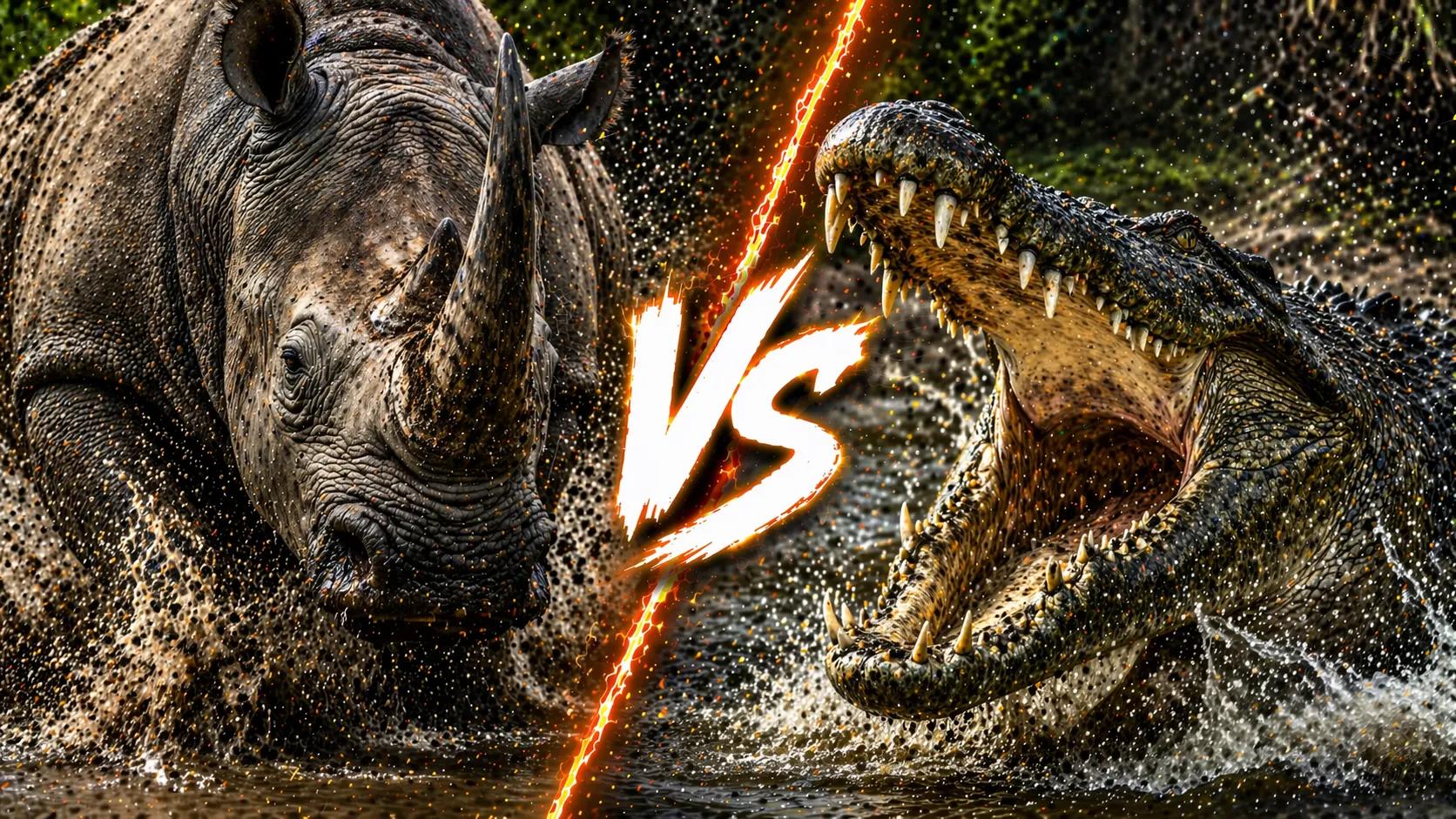
Rhino vs Crocodile: Which Dangerous Animal Has the Edge?
A grounded rhino vs crocodile comparison covering charge lanes, ambush, and whether a water-edge bite can overcome a giant horned grazer.
White Rhinoceros vs Crocodile
Matchup winner
White Rhinoceros
Quick verdict
Start with the direct answer, then use the structured comparison below to see what changes the outcome.
White rhinoceros gets the clear overall edge because the size, horn pressure, and land authority are too much in any clean clash. Crocodile only improves if the encounter begins with a strong waterline ambush on a compromised angle.
Read the full explanation
Rhino owns the open lane. Crocodile only stays live through the trap.
Reader vote
Who do you think wins?
Pick a side — no account needed. Results update live.
No votes yet — be the first to call it.
Editorial note
Why people disagree
It compares lane-control megafauna with ambush-edge predation in a very scenario-dependent way.
Open-lane pressure
The rhino dominates any honest frontal clash.
Ambush start
The crocodile case only begins with first bite.
Terrain breadth
The bigger question still leans rhino.
Comparison FAQ
Short, direct answers to the next questions readers usually ask after the headline verdict.
Who wins, white rhinoceros or crocodile?+
White rhinoceros gets the clear overall edge because the size, horn pressure, and land authority are too much in any clean clash. Crocodile only improves if the encounter begins with a strong waterline ambush on a compromised angle.
Why does this matchup stay interesting?+
Crocodile stays dangerous only through the ambush start. White rhinoceros still gets the clean overall verdict because the direct-body gap is too severe.
Head-to-head species stats
These are the same core AnimalDex stat dimensions used on the dedicated animal pages, pulled side by side so the matchup is faster to scan.
White Rhinoceros
Tier BCrocodile
Tier CTrait-by-trait comparison
Only the categories that matter to this matchup are included. The goal is not filler stats, but the real design differences that change the result.
Massive horn-first forward authority
Open-lane pressure
White Rhinoceros
Far weaker in straight dry-ground collision
Open-lane pressure
White Rhinoceros
Less dependent on surprise
Ambush start
Crocodile
Highly dangerous if it starts from the right water-edge angle
Ambush start
Crocodile
Safer across more broad land scenarios
Terrain breadth
White Rhinoceros
Needs tighter water-linked geometry
Terrain breadth
White Rhinoceros
How the verdict forms
Verdict timeline
01 · Open-lane pressure
White Rhinoceros
02 · Ambush start
Crocodile
03 · Terrain breadth
White Rhinoceros
Change the conditions
Scenario breakdown
This is where shallow battle content usually fails. Terrain, spacing, timing, and engagement style can change the answer.
Scenario lean
White Rhinoceros
Verdict confidence
82%
Rhino clearly
This is the crocodile's worst version of the problem.
AnimalDex field profiles
Explore these animals
White Rhinoceros
Ceratotherium simum
Open grassland, savannah, floodplain, and lightly wooded grazing country with access to water and wallows.
Crocodile
Crocodylidae
Rivers, estuaries, mangroves, floodplains, swamps, and shorelines with reliable basking and ambush cover.
Systems Intelligence & Hidden Purpose
See the animals behind this comparison as engineered biological systems: what each one is built to do, where it gains leverage, and why the matchup changes by scenario.
Specialized Hardware
Square grazing lip, heavy neck support, thick skin, and horn-forward charge mechanics make white rhinoceroses bulk-feeding hardware built for open ground.
Systems Script
White rhinoceroses convert large grass volumes into megaherbivore pressure across savannah systems. They reshape short-grass structure, path use, and wallow zones while forcing the landscape to make room for body scale.
Strategic Insight
Scale is powerful when it is paired with a simple repeatable operating loop. Do the basic high-value action well enough, and the whole environment starts bending around it.
Specialized Hardware
Pressure-sensitive receptors around the jaws, eyes and nostrils mounted high on the skull, and a tail built for explosive propulsion make crocodiles effective ambush hardware at the land-water edge.
Systems Script
Crocodiles control chokepoints where rivers, wetlands, and shorelines concentrate traffic. They regulate prey behavior, move nutrients through kills and carcasses, and add caution to landscapes that would otherwise become too predictable.
Strategic Insight
You do not need to dominate every square meter. Control the bottlenecks and the rest of the map starts behaving differently.
Final take
Crocodile stays dangerous only through the ambush start. White rhinoceros still gets the clean overall verdict because the direct-body gap is too severe.
Collect both animals in AnimalDex
Track the species behind this matchup, compare their real traits, and build the rivalry into your AnimalDex collection.
Related comparisons
Continue with nearby matchups to compare more real-world animal traits without dropping into junky who-wins filler.

Elephant vs Rhino: Who Has the Real Edge?
Elephant usually has the overall edge through greater size, reach, and control of space. A rhino still remains dangerous because its charge is compact, forceful, and built for brutal short-range disruption.
Read comparison
Crocodile vs Polar Bear: Which Predator Has the Edge?
Polar bear gets the overall edge on land or partial land because it is larger, more mobile out of water, and better at sustained violent contact once the crocodile loses ambush shape. Crocodile becomes far more dangerous in water-linked ambush where the bite starts first and the bear does not control footing.
Read comparison
Discussion
What do you think?
Share your reasoning with other readers. Be civil and stick to the animals.
Sign in to join the discussion.
Sign inNo comments yet. Start the conversation.