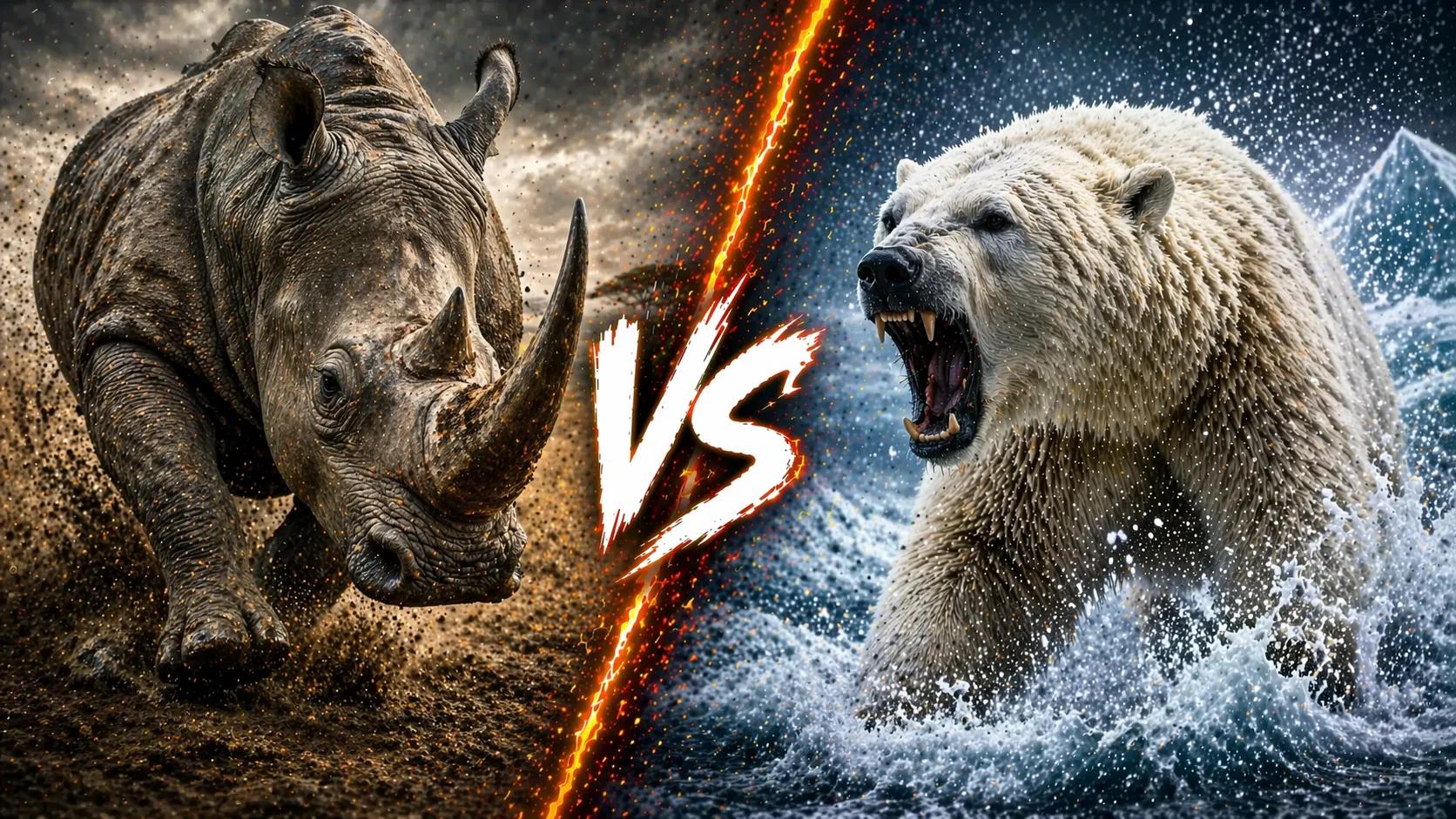
White Rhinoceros and Polar Bear, side by side
A grounded rhino vs polar bear comparison covering charge structure, bite pressure, and why horn-first mass changes the matchup sharply.
White Rhinoceros Polar Bear
In short
The short version first. The comparison below shows what changes with the setting.
A rhino would win: an adult white rhino weighs around two tonnes, several times a large male polar bear, and charges with its horn. In reality the two never meet in the wild.
Read the full explanation
Realistically, the rhino wins. An adult white rhinoceros commonly weighs 1,800 to 2,500 kg, while a big male polar bear is around 350 to 700 kg, so the bear would face an animal several times its size with thick skin and a horn it charges with. Polar bears are built to ambush seals on sea ice, not to bring down a healthy adult rhino. The matchup is purely hypothetical: polar bears live in the Arctic and rhinos in Africa and southern Asia, so the two never meet.
Reader vote
Whose way would you take?
Pick a side — no account needed. Results update live.
No votes yet. Be the first to pick.
Editorial note
Why people disagree
It compares predatory danger with one of the strongest lane-control herbivore body plans in the catalog.
Charge structure
Rhino gets the cleaner first big move.
Body resilience
The rhino body asks much harder questions of the attacker.
Adaptability in chaos
The bear only gets better once the fight stops looking like a charge problem.
Comparison FAQ
Short, direct answers to the next questions readers usually ask.
Who wins, rhino or polar bear?+
The rhino, realistically. It is several times heavier and charges with a horn, while the polar bear's hunting style is built around seals rather than giant herbivores.
Would a polar bear beat a rhino?+
Very unlikely. The polar bear is the largest land carnivore, but an adult white rhino is still several times heavier, has thick, tough skin and charges with a long front horn. Polar bears specialise in hunting seals, prey far smaller than a rhino. A bear might injure a rhino with bites and claws, but it has no reliable way to stop one, so the rhino is the realistic winner.
Do rhinos and polar bears ever meet?+
No. Polar bears live on Arctic sea ice and coasts in Canada, Alaska, Greenland, Norway and Russia, while the five rhino species live in sub-Saharan Africa and southern Asia. Their ranges are thousands of kilometres apart and their climates are opposites, so any matchup is hypothetical. It is still a useful way to compare a large predator with a large, well-defended herbivore.
How much heavier is a rhino than a polar bear?+
Much heavier. A white rhinoceros, the largest rhino, commonly weighs 1,800 to 2,500 kg, and big males can be heavier still. Adult male polar bears usually weigh about 350 to 700 kg, and females roughly half that. Even a very large polar bear would be giving away well over a tonne, which is why the rhino's charge is so hard for the bear to handle.
Why does the polar bear still improve in some scenarios?+
Because it is more flexible once the clash stops being a clean frontal charge problem.
Their stats, side by side
The same core AnimalDex stats used on each animal's own page, side by side so the two are faster to compare.
White Rhinoceros
Polar Bear
Trait-by-trait comparison
Only the categories that matter for these two: the real design differences, not filler stats.
Horn-first forward pressure built for open-ground dominance
Charge structure
White Rhinoceros
Relies more on bite timing and opportunistic angle choice
Charge structure
White Rhinoceros
Thick skin and huge frame with difficult approach geometry
Body resilience
White Rhinoceros
Very tough for a bear, but less protected in a frontal lane clash
Body resilience
White Rhinoceros
Best in direct forward pressure
Adaptability in chaos
Polar Bear
Better at improvising if the shape breaks apart
Adaptability in chaos
Polar Bear
Trait by trait
Where each one has the edge
01 · Charge structure
White Rhinoceros
02 · Body resilience
White Rhinoceros
03 · Adaptability in chaos
Polar Bear
Change the conditions
Scenario breakdown
The setting changes everything: terrain, spacing, timing and approach decide which way of surviving works.
Has the edge here
White Rhinoceros
Verdict confidence
82%
Rhino clearly
This is the most natural and strongest form of the rhino case.
AnimalDex field profiles
Explore these animals
White Rhinoceros
Ceratotherium simum
Open grassland, savannah, floodplain, and lightly wooded grazing country with access to water and wallows.
Polar Bear
Ursus maritimus
Sea ice, Arctic coastlines, pack ice margins, and seasonal marine hunting zones.
Systems Intelligence & Hidden Purpose
See the two animals as engineered biological systems: what each one is built to do, where it gains leverage, and why the answer changes with the setting.
Specialized Hardware
Square grazing lip, heavy neck support, thick skin, and horn-forward charge mechanics make white rhinoceroses bulk-feeding hardware built for open ground.
Systems Script
White rhinoceroses convert large grass volumes into megaherbivore pressure across savannah systems. They reshape short-grass structure, path use, and wallow zones while forcing the landscape to make room for body scale.
Strategic Insight
Scale is powerful when it is paired with a simple repeatable operating loop. Do the basic high-value action well enough, and the whole environment starts bending around it.
Specialized Hardware
Insulation, scent range, swimming power, and seal-focused hunting behavior make polar bears predatory hardware tuned to a moving frozen platform.
Systems Script
Polar bears link sea-ice structure to upper food-web pressure. When the platform changes, the hunter changes, and the whole Arctic operating system starts losing predictability.
Strategic Insight
If your system depends on one platform, monitor the platform harder than the performance metrics built on top of it.
Final take
Polar bear is still a major threat in the abstract. White rhinoceros gets the cleaner direct-fight verdict because horn-first mass is a terrible problem for the bear to solve.
Ask them both
Bring the same problem to the White Rhinoceros and the Polar Bear. Each answers from its own Power, and they won't agree.
Related comparisons
More pairs, compared on real-world traits.

Elephant and White Rhinoceros
Elephant usually has the overall edge through greater size, reach, and control of space. A rhino still remains dangerous because its charge is compact, forceful, and built for brutal short-range disruption.
Read comparison
Elephant and Polar Bear
Elephant gets the overwhelming overall edge through enormous size, reach, and space control. Polar bear remains dangerous because it is an apex predator with serious bite and commitment, but it is still far too outscaled in a clean direct clash.
Read comparison
Discussion
What do you think?
Share your reasoning with other readers. Be civil and stick to the animals.
Sign in to join the discussion.
Sign inNo comments yet. Start the conversation.