


Rosy Maple Moth vs Stick Insect: Who Actually Wins?
Rosy Maple Moth vs Stick Insect: who would win? A biology-first breakdown of size, armor, defenses, flight, and why the stick insect takes it.
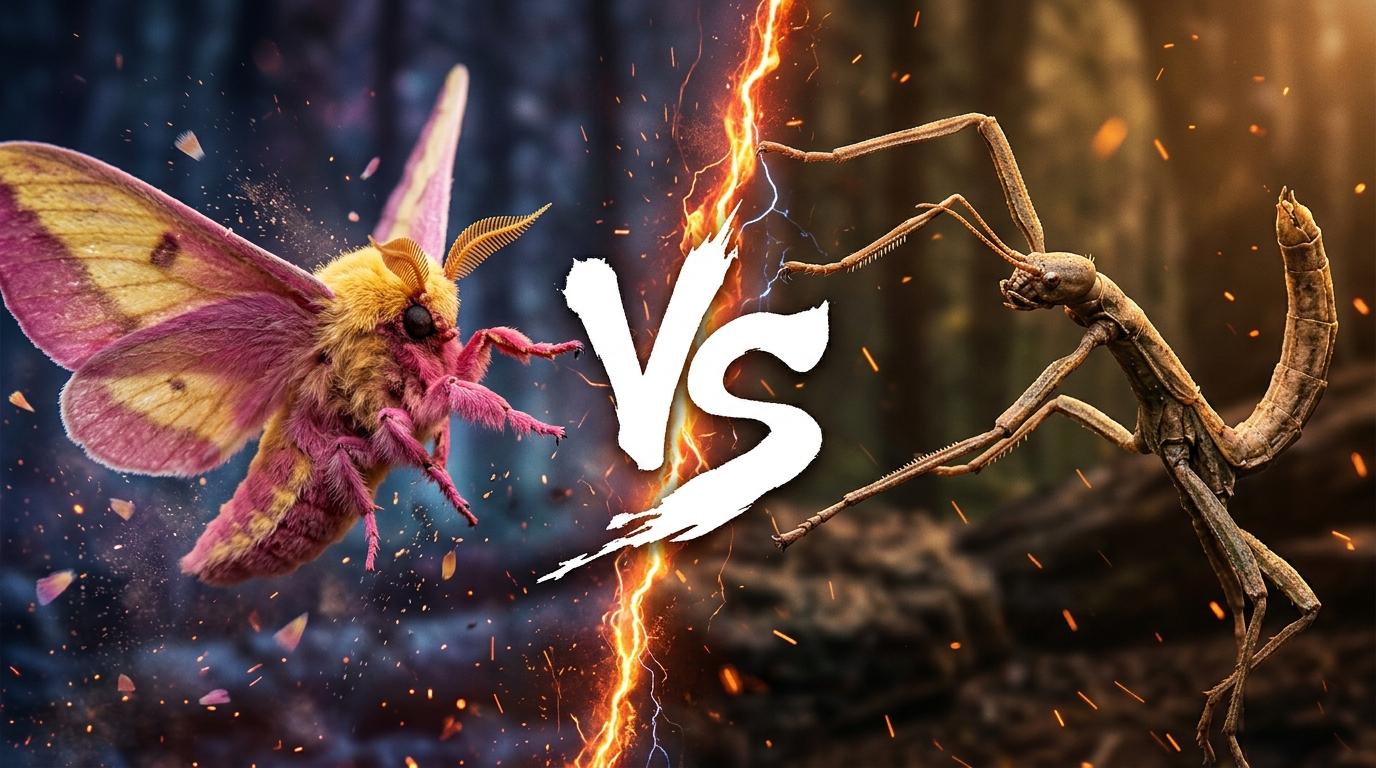
Rosy Maple Moth vs Stick Insect
Matchup winner
Stick Insect
Quick verdict
Start with the direct answer, then use the structured comparison below to see what changes the outcome.
The stick insect wins. Neither insect is built to fight, and neither would hunt the other, but a contested encounter comes down to body mass, reach, and defensive hardware. Stick insects range from finger-length to over 30 cm, and some species carry spiny hind legs that clamp and kick or glands that spray irritating chemicals. The adult Rosy Maple Moth is a soft, fuzzy flier with a wingspan around 3–5 cm. Its mouthparts are reduced and non-feeding, and it lives only days to reproduce. The moth's real advantage is flight. It can leave, but it cannot push a stick insect off a branch. In any frame where someone has to give ground, the bigger, tougher, more stubborn phasmid holds the perch.
Read the full explanation
Stick insect wins on size, reach, and armor.
The adult moth has reduced, non-feeding mouthparts and no real offensive tool.
Spiny-legged and chemical-spraying phasmids add genuine deterrence.
The moth's only winning move is flying away, which is escape rather than victory.
Reader vote
Who do you think wins?
Pick a side — no account needed. Results update live.
No votes yet — be the first to call it.
Editorial note
Why people disagree
AnimalDex dominance stats rate the moth slightly higher, but those numbers reflect activity and flight, not contact strength.
Body mass & reach
Longer limbs and greater mass let the phasmid shove, brace, and outlast a featherweight moth.
Defensive hardware
Spines and repellent sprays punish contact. Fuzz only cushions it.
Mobility & disengagement
The moth controls whether an encounter happens at all, but mobility alone cannot claim a perch.
Read the full explanation +
People picture slender twig-mimics and forget the heavy, thorny species like Extatosoma and Eurycantha.
Some readers count the moth's easy escape as a win. A battle verdict counts who holds the ground.
Comparison FAQ
Short, direct answers to the next questions readers usually ask after the headline verdict.
Would a Rosy Maple Moth beat a stick insect?+
No. The stick insect is larger, longer-lived, and better defended. The moth's best outcome is flying away.
Which is stronger, a Rosy Maple Moth or a stick insect?+
The stick insect. Its greater mass, longer limbs, and in some species spiny legs give it far more physical force than the delicate moth.
Do they actually fight in nature?+
Essentially never. Both are herbivores with different lifestyles: the moth caterpillar eats maple leaves, and the adult moth doesn't feed.
Why is the Rosy Maple Moth still hard to beat?+
Flight. It can disengage instantly and at night, so few slow-moving insects can ever pin it down.
Can stick insects hurt you?+
Most cannot. A few spiny species can pinch with their legs, and some spray irritants that sting the eyes.
Head-to-head species stats
These are the same core AnimalDex stat dimensions used on the dedicated animal pages, pulled side by side so the matchup is faster to scan.
Rosy Maple Moth
Tier EStick Insect
Tier CTrait-by-trait comparison
Only the categories that matter to this matchup are included. The goal is not filler stats, but the real design differences that change the result.
Compact, ~3–5 cm wingspan
Body mass & reach
Stick Insect
Long-bodied, many species 10–30+ cm
Body mass & reach
Stick Insect
Fuzz, bright warning-style colors
Defensive hardware
Stick Insect
Camouflage, leg spines, chemical spray in some species
Defensive hardware
Stick Insect
Capable nocturnal flier
Mobility & disengagement
Rosy Maple Moth
Slow walker, some species glide or fly weakly
Mobility & disengagement
Rosy Maple Moth
Essentially none, mouthparts reduced
Offensive tools
Stick Insect
Leaf-chewing mandibles, clamping spiny legs (some species)
Offensive tools
Stick Insect
Adult lives about a week, non-feeding
Staying power
Stick Insect
Adults live months, feed continuously
Staying power
Stick Insect
How the verdict forms
Verdict timeline
01 · Body mass & reach
Stick Insect
02 · Defensive hardware
Stick Insect
03 · Mobility & disengagement
Rosy Maple Moth
04 · Offensive tools
Stick Insect
05 · Staying power
Stick Insect
Change the conditions
Scenario breakdown
This is where shallow battle content usually fails. Terrain, spacing, timing, and engagement style can change the answer.
Scenario lean
Stick Insect
Verdict confidence
82%
Stick insect holds the twig.
In foliage, camouflage and grip dominate. The phasmid locks on, sways like a twig, and responds to contact with kicks or a defensive posture. The moth has no lever to dislodge it, so it relocates.
AnimalDex field profiles
Explore these animals
Rosy Maple Moth
Dryocampa rubicunda
deciduous woodland and suburban tree cover
Stick Insect
—
Habitat details are not published on a dedicated AnimalDex species page yet.
Species guide coming soon.
Systems Intelligence & Hidden Purpose
See the animals behind this comparison as engineered biological systems: what each one is built to do, where it gains leverage, and why the matchup changes by scenario.
Specialized Hardware
pink-and-yellow fluffy wings, soft feathery body, and night maple-forest flight give the Rosy Maple Moth a body plan tuned for its niche.
Systems Script
Rosy Maple Moths operate through deciduous woodland and suburban tree cover. Their design links movement, feeding, shelter, and timing into one workable survival system.
Strategic Insight
Dense environments reward precision, patience, and the ability to read layered cover.
Final take
This is a gentle matchup between two harmless herbivores, but the biology still picks a side. The stick insect brings size, longevity, and in many species real deterrents like thorns and sprays. The Rosy Maple Moth is a beautiful, short-lived reproductive specialist with almost nothing to fight with.
Read the full explanation
The moth's escape skill is real, and it explains why it is rated more active. When the question is who wins, though, the insect that keeps its ground is the stick insect.
Collect both animals in AnimalDex
Track the species behind this matchup, compare their real traits, and build the rivalry into your AnimalDex collection.
Related comparisons
Continue with nearby matchups to compare more real-world animal traits without dropping into junky who-wins filler.
Rosy Maple Moth vs Northern Walkingstick: Who Actually Wins?
The Northern Walkingstick wins this matchup clearly. It is a much longer, heavier-bodied insect, often 7 to 9 cm long against a moth whose wings span roughly 3 to 5 cm. It has a tougher exoskeleton, clinging legs that lock onto bark and twigs, and a life built around staying put while the Rosy Maple Moth lives fast and fragile. The moth has no functional mouthparts as an adult and lives only about a week on its caterpillar reserves. Its scale-covered wings tear easily, and its only real move is flight. Neither species is a fighter. Both are plant-eaters that never evolved to attack, so any contest comes down to mass, grip, durability, and who can push the other off a branch. On every physical measure except getting away, the walkingstick holds the edge.
Read comparison
Luna Moth vs Rosy Maple Moth: Who Actually Wins?
The Luna Moth wins. Neither species has weapons, venom, or working mouthparts as an adult, so a 'fight' between them is really a contest of mass, wing thrust, and staying power on a contested perch. On those terms the Luna Moth's advantages are hard to overcome. Its wingspan of roughly 8–11.5 cm is about twice the Rosy Maple Moth's 3–5.5 cm, which gives it far more wing area to buffet, shove, and hold a surface. Its long, twisting hindwing tails also give it a documented edge against bats, the predator that actually decides most moth 'battles.' The Rosy Maple Moth is stockier for its size and better suited to tight foliage. Still, when two moths collide on a branch, a window screen, or under a porch light, the much larger moth usually keeps its spot.
Read comparison
Discussion
What do you think?
Share your reasoning with other readers. Be civil and stick to the animals.
Sign in to join the discussion.
Sign inNo comments yet. Start the conversation.