

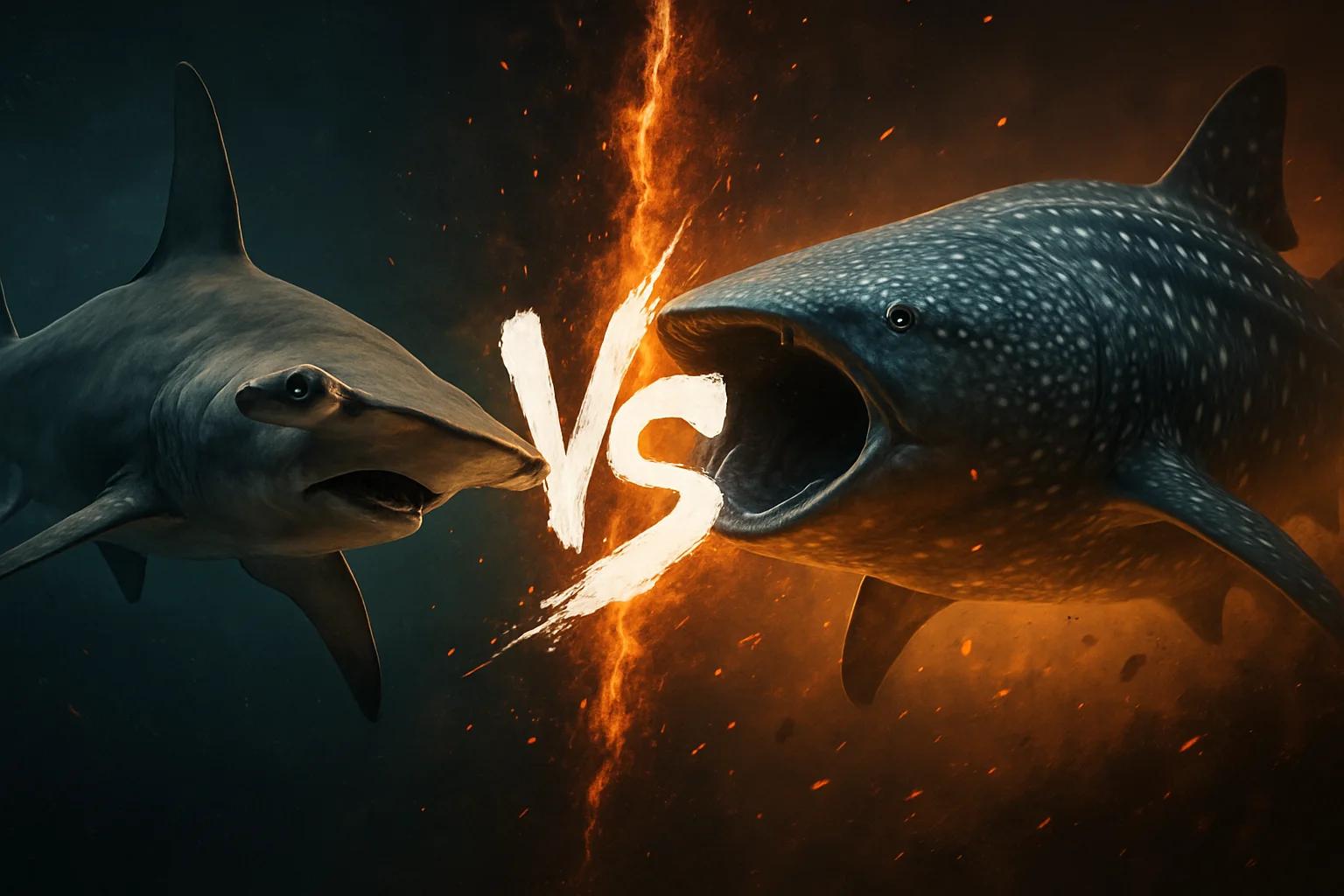
Scalloped Hammerhead vs Whale Shark: Who Actually Wins?
Scalloped hammerhead vs whale shark: a fast schooling predator against the largest fish alive. See who wins, why, and when the hammerhead has the edge.
Scalloped Hammerhead vs Whale Shark
Matchup winner
Whale Shark
Quick verdict
Start with the direct answer, then use the structured comparison below to see what changes the outcome.
The whale shark wins, and not narrowly. A scalloped hammerhead is a capable predator, usually 2–3 m long, with a sensor-packed head, good acceleration, and a mouth built for squid and reef fish. A whale shark is the largest fish on Earth, commonly 5.5–10 m and sometimes more, with skin roughly 10 cm thick and a body mass more than 50 times greater. The hammerhead has no tool that can reach anything vital. Its bite is sized for prey it can swallow, and against a whale shark it would barely mark the hide. The whale shark is a harmless filter feeder with tiny, useless teeth, so it won't 'win' by killing anything. It wins by being impossible to beat. The hammerhead runs out of options long before the whale shark runs out of body. The only real exception is a newborn or very small juvenile whale shark, which is vulnerable to predatory sharks.
Read the full explanation
Whale shark wins overall. Its sheer size and thick skin make it effectively immune to a scalloped hammerhead.
The hammerhead is faster, more agile, and an active predator, but its jaws are built for squid and fish, not a 10-metre armored body.
Neither shark wants this fight. The likely real outcome is the hammerhead losing interest and leaving.
Flip the age bracket and the answer flips too: a hatchling-sized whale shark is legitimate prey.
Reader vote
Who do you think wins?
Pick a side — no account needed. Results update live.
No votes yet — be the first to call it.
Editorial note
Why people disagree
'Predator beats filter feeder' sounds logical, but predation only works when the prey fits the predator's toolkit. A whale shark doesn't fit.
Explosive power
The hammerhead controls when and where contact happens, but speed only matters if contact can do damage.
Mass and body scale
A body this much larger turns every bite into a scratch and every bump into a shove the hammerhead can't match.
Close-range durability
This is the decisive trait. The whale shark's armor-grade skin closes off the hammerhead's only route to winning.
Read the full explanation +
Hammerheads look aggressive and schools look intimidating, yet scalloped hammerheads target small prey and avoid tangling with giants.
Some people argue a whale shark 'can't fight back.' It doesn't need to. In a contest with no lethal pathway, durability decides the result.
Comparison FAQ
Short, direct answers to the next questions readers usually ask after the headline verdict.
Would a scalloped hammerhead beat a whale shark?+
No. An adult whale shark is far too large and thick-skinned for a scalloped hammerhead to seriously injure. The whale shark wins by durability.
Which is stronger, a hammerhead or a whale shark?+
The whale shark, by a huge margin in raw mass and force. The hammerhead is stronger only in bite effectiveness and acceleration.
Can a whale shark hurt a hammerhead?+
Not deliberately. Its teeth are tiny and it feeds on plankton. At most, its bulk could shove or bump a smaller shark.
Why is the hammerhead still dangerous?+
It is an agile, sensor-rich predator that can kill juvenile whale sharks and many other animals. It only loses here because an adult whale shark sits far outside its prey size range.
Do hammerheads and whale sharks meet in the wild?+
Yes. Both gather at productive tropical sites and seamounts, such as those around the Galápagos, and they generally ignore each other.
Head-to-head species stats
These are the same core AnimalDex stat dimensions used on the dedicated animal pages, pulled side by side so the matchup is faster to scan.
Scalloped Hammerhead
Tier BWhale Shark
Tier CTrait-by-trait comparison
Only the categories that matter to this matchup are included. The goal is not filler stats, but the real design differences that change the result.
Quick bursts, sharp turns
Explosive power
Scalloped Hammerhead
Slow, steady cruising around 5 km/h
Explosive power
Scalloped Hammerhead
Usually 2–3 m, rarely over 4 m
Mass and body scale
Whale Shark
Commonly 5.5–10 m, multi-tonne
Mass and body scale
Whale Shark
Standard shark skin and a slim build
Close-range durability
Whale Shark
Hide up to about 10 cm thick
Close-range durability
Whale Shark
Serrated teeth for fish and squid
Weaponry
Scalloped Hammerhead
Thousands of tiny, non-functional teeth
Weaponry
Scalloped Hammerhead
Wide-set eyes and an electroreceptive cephalofoil
Sensory targeting
Scalloped Hammerhead
Adequate senses tuned for finding plankton
Sensory targeting
Scalloped Hammerhead
Strong daily movements between seamounts and hunting grounds
Endurance and range
Whale Shark
Ocean-crossing migrations and very deep dives
Endurance and range
Whale Shark
How the verdict forms
Verdict timeline
01 · Explosive power
Scalloped Hammerhead
02 · Mass and body scale
Whale Shark
03 · Close-range durability
Whale Shark
04 · Weaponry
Scalloped Hammerhead
05 · Sensory targeting
Scalloped Hammerhead
06 · Endurance and range
Whale Shark
Change the conditions
Scenario breakdown
This is where shallow battle content usually fails. Terrain, spacing, timing, and engagement style can change the answer.
Scenario lean
Whale Shark
Verdict confidence
82%
Whale shark, effortlessly
In open water, the hammerhead's agility lets it circle and probe, but each pass meets a wall of thick hide. With no vulnerable target it can reach, the predator's cost-benefit math says leave. The whale shark keeps cruising.
AnimalDex field profiles
Explore these animals
Scalloped Hammerhead
Sphyrna lewini
Coastal shelves, seamounts, oceanic islands, estuaries, and warm offshore waters.
Whale Shark
Rhincodon typus
Warm coastal waters, offshore fronts, reefs, and seasonal plankton aggregation sites.
Systems Intelligence & Hidden Purpose
See the animals behind this comparison as engineered biological systems: what each one is built to do, where it gains leverage, and why the matchup changes by scenario.
Specialized Hardware
Hammer-shaped head, expanded electroreception spacing, and coordinated schooling behavior make hammerheads broad-scan hardware for complex marine hunting.
Systems Script
Scalloped hammerheads convert unusual head geometry into better prey detection and maneuvering, especially around reefs and seamounts. Their design proves shape can be a sensing strategy.
Strategic Insight
A wider information array can change decision quality more than simply moving faster.
Specialized Hardware
An enormous mouth, fine filtering structures, and low-cost cruising mechanics allow the whale shark to process huge volumes of plankton-rich water without high-speed pursuit.
Systems Script
Whale sharks connect surface productivity to larger marine food webs by converting diffuse plankton pulses into mobile biomass. Their movement patterns also mark productive ocean zones where energy concentrates seasonally.
Strategic Insight
Scale does not always come from chasing more targets. Sometimes it comes from building a system that can process volume efficiently once the flow arrives.
Final take
This matchup is a lesson in scale beating sharpness. The scalloped hammerhead is the more skilled animal in every predatory sense: faster, better at sensing prey, and properly armed. None of that counts when the opponent is many times its length and wrapped in some of the thickest skin in the animal kingdom.
Read the full explanation
The whale shark wins by making the fight pointless. A gentle filter feeder with no offensive intent still comes out on top, because the hammerhead has no way to turn contact into damage. The hammerhead's one real window is a very young whale shark, and that window closes fast as the giant grows.
Collect both animals in AnimalDex
Track the species behind this matchup, compare their real traits, and build the rivalry into your AnimalDex collection.
Discussion
What do you think?
Share your reasoning with other readers. Be civil and stick to the animals.
Sign in to join the discussion.
Sign inNo comments yet. Start the conversation.