

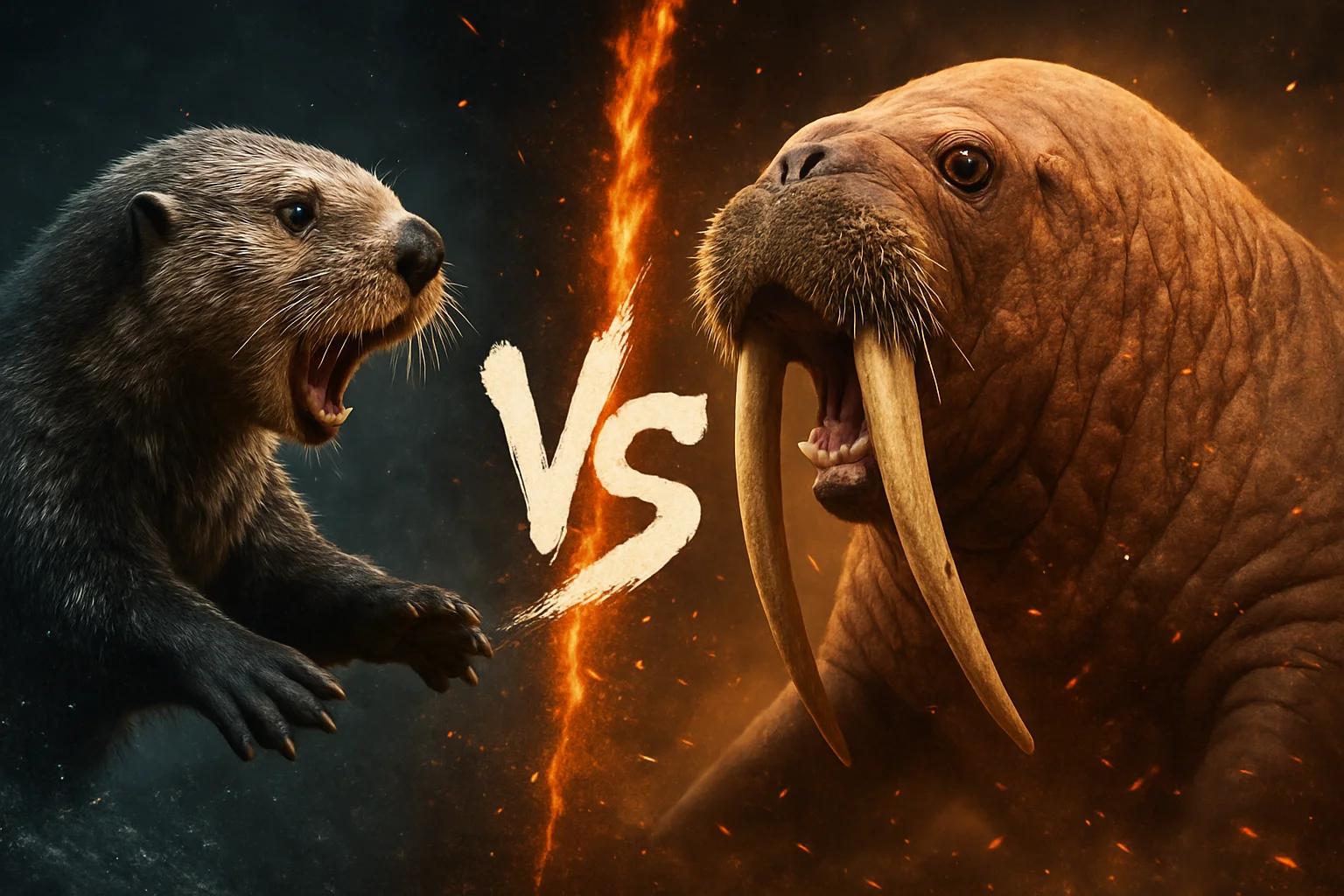
Sea Otter vs Walrus: Who Actually Wins?
Sea otter vs walrus: who would win? A biology-first look at size, tusks, blubber, agility and intelligence, and why the walrus wins clearly.
Sea Otter vs Walrus
Matchup winner
Walrus
Quick verdict
Start with the direct answer, then use the structured comparison below to see what changes the outcome.
The walrus wins, and it isn't close. An adult male walrus can weigh 800–1,700 kg (1,800–3,700 lb) against a sea otter's 14–45 kg (30–100 lb), a mass gap of roughly 30 to 1 or more. The walrus brings tusks up to a meter long, skin several centimeters thick over a deep blubber layer, and a neck and shoulder build forged in brutal male-on-male tusk fights. The sea otter has real strengths: it is quick, clever, dexterous, and has a bite strong enough to crack urchins and clams. But nothing in its toolkit can get through a walrus's armor. Its best play is speed and retreat, not victory.
Read the full explanation
Walrus wins decisively: far heavier, armored, and tusked.
The sea otter's bite is built for shellfish, not for punching through thick hide and blubber.
The otter's only real edge is agility. It can escape, but it can't win.
In nature they rarely meet; walrus range overlaps otters only in parts of the Bering region.
Reader vote
Who do you think wins?
Pick a side — no account needed. Results update live.
No votes yet — be the first to call it.
Editorial note
Why people disagree
Sea otters seem feisty and smart, so people overrate how far cleverness can carry a 30 kg animal against a 1-ton one.
Mass and frame
Mass dictates who can shove, pin, and absorb blows. The walrus's advantage is overwhelming.
Weapon system
Tusks are evolved fighting tools; otter teeth are evolved nutcrackers.
Close-range durability
The walrus can shrug off the very hits the otter is able to land.
Read the full explanation +
Walruses look slow and blubbery on land, which hides how agile and dangerous they are in water.
Some imagine the otter darting in for bites, but its bites barely matter against centimeters of hide and fat.
Comparison FAQ
Short, direct answers to the next questions readers usually ask after the headline verdict.
Would a sea otter beat a walrus?+
No. A walrus would win almost every real confrontation thanks to its enormous mass, tusks, and thick protective hide.
Which is stronger, a sea otter or a walrus?+
The walrus, by a huge margin. It outweighs an otter dozens of times over and has a powerful neck and shoulders for tusk combat and hauling out onto ice.
Can a sea otter hurt a walrus?+
Barely. Its bite can crack shells, but walrus skin and blubber are several centimeters thick, so otter bites would cause only superficial wounds.
Why is the sea otter still dangerous?+
Sea otters have strong jaws and sharp claws, and they can bite hard when cornered. Their speed and agility let them avoid larger threats, which makes them hard to catch.
Do sea otters and walruses meet in the wild?+
Only occasionally, in overlapping northern Pacific and Bering waters. Serious conflict is rare, since both mostly focus on bottom-dwelling prey.
Head-to-head species stats
These are the same core AnimalDex stat dimensions used on the dedicated animal pages, pulled side by side so the matchup is faster to scan.
Sea Otter
Tier AWalrus
Tier BTrait-by-trait comparison
Only the categories that matter to this matchup are included. The goal is not filler stats, but the real design differences that change the result.
14–45 kg, slender
Mass and frame
Walrus
800–1,700 kg bulls
Mass and frame
Walrus
Crushing molars, small claws
Weapon system
Walrus
Tusks up to ~1 m
Weapon system
Walrus
Dense fur, no blubber
Close-range durability
Walrus
Thick hide over deep blubber
Close-range durability
Walrus
Nimble, quick turns
Agility and evasion
Sea Otter
Powerful but bulky
Agility and evasion
Sea Otter
Tool use with rocks
Problem-solving
Sea Otter
Tactile, suction-feeding specialist
Problem-solving
Sea Otter
Minor territorial scuffles
Combat conditioning
Walrus
Violent tusk duels between bulls
Combat conditioning
Walrus
How the verdict forms
Verdict timeline
01 · Mass and frame
Walrus
02 · Weapon system
Walrus
03 · Close-range durability
Walrus
04 · Agility and evasion
Sea Otter
05 · Problem-solving
Sea Otter
06 · Combat conditioning
Walrus
Change the conditions
Scenario breakdown
This is where shallow battle content usually fails. Terrain, spacing, timing, and engagement style can change the answer.
Scenario lean
Walrus
Verdict confidence
82%
Walrus dominates.
In open water the walrus can use its full swimming power and tusk sweeps. The otter can outturn it briefly, but it has no damage path. A single tusk strike or body slam ends the exchange.
AnimalDex field profiles
Explore these animals
Sea Otter
Enhydra lutris
Cold coastal seas, kelp forests, rocky shores, and sheltered nearshore marine habitat.
Walrus
Odobenus rosmarus
Arctic seas, ice edges, and shallow marine feeding grounds.
Systems Intelligence & Hidden Purpose
See the animals behind this comparison as engineered biological systems: what each one is built to do, where it gains leverage, and why the matchup changes by scenario.
Specialized Hardware
Often floats on the back, very dense brown fur, and uses paws to handle food and tools give the Sea Otter a body plan tuned for its niche.
Systems Script
Sea Otters operate in cold coastal seas, kelp forests, rocky shores, and sheltered nearshore marine habitat. Their design helps them match food access, shelter, and timing inside that environment.
Strategic Insight
A small specialist can hold an entire habitat together when its feeding changes the whole food web.
Specialized Hardware
Long ivory tusks, heavy wrinkled brown body, and dense whiskers around the muzzle give the Walrus a body plan tuned for its niche.
Systems Script
Walruss operate in arctic seas, ice edges, and shallow marine feeding grounds. Their design helps them match food access, shelter, and timing inside that environment.
Strategic Insight
Scale works best when it is paired with a reliable platform to rest, gather, and launch from.
Final take
The walrus is the clear winner. It is a ton-class marine fighter with tusks and armor, facing a small, brilliant forager whose weapons were designed for shellfish.
Read the full explanation
The sea otter deserves respect as a keystone species and a skilled survivor, but its smartest move in this matchup is to leave. Evolution built it to outthink urchins, not to outfight giants.
Collect both animals in AnimalDex
Track the species behind this matchup, compare their real traits, and build the rivalry into your AnimalDex collection.
Discussion
What do you think?
Share your reasoning with other readers. Be civil and stick to the animals.
Sign in to join the discussion.
Sign inNo comments yet. Start the conversation.