

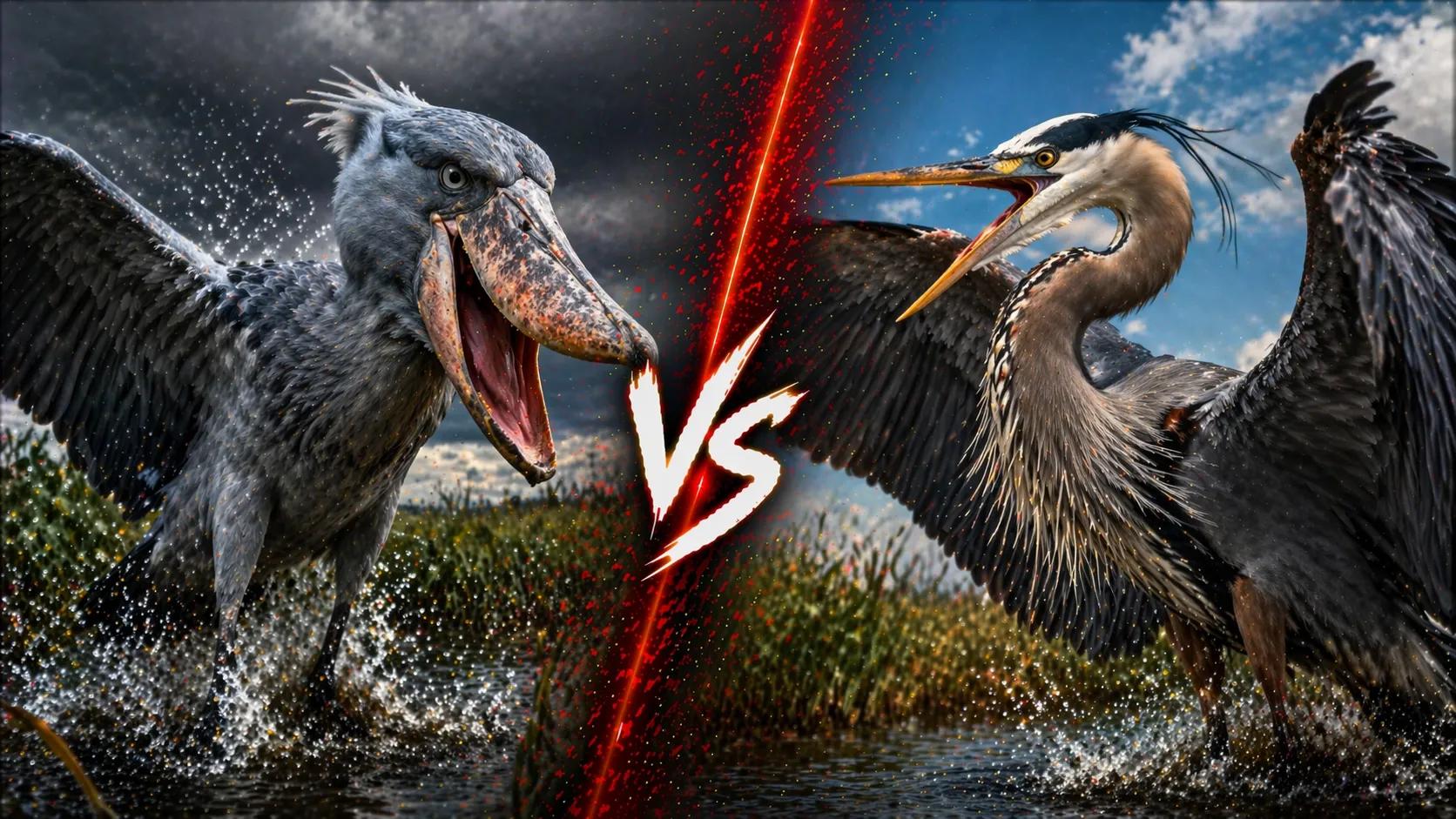
Shoebill vs Great Blue Heron: Which Wetland Hunter Has the Edge?
A shoebill vs great blue heron comparison covering size, strike style, marsh habitat fit, and what changes when a wetland standoff becomes a real clash.
Shoebill vs Great Blue Heron
Matchup winner
Shoebill
Quick verdict
Start with the direct answer, then use the structured comparison below to see what changes the outcome.
Shoebill usually has the edge because it is heavier, more imposing, and built for a more forceful strike package. Great blue heron is still the cleaner light-frame specialist in shallower, more delicate hunting situations.
Read the full explanation
Both birds are wetland ambush hunters, but they do not solve the same problem the same way. Shoebill is the broader, heavier, more intimidating package. Great blue heron is the lighter, more graceful spear-fisher.
Reader vote
Who do you think wins?
Pick a side — no account needed. Results update live.
No votes yet — be the first to call it.
Editorial note
Why people disagree
The page works because it compares two long-legged marsh predators that look similar at a distance but are not built for the same degree of force.
Body authority
Shoebill brings the more intimidating physical baseline.
Precision feeding
Heron is better tuned for lighter precision work.
Direct clash value
If the question becomes confrontation instead of feeding, shoebill gets stronger.
Comparison FAQ
Short, direct answers to the next questions readers usually ask after the headline verdict.
Is a shoebill stronger than a great blue heron?+
Yes. The shoebill usually gets the strength and clash advantage because of its heavier build and more forceful strike profile.
What does the great blue heron do better?+
It is better tuned for lighter, more elegant precision hunting in shallower wetland settings.
Head-to-head species stats
These are the same core AnimalDex stat dimensions used on the dedicated animal pages, pulled side by side so the matchup is faster to scan.
Shoebill
Tier BGreat Blue Heron
Tier DTrait-by-trait comparison
Only the categories that matter to this matchup are included. The goal is not filler stats, but the real design differences that change the result.
Heavier body and more imposing presence
Body authority
Shoebill
Lighter frame with less brute authority
Body authority
Shoebill
Powerful directed attack on larger prey
Precision feeding
Great Blue Heron
Fine control for fish, frogs, and shallower marsh hunting
Precision feeding
Great Blue Heron
More durable and force-oriented
Direct clash value
Shoebill
Better served by avoiding a rough encounter
Direct clash value
Shoebill
How the verdict forms
Verdict timeline
01 · Body authority
Shoebill
02 · Precision feeding
Great Blue Heron
03 · Direct clash value
Shoebill
Change the conditions
Scenario breakdown
This is where shallow battle content usually fails. Terrain, spacing, timing, and engagement style can change the answer.
Scenario lean
Depends on context
Verdict confidence
52%
Depends on the task
The heron is excellent at lighter precise work, but that is different from asking which bird is stronger.
AnimalDex field profiles
Explore these animals
Shoebill
Balaeniceps rex
Papyrus swamp, marsh, and shallow tropical wetlands with dense floating vegetation.
Great Blue Heron
Ardea herodias
Marsh, lake edge, river shallows, tidal flats, and artificial ponds or canals.
Systems Intelligence & Hidden Purpose
See the animals behind this comparison as engineered biological systems: what each one is built to do, where it gains leverage, and why the matchup changes by scenario.
Specialized Hardware
A giant gripping bill, long wetland legs, and remarkable motion control make the shoebill ambush hardware for dense marsh channels.
Systems Script
Shoebills convert hidden swamp prey into top-level pressure in habitats too cluttered for many other large birds. They remind the wetland that concealment is never complete.
Strategic Insight
If the target lives in noise and clutter, patience becomes part of the equipment.
Specialized Hardware
Long legs, telescoping neck mechanics, and a stabbing bill make herons patient interception hardware for shallow water prey.
Systems Script
Herons regulate fish, frogs, and small aquatic animals while mapping wetland productivity in plain sight. They turn still water into an arena of timed precision rather than random waiting.
Strategic Insight
Stillness is useful when it shortens the distance between signal and strike.
Final take
Great blue heron is the finer precision wetland hunter. Shoebill is the stronger answer when the page asks which bird carries the more forceful overall edge.
Collect both animals in AnimalDex
Track the species behind this matchup, compare their real traits, and build the rivalry into your AnimalDex collection.
Discussion
What do you think?
Share your reasoning with other readers. Be civil and stick to the animals.
Sign in to join the discussion.
Sign inNo comments yet. Start the conversation.