

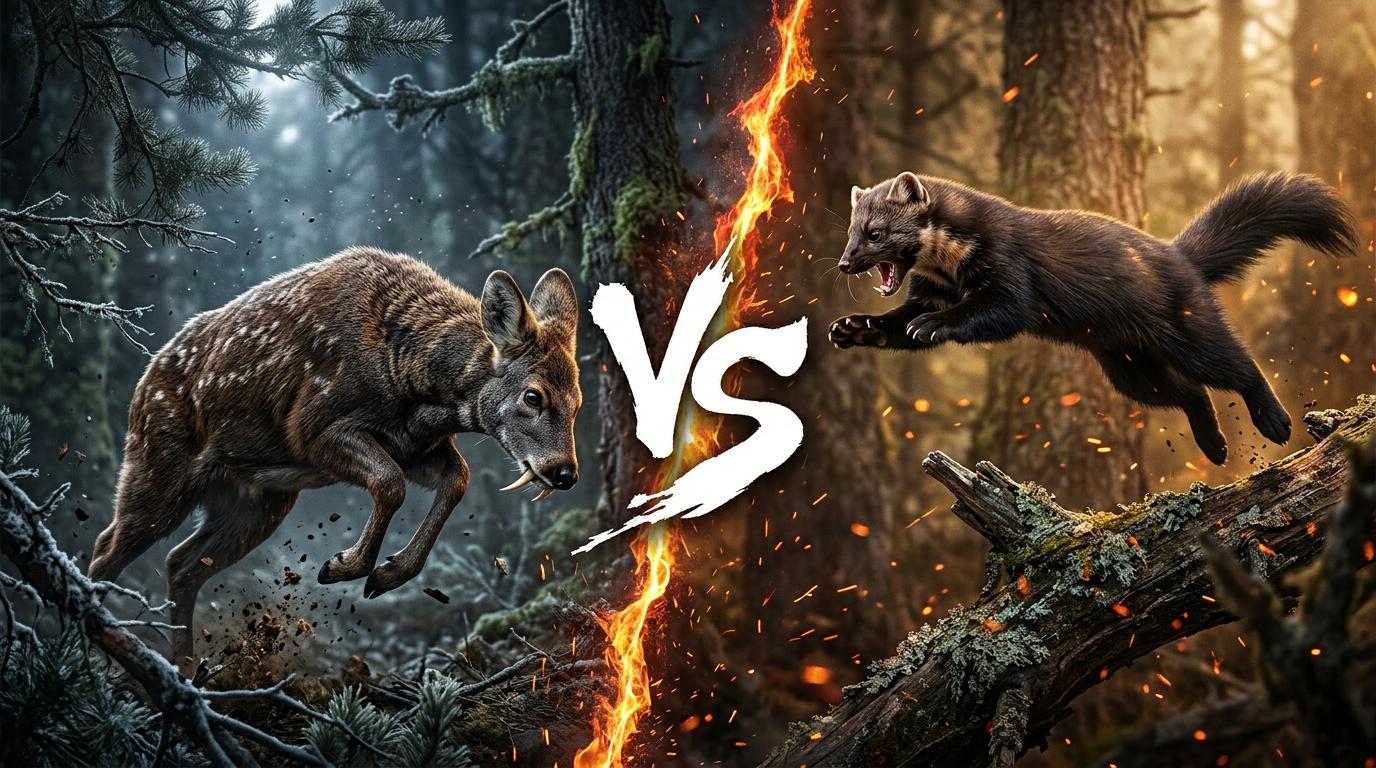
Siberian Musk Deer vs Sable: Who Actually Wins?
Siberian musk deer vs sable: a taiga predator against prey roughly ten times its weight. Here is who wins and why the deer's size and escape tools usually beat the sable's bite.
Siberian Musk Deer vs Sable
Matchup winner
Siberian Musk Deer
Quick verdict
Start with the direct answer, then use the structured comparison below to see what changes the outcome.
The Siberian musk deer wins most realistic encounters against a sable, and the reason is mass. An adult musk deer weighs about 9–17 kg. A sable typically weighs 0.7–1.8 kg. That gap means a lone sable cannot reliably pin, choke, or bleed out a healthy adult deer. The deer also has more than size. Its explosive bounding takes it up steep, rocky slopes the sable will not chase across, and males carry long saber-like upper canines. Strong hind legs add sharp hooves for driving off a small attacker. The sable is a genuinely skilled taiga predator with a fast, precise bite, and it does take musk deer fawns and weakened animals. Against a healthy adult, though, the deer's best move is not to fight at all, and that is exactly why it comes out ahead.
Read the full explanation
Winner: Siberian Musk Deer, mainly through survival and escape rather than killing the sable.
Mass decides it. The deer outweighs the sable roughly 8–15 to 1.
The sable is dangerous to fawns, sick deer, and deer trapped in deep snow.
A healthy adult deer in rocky cover almost always walks away.
Reader vote
Who do you think wins?
Pick a side — no account needed. Results update live.
No votes yet — be the first to call it.
Editorial note
Why people disagree
AnimalDex scores rate the sable higher for dominance and size presence, but its actual body mass is a small fraction of an adult musk deer's.
Body mass advantage
A predator this small needs a quick neck bite to win, and an adult deer is too big to control while it lands one.
Explosive escape power
In a predator–prey contest, the animal that breaks contact first usually wins.
Precision killing tools
The sable is the better killer per kilogram, but its tools are scaled for voles, pikas, and hares.
Read the full explanation +
Mustelids have a fearsome reputation, and people project wolverine-style aggression onto a much smaller animal.
Field reports of sables and martens killing musk deer usually involve fawns, weakened adults, deep snow, or group hunting by the larger yellow-throated marten, not a lone sable against a healthy adult.
Comparison FAQ
Short, direct answers to the next questions readers usually ask after the headline verdict.
Would a Siberian musk deer beat a sable?+
Yes, in most realistic encounters between healthy adults. The deer outweighs the sable many times over and usually escapes or fends it off.
Which animal is stronger?+
The musk deer is far stronger in absolute terms because it is roughly 8–15 times heavier. The sable is stronger for its size and is the better hunter, but scale wins here.
Do sables hunt musk deer?+
Sometimes. Most kills involve fawns or adults weakened by winter, especially in deep snow. The yellow-throated marten, a larger relative, hunts musk deer more effectively, often in pairs or small groups.
Why is the sable still dangerous even though it loses?+
It has a fast, precise bite and excellent stealth. It also moves easily over and under snow. In the right conditions those traits let it kill young or struggling deer.
Are musk deer canines used for fighting?+
Mostly in rivalries between males during the rut. They can still discourage a small predator, but escape is the deer's main defense.
Head-to-head species stats
These are the same core AnimalDex stat dimensions used on the dedicated animal pages, pulled side by side so the matchup is faster to scan.
Siberian Musk Deer
Tier CSable
Tier BTrait-by-trait comparison
Only the categories that matter to this matchup are included. The goal is not filler stats, but the real design differences that change the result.
About 9–17 kg
Body mass advantage
Siberian Musk Deer
About 0.7–1.8 kg
Body mass advantage
Siberian Musk Deer
Long hind legs and springing bounds up steep rock
Explosive escape power
Siberian Musk Deer
Agile sprinter and climber over short distances
Explosive escape power
Siberian Musk Deer
Male canines up to about 7–10 cm, plus hooves
Precision killing tools
Sable
Sharp carnassials and a fast skull or neck bite
Precision killing tools
Sable
Mostly vigilant and freezes, then flees
Ambush control
Sable
Stealthy forest hunter that uses logs, roots, and snow tunnels
Ambush control
Sable
Rocky slopes and dense conifer thickets
Terrain mastery
Siberian Musk Deer
Forest floor, trees, and under-snow runways
Terrain mastery
Siberian Musk Deer
Larger frame that absorbs small bites
Close-range durability
Siberian Musk Deer
Tough and wiry, but vulnerable to a solid kick
Close-range durability
Siberian Musk Deer
How the verdict forms
Verdict timeline
01 · Body mass advantage
Siberian Musk Deer
02 · Explosive escape power
Siberian Musk Deer
03 · Precision killing tools
Sable
04 · Ambush control
Sable
05 · Terrain mastery
Siberian Musk Deer
06 · Close-range durability
Siberian Musk Deer
Change the conditions
Scenario breakdown
This is where shallow battle content usually fails. Terrain, spacing, timing, and engagement style can change the answer.
Scenario lean
Siberian Musk Deer
Verdict confidence
82%
The deer shakes off the attack and escapes.
Even if the sable lands a surprise grip, it cannot hold onto a struggling animal ten times its weight. The deer thrashes, kicks, and bounds into dense cover or up a slope. A failed ambush leaves the sable with nothing but risk.
AnimalDex field profiles
Explore these animals
Siberian Musk Deer
—
Habitat details are not published on a dedicated AnimalDex species page yet.
Species guide coming soon.
Sable
Martes zibellina
taiga forest, boreal woodland, and snowy conifer habitat
Systems Intelligence & Hidden Purpose
See the animals behind this comparison as engineered biological systems: what each one is built to do, where it gains leverage, and why the matchup changes by scenario.
Specialized Hardware
silky dark fur, cold-forest agility, and quiet branch-and-ground hunting give the Sable a body plan tuned for its niche.
Systems Script
Sables operate through taiga forest, boreal woodland, and snowy conifer habitat Their design links movement, shelter, feeding, and survival into one workable system.
Strategic Insight
Soft appearance can hide a very efficient system underneath.
Final take
The Siberian musk deer wins overall. It does not usually overpower the sable in a slugfest. It wins because a healthy adult is simply too large and too evasive for a lone sable to finish. Biology scales predator success with relative size, and this gap is enormous.
Read the full explanation
The sable keeps real power in narrow windows: fawns, deep snow, and weakened animals. Those conditions explain the field reports, but they do not reflect a fair matchup between healthy adults. Over many encounters, the deer survives far more often than the sable succeeds.
Collect both animals in AnimalDex
Track the species behind this matchup, compare their real traits, and build the rivalry into your AnimalDex collection.
Related comparisons
Continue with nearby matchups to compare more real-world animal traits without dropping into junky who-wins filler.

Red Squirrel vs Sable: Who Actually Wins?
The sable wins, and it isn't close. Martes zibellina is a dedicated mustelid predator. At roughly 0.7–1.8 kg it is two to five times heavier than a 250–350 g red squirrel, and it carries a killing bite, flexible spine and taiga-honed hunting instincts built for seizing small mammals. Sables routinely include squirrels in their diet and climb competently. Once contact happens, the squirrel's only real asset is escape. The red squirrel's edge lies in vertical agility, thin-branch travel and alertness, which let it avoid fights rather than win them. In any scenario where the two actually engage, the sable's mass, bite and predatory script decide it within seconds.
Read comparison
Eurasian Lynx vs Sable: Who Actually Wins?
The Eurasian lynx wins, and it isn't close. An adult lynx typically weighs 18–30 kg against a sable's 0.7–1.8 kg. That is roughly a fifteen-to-twentyfold mass advantage. The lynx also brings long legs, huge padded paws, retractable claws and a killing bite built to take roe deer many times heavier than a sable. Lynx are documented predators of martens across Eurasia, and studies in European forests show martens actively avoid lynx territory cores. The sable is a fierce, fast, tree-savvy mustelid with a sharp bite and real nerve. Its realistic win condition is not beating the lynx but escaping it, by climbing thin branches, slipping into root tangles or vanishing under snow. In any direct confrontation the cat's size, reach and killing technique decide it quickly.
Read comparison
Discussion
What do you think?
Share your reasoning with other readers. Be civil and stick to the animals.
Sign in to join the discussion.
Sign inNo comments yet. Start the conversation.