


Sri Lanka Frogmouth vs Superb Lyrebird: Who Actually Wins?
Sri Lanka Frogmouth vs Superb Lyrebird: a biology-first look at size, power, defenses and behavior to answer who would win in a confrontation.
Sri Lanka Frogmouth vs Superb Lyrebird
Matchup winner
Superb Lyrebird
Quick verdict
Start with the direct answer, then use the structured comparison below to see what changes the outcome.
The Superb Lyrebird wins this matchup clearly. It is a ground-dwelling, pheasant-sized bird of roughly 0.9–1.1 kg with powerful scratching legs and strong claws built to rake through leaf litter and soil. The Sri Lanka Frogmouth is a small nocturnal ambush insectivore of around 50–60 g. Its broad gape, wide-mouthed bill and remarkable dead-branch camouflage are made for snapping up insects and for staying unseen, not for grappling. With roughly fifteen to twenty times the body mass, sturdier legs, and the advantage of fighting on the ground, the lyrebird holds almost every physical edge. The frogmouth's real strength is avoiding the encounter entirely, through camouflage and stillness.
Read the full explanation
Superb Lyrebird wins: it is far heavier and has strong, clawed digging feet.
The frogmouth is a tiny camouflage specialist, built to hide rather than fight.
The frogmouth's best outcome is never being noticed, and it is very good at that.
Neither species hunts the other, so this is a hypothetical size-and-hardware comparison.
Reader vote
Who do you think wins?
Pick a side — no account needed. Results update live.
No votes yet — be the first to call it.
Editorial note
Why people disagree
Rarity and mystique make the frogmouth seem formidable, but its toolkit is defensive and insect-focused.
Raw body mass
Mass decides contact between birds. The lyrebird can simply bowl the frogmouth over.
Striking hardware
Feet that can shift large amounts of forest soil translate into real raking force.
Concealment mastery
The frogmouth's survival plan is never being detected.
Read the full explanation +
The lyrebird's fame comes from mimicry and display, which hides how strong its legs actually are.
Camouflage experts 'win' by not being found, which a straight fight scenario ignores.
Comparison FAQ
Short, direct answers to the next questions readers usually ask after the headline verdict.
Would a Sri Lanka Frogmouth beat a Superb Lyrebird?+
No. The lyrebird is roughly fifteen to twenty times heavier and has strong clawed feet, so it would win any real physical contest.
Which bird is stronger?+
The Superb Lyrebird, by a wide margin. Its legs are built to dig through forest soil, while the frogmouth's feet are small and made for perching.
Why does the frogmouth stay dangerous even though it loses?+
It is only dangerous in the sense of being hard to find. Its branch-like camouflage, nocturnal timing and startling gape display let it avoid or deter threats without ever making contact.
Do these birds ever meet in the wild?+
No. The frogmouth lives in Sri Lanka and southwest India, and the lyrebird in southeastern Australia. This is a hypothetical comparison.
Head-to-head species stats
These are the same core AnimalDex stat dimensions used on the dedicated animal pages, pulled side by side so the matchup is faster to scan.
Sri Lanka Frogmouth
Tier BSuperb Lyrebird
Tier CTrait-by-trait comparison
Only the categories that matter to this matchup are included. The goal is not filler stats, but the real design differences that change the result.
About 50–60 g, palm-sized
Raw body mass
Superb Lyrebird
About 0.9–1.1 kg, pheasant-sized
Raw body mass
Superb Lyrebird
Wide soft gape, weak feet for perching
Striking hardware
Superb Lyrebird
Heavy legs with long, strong claws for raking soil
Striking hardware
Superb Lyrebird
Elite broken-branch mimicry, motionless by day
Concealment mastery
Sri Lanka Frogmouth
Brown forest-floor plumage, wary but conspicuous
Concealment mastery
Sri Lanka Frogmouth
Clumsy on the ground, a perch-bound sitter
Ground control
Superb Lyrebird
Fast, agile runner of the forest floor
Ground control
Superb Lyrebird
Nocturnal hunter with sensitive eyes
Night operations
Sri Lanka Frogmouth
Diurnal, roosts in trees at night
Night operations
Sri Lanka Frogmouth
Gaping threat display that flashes a wide mouth
Deterrence display
Superb Lyrebird
Loud alarm calls, powerful mimicry, territorial display
Deterrence display
Superb Lyrebird
How the verdict forms
Verdict timeline
01 · Raw body mass
Superb Lyrebird
02 · Striking hardware
Superb Lyrebird
03 · Concealment mastery
Sri Lanka Frogmouth
04 · Ground control
Superb Lyrebird
05 · Night operations
Sri Lanka Frogmouth
06 · Deterrence display
Superb Lyrebird
Change the conditions
Scenario breakdown
This is where shallow battle content usually fails. Terrain, spacing, timing, and engagement style can change the answer.
Scenario lean
Superb Lyrebird
Verdict confidence
82%
Lyrebird wins if contact occurs.
Dense cover helps the frogmouth hide. But if both birds are forced into contact, the lyrebird's mass and clawed feet overwhelm a bird with soft bill tissue and weak perching feet.
AnimalDex field profiles
Explore these animals
Sri Lanka Frogmouth
Batrachostomus moniliger
rainforest understory and dense evergreen woodland
Superb Lyrebird
Menura novaehollandiae
Temperate rainforest, wet forest, and dense woodland with rich leaf litter.
Systems Intelligence & Hidden Purpose
See the animals behind this comparison as engineered biological systems: what each one is built to do, where it gains leverage, and why the matchup changes by scenario.
Specialized Hardware
huge frog-like bill, leaf-brown camouflage, and still branch-roosting posture give the Sri Lanka Frogmouth a body plan tuned for its niche.
Systems Script
Sri Lanka Frogmouths operate through rainforest understory and dense evergreen woodland. Their design links movement, feeding, shelter, and timing into one workable survival system.
Strategic Insight
Dense environments reward precision, patience, and the ability to read layered cover.
Specialized Hardware
Brown forest bird with strong legs, spectacular lyre-shaped tail on males, and exceptional mimicry of natural and human sounds give the Superb Lyrebird a body plan tuned for its niche.
Systems Script
Superb Lyrebirds operate in temperate rainforest, wet forest, and dense woodland with rich leaf litter. Their design helps them match food access, shelter, and timing inside that environment.
Strategic Insight
Mastery of signal can be just as impressive as mastery of force.
Final take
The Superb Lyrebird is the clear winner. It brings far more mass, stronger feet and claws, and comfort on the ground, all of which turn directly into an advantage at close range.
Read the full explanation
The Sri Lanka Frogmouth was never built to win fights. Its specialty is going unnoticed: it looks like a dead branch by day and hunts quietly after dark. In nature, that strategy counts for more than brawling, and it is why the frogmouth thrives without needing to fight anything bigger than a beetle.
Collect both animals in AnimalDex
Track the species behind this matchup, compare their real traits, and build the rivalry into your AnimalDex collection.
Related comparisons
Continue with nearby matchups to compare more real-world animal traits without dropping into junky who-wins filler.
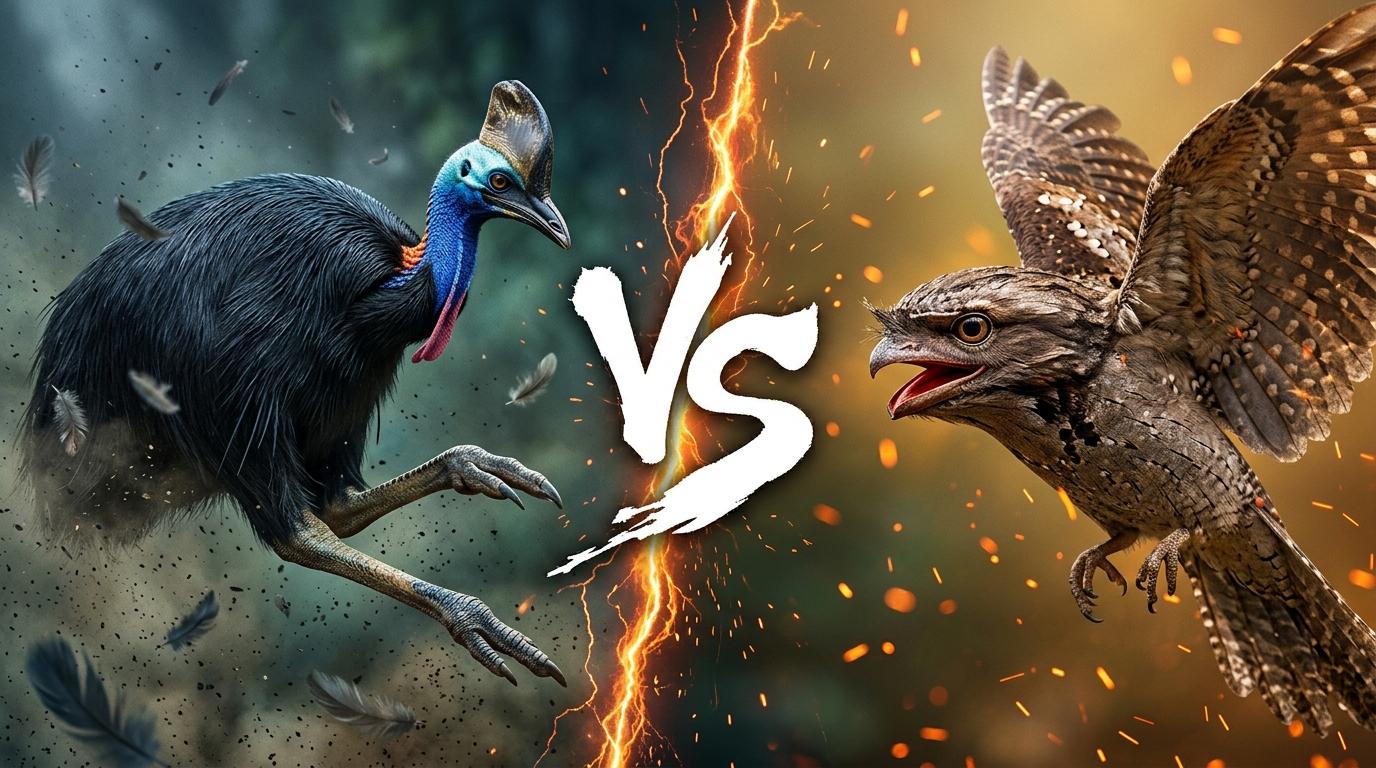
Dwarf Cassowary vs Sri Lanka Frogmouth: Who Actually Wins?
The Dwarf Cassowary wins, and it isn't close. Casuarius bennetti is a flightless rainforest heavyweight of New Guinea. It stands about 1 m tall, weighs roughly 18–26 kg, and carries dagger-like inner toe claws behind a forward kick that can split skin and bruise bone. The Sri Lanka Frogmouth is a small nocturnal bird of about 23 cm and well under 100 g. It is built for stillness, camouflage and snapping up insects, not for combat. It has no talons for grappling, no hooked killing beak and no mass to absorb a strike. The frogmouth's real weapon is never being noticed, and its real escape is a short, silent flight. In any frame where the two actually make contact, the cassowary's mass and kick end the exchange immediately.
Read comparison
Discussion
What do you think?
Share your reasoning with other readers. Be civil and stick to the animals.
Sign in to join the discussion.
Sign inNo comments yet. Start the conversation.