#0142 · Generation I
What Animal Is Aerodactyl Based On?
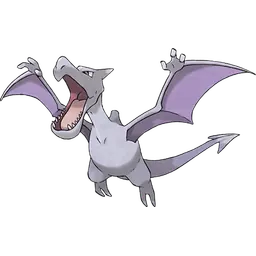
Aerodactyl is mostly a fantasy design, but its closest real animal is the Large Flying Fox.
Closest animal
Large Flying FoxConfidence
Broad or mixed-animal match
How Aerodactyl compares to the real Large Flying Fox
Aerodactyl's official category is the Fossil Pokémon. AnimalDex rates its resemblance to the Large Flying Fox as a broad match, meaning the animal is one influence in a largely fantasy design. Aerodactyl is a pterosaur, an extinct flying reptile with leathery wings and fangs. Among living animals, the large flying fox, with its wide membranous wings and toothy face, is the nearest comparison.
The comparison covers looks and behavior cues, not biology: Aerodactyl is a fictional Pokémon, while the Large Flying Fox (Pteropus vampyrus) is a real mammal. On AnimalDex the real Large Flying Fox scores 26 for dominance, 53 for speed, 18 for size and 48 for intelligence, out of 100, so its strongest trait is speed.
Official category: Fossil Pokemon. This page is an AnimalDex comparison for real-animal resemblance, not an official design-origin claim.
Meet the real Large Flying Fox
Pteropus vampyrus
One of the largest bats in the world, with wings spanning up to about 1.5 metres and a body weighing around a kilogram. It eats only fruit, nectar and flowers, and finds them by sight and smell, since it has no echolocation.
How to recognize it
- Fox-like face with a long muzzle and pointed ears
- No tail at all
- Shoulder mantle paler than the back, often orange or reddish-brown
Real Large Flying Fox facts
- Linnaeus named it vampyrus in 1758, yet it has never been known to take blood.
- Satellite-tagged animals from Peninsular Malaysia flew to roosts in Thailand and Sumatra, so a single population is shared between several countries.
- Diet
- Figs, mango, rambutan and langsat are among the fruit taken, with nectar and blossom from durian and coconut. Fruit is crushed against the roof of the mouth; the juice is swallowed and the fibre spat out as a flattened pellet.
- Lifespan
- About 15 years is the usual estimate for the wild; captive animals are reported to have lived past 20.
- Predators and threats
- People are the chief threat: it is hunted for meat, shot or netted as an orchard pest, and its roost forest is being cleared. Pythons and large birds of prey are thought to take some at roosts. Disturbed colonies take flight together and circle before resettling.
| Dominance | Speed | Size | Intelligence |
|---|---|---|---|
| 26/100 | 53/100 | 18/100 | 48/100 |
Aerodactyl animal FAQ
- What animal is Aerodactyl based on?
- Aerodactyl is mostly a fantasy design, but its closest real animal is the Large Flying Fox. Aerodactyl is a pterosaur, an extinct flying reptile with leathery wings and fangs. Among living animals, the large flying fox, with its wide membranous wings and toothy face, is the nearest comparison.
- Is Aerodactyl a real animal?
- No. Aerodactyl is a fictional Pokémon. Its closest real counterpart is the Large Flying Fox (Pteropus vampyrus), which AnimalDex covers with real field-guide facts.
- What is the real Large Flying Fox like?
- One of the largest bats in the world, with wings spanning up to about 1.5 metres and a body weighing around a kilogram. It eats only fruit, nectar and flowers, and finds them by sight and smell, since it has no echolocation.
- Which other Pokémon are based on the Large Flying Fox?
- AnimalDex also pairs Lunala with the Large Flying Fox.