#0015 · Generation I
What Animal Is Beedrill Based On?
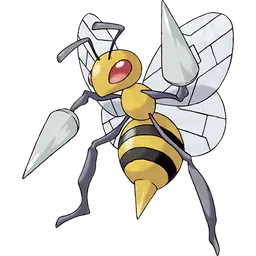
Beedrill most closely resembles the German Yellowjacket.
Closest animal
German YellowjacketConfidence
Reasonable animal match
How Beedrill compares to the real German Yellowjacket
Beedrill's official category is the Poison Bee Pokémon. AnimalDex rates its resemblance to the German Yellowjacket as a reasonable match, meaning the animal is clear but the design mixes in other traits. Beedrill's yellow-and-black striped body, slim waist and repeated stinging point most closely to a wasp, even though its name and category say bee. Its drill-like forearm stingers are fantasy additions.
The comparison covers looks and behavior cues, not biology: Beedrill is a fictional Pokémon, while the German Yellowjacket (Vespula germanica) is a real invertebrate. On AnimalDex the real German Yellowjacket scores 22 for dominance, 26 for speed, 4 for size and 19 for intelligence, out of 100, so its strongest trait is speed. AnimalDex also links Beedrill to the Western Honey Bee, covered below.
Official category: Poison Bee Pokemon. This page is an AnimalDex comparison for real-animal resemblance, not an official design-origin claim.
Meet the real German Yellowjacket
Vespula germanica
European wasp carries Collective Defense through colonies, paper architecture, and quick response to disturbance, succeeding by making many small workers act like one dangerous body.
How to recognize it
- Black-and-yellow warning pattern
- Paper nest colony life
- Fast defensive flight
Real German Yellowjacket facts
- Workers build papery nests from chewed wood fibers.
- Colonies grow through the warm season and can become highly defensive near nests.
- Diet
- They eat nectar, fruit, carrion, human scraps, and insects gathered for larvae. The diet supports flexible colony growth because workers can switch between hunting and scavenging.
- Lifespan
- Individual workers usually live weeks, while queens can survive through winter to start new colonies. The colony itself is mostly seasonal in temperate climates.
- Predators and threats
- Birds, mammals, spiders, parasitoids, weather, and humans can threaten nests or individuals. Group defense and hidden paper nests reduce the risk of losing the whole colony.
| Dominance | Speed | Size | Intelligence |
|---|---|---|---|
| 22/100 | 26/100 | 4/100 | 19/100 |
Meet the real Western Honey Bee
Apis mellifera
A honey bee that finds good forage comes home and dances its bearing and distance to the others. Nothing else in the hive has seen the flowers, and they go anyway — the colony's real advantage is that a discovery does not stay with the finder.
How to recognize it
- Golden-brown, banded abdomen with a densely furred thorax
- Pollen baskets on the hind legs, often loaded and bright
- Barbed sting that stays in the wound, unlike a wasp's
Real Western Honey Bee facts
- The waggle dance encodes direction as an angle from the sun and distance as the length of the waggle run, and other bees read it in complete darkness by touch and vibration.
- A colony holds 20,000 to 60,000 bees in summer and overwinters as a cluster that shivers to keep its centre near 34 degrees Celsius.
- Diet
- Nectar, converted to honey and stored, and pollen for protein. Foraging is directed by returning dancers rather than by independent search, so the colony concentrates on whatever is best right now and shifts as that changes.
- Lifespan
- Summer workers live around six weeks; winter workers several months; a queen three to five years, sometimes longer.
- Predators and threats
- Wasps and hornets, badgers and bears at the nest, and birds taking foragers in flight. Guard bees screen the entrance by scent, and the colony can ball an intruding wasp and overheat it.
| Dominance | Speed | Size | Intelligence |
|---|---|---|---|
| 12/100 | 30/100 | 2/100 | 20/100 |
Beedrill animal FAQ
- What animal is Beedrill based on?
- Beedrill most closely resembles the German Yellowjacket. Beedrill's yellow-and-black striped body, slim waist and repeated stinging point most closely to a wasp, even though its name and category say bee. Its drill-like forearm stingers are fantasy additions.
- Is Beedrill a real animal?
- No. Beedrill is a fictional Pokémon. Its closest real counterpart is the German Yellowjacket (Vespula germanica), which AnimalDex covers with real field-guide facts.
- What is the real German Yellowjacket like?
- European wasp carries Collective Defense through colonies, paper architecture, and quick response to disturbance, succeeding by making many small workers act like one dangerous body.
- Which other Pokémon are based on the German Yellowjacket?
- AnimalDex also pairs Weedle and Kakuna with the German Yellowjacket.