#0091 · Generation I
What Animal Is Cloyster Based On?
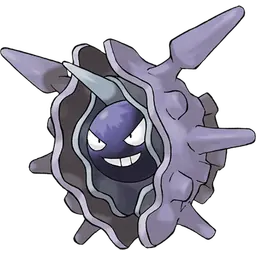
Cloyster most closely resembles the Thorny Oyster.
Closest animal
Thorny OysterConfidence
Reasonable animal match
How Cloyster compares to the real Thorny Oyster
Cloyster's official category is the Bivalve Pokémon. AnimalDex rates its resemblance to the Thorny Oyster as a reasonable match, meaning the animal is clear but the design mixes in other traits. Cloyster's heavily armoured shell bristles with long spikes, matching the thorny oyster, whose shell is covered in protective spines. Underneath the spikes it is still a two-shelled bivalve.
The comparison covers looks and behavior cues, not biology: Cloyster is a fictional Pokémon, while the Thorny Oyster (Spondylidae) is a real animal. On AnimalDex the real Thorny Oyster scores 5 for dominance, 1 for speed, 9 for size and 2 for intelligence, out of 100, so its strongest trait is size. AnimalDex also links Cloyster to the Giant Clam, covered below.
Official category: Bivalve Pokemon. This page is an AnimalDex comparison for real-animal resemblance, not an official design-origin claim.
Meet the real Thorny Oyster
Spondylidae
Thorny oysters, a family of bivalves nearly all in the genus Spondylus, fix one valve to rock or reef and grow long spines or frills from the upper valve. Many species have bright red, orange, purple or yellow shells, colours that often show only once the encrusting sponges and algae are scraped away.
How to recognize it
- Ball-and-socket hinge with two interlocking teeth in each valve
- Unequal valves, the lower one usually deeper than the upper
- Inner shell surface white, usually with a coloured margin
Real Thorny Oyster facts
- Despite the name they are not true oysters; they are more closely related to scallops.
- Roughly 70 living species are usually recognised, most of them in warm seas.
- Diet
- Filter feeders: they draw water across the gills, trap phytoplankton and fine organic particles in mucus, and move them to the mouth with beating cilia.
- Lifespan
- Lifespan has not been measured for most thorny oysters, so no reliable range can be given for the family.
- Predators and threats
- Fish, crabs, snails, sea stars, and humans threaten it.
| Dominance | Speed | Size | Intelligence |
|---|---|---|---|
| 5/100 | 1/100 | 9/100 | 2/100 |
Meet the real Giant Clam
Tridacna gigas
The giant clam (Tridacna gigas) is the largest living bivalve mollusc, a reef clam of the shallow Indo-Pacific whose shell can exceed 1.2 m across and whose body can weigh more than 200 kg. It lives with its hinge down and its shell open to the sun, feeding largely on sugars made by microscopic algae farmed inside its mantle.
How to recognize it
- Massive, heavy shell with four or five deep, curved folds and a wavy, interlocking edge where the two valves meet.
- A thick fleshy mantle spills over the open shell, mottled in brown, green, blue or gold with iridescent spots.
- Two siphons show in the mantle: a large inhalant opening and a smaller exhalant tube.
Real Giant Clam facts
- Reflective cells called iridocytes in the mantle scatter sunlight deeper into the tissue, spreading the light evenly across the algae.
- A single large giant clam can release hundreds of millions of eggs in one spawning.
Cloyster animal FAQ
- What animal is Cloyster based on?
- Cloyster most closely resembles the Thorny Oyster. Cloyster's heavily armoured shell bristles with long spikes, matching the thorny oyster, whose shell is covered in protective spines. Underneath the spikes it is still a two-shelled bivalve.
- Is Cloyster a real animal?
- No. Cloyster is a fictional Pokémon. Its closest real counterpart is the Thorny Oyster (Spondylidae), which AnimalDex covers with real field-guide facts.
- What is the real Thorny Oyster like?
- Thorny oysters, a family of bivalves nearly all in the genus Spondylus, fix one valve to rock or reef and grow long spines or frills from the upper valve. Many species have bright red, orange, purple or yellow shells, colours that often show only once the encrusting sponges and algae are scraped away.