#0488 · Generation IV
What Animal Is Cresselia Based On?
Cresselia is mostly a fantasy design, but its closest real animal is the Whooper Swan.
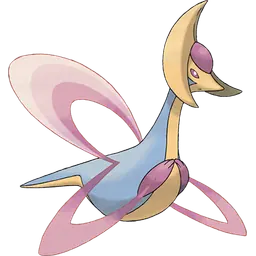
Closest animal
Whooper SwanConfidence
Broad or mixed-animal match
How Cresselia compares to the real Whooper Swan
Cresselia's official category is the Lunar Pokémon. AnimalDex rates its resemblance to the Whooper Swan as a broad match, meaning the animal is one influence in a largely fantasy design. Cresselia is a lunar Pokemon with a crescent-moon body and long neck, mostly a mythic design. Its graceful swan-like neck, wing ribbons and white-and-pink colours are closest to a swan.
The comparison covers looks and behavior cues, not biology: Cresselia is a fictional Pokémon, while the Whooper Swan (Cygnus cygnus) is a real bird. On AnimalDex the real Whooper Swan scores 55 for dominance, 55 for speed, 48 for size and 42 for intelligence, out of 100, so its strongest trait is dominance. AnimalDex also links Cresselia to the Mute Swan, covered below.
Official category: Lunar Pokemon. This page is an AnimalDex comparison for real-animal resemblance, not an official design-origin claim.
Meet the real Whooper Swan
Cygnus cygnus
Among the heaviest flying birds in Europe, yet a long-distance migrant. Birds from Iceland cross several hundred kilometres of open North Atlantic to winter in Britain and Ireland, a flight thought to be made without stopping.
How to recognize it
- Yellow on the bill forming a wedge that reaches past the nostrils
- Long, straight neck usually held stiffly upright
- Long, flat forehead profile without a knob
Real Whooper Swan facts
- Its dangers include foxes, eagles, mink, gulls for young, and humans.
- The whooper swan is the national bird of Finland.
- Diet
- Whooper Swan feeds on aquatic plants, roots, grasses, grains, and some small invertebrates.
- Lifespan
- Most wild birds probably live around 10 years; ringed individuals have been recorded at more than 20 years.
- Predators and threats
- Adults have few natural enemies, and most losses are of eggs and small cygnets. Parents defend eggs and cygnets fiercely, hissing and charging with raised wings. Collisions with power lines and lead poisoning from swallowed shot kill many birds.
| Dominance | Speed | Size | Intelligence |
|---|---|---|---|
| 55/100 | 55/100 | 48/100 | 42/100 |
Meet the real Mute Swan
Cygnus olor
One of the heaviest flying birds, with adult males commonly around 10 to 12 kg. Despite the name it is not silent: it hisses, snorts and grunts, and its wings make a loud, rhythmic throbbing in flight.
How to recognize it
- Orange-red bill with a black base and knob
- Neck held in a gentle S-curve, bill angled down
- Wings often raised in an arch over the back while swimming
Real Mute Swan facts
- In England, unmarked mute swans on open water have long been claimed by the Crown, and an annual Swan Upping census still counts birds on parts of the Thames.
- It feeds by dipping its long neck or up-ending, reaching plants up to about a metre below the surface.
- Diet
- Aquatic plants, submerged vegetation, grasses, and grains.
- Lifespan
- They can live many years, sometimes decades, making pair bonds and territory long-term.
- Predators and threats
- Foxes, mink, large birds, dogs, and humans threaten eggs or young; adults defend strongly. Grace is soft until the boundary is crossed.
| Dominance | Speed | Size | Intelligence |
|---|---|---|---|
| 54/100 | 56/100 | 46/100 | 38/100 |
Cresselia animal FAQ
- What animal is Cresselia based on?
- Cresselia is mostly a fantasy design, but its closest real animal is the Whooper Swan. Cresselia is a lunar Pokemon with a crescent-moon body and long neck, mostly a mythic design. Its graceful swan-like neck, wing ribbons and white-and-pink colours are closest to a swan.
- Is Cresselia a real animal?
- No. Cresselia is a fictional Pokémon. Its closest real counterpart is the Whooper Swan (Cygnus cygnus), which AnimalDex covers with real field-guide facts.
- What is the real Whooper Swan like?
- Among the heaviest flying birds in Europe, yet a long-distance migrant. Birds from Iceland cross several hundred kilometres of open North Atlantic to winter in Britain and Ireland, a flight thought to be made without stopping.