#0330 · Generation III
What Animal Is Flygon Based On?
Flygon most closely resembles the Pit-trapping Antlion.
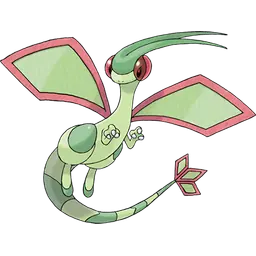
Closest animal
Pit-trapping AntlionConfidence
Reasonable animal match
How Flygon compares to the real Pit-trapping Antlion
Flygon's official category is the Mystic Pokémon. AnimalDex rates its resemblance to the Pit-trapping Antlion as a reasonable match, meaning the animal is clear but the design mixes in other traits. Flygon combines the adult antlion's dragonfly-like wings with a dragon body. Its antlion base remains the closest real animal, with dragonflies a secondary cue for its wings and eye covers.
The comparison covers looks and behavior cues, not biology: Flygon is a fictional Pokémon, while the Pit-trapping Antlion (Myrmeleon immaculatus) is a real animal. On AnimalDex the real Pit-trapping Antlion scores 10 for dominance, 14 for speed, 4 for size and 9 for intelligence, out of 100, so its strongest trait is speed. AnimalDex also links Flygon to the Common Green Darner, covered below.
Official category: Mystic Pokemon. This page is an AnimalDex comparison for real-animal resemblance, not an official design-origin claim.
Meet the real Pit-trapping Antlion
Myrmeleon immaculatus
Known mainly from its larva, a relative of the lacewings that hunts from a hole of its own making. Shuffling backwards in a tightening spiral, it flicks sand out with its head until a steep-sided cone is left, then buries itself at the bottom. When prey struggles on the slope it throws more sand to bring it down.
How to recognize it
- Larva is oval, grey-brown and bristly, with long sickle-shaped jaws.
- Larvae walk only backwards.
- Adult resembles a slender grey damselfly with short, clubbed antennae.
Real Pit-trapping Antlion facts
- The winding furrows a larva leaves in dust while looking for a pit site earned it the American name doodlebug.
- The larva has no open mouth; it sucks the body fluids of prey through channels in its hollow jaws.
- Diet
- Ants and other small crawling insects. The larva digs a cone-shaped pit in dry sand and waits buried at the bottom; prey slipping on the loose walls tumbles into its jaws and is sucked dry.
- Lifespan
- The larval stage usually lasts one to three years, longer where little food reaches the pit. The pupa takes about a month, and the winged adult lives only a few weeks.
- Predators and threats
- Birds, lizards, spiders, parasitic wasps, and disturbance threaten antlions. Buried stillness keeps the hunter hidden.
| Dominance | Speed | Size | Intelligence |
|---|---|---|---|
| 10/100 | 14/100 | 4/100 | 9/100 |
Meet the real Common Green Darner
Anax junius
Common Green Darner turns Migrating Precision into a line of flight, linking aquatic beginnings, aerial hunting, and seasonal movement across changing landscapes.
How to recognize it
- Strong flight allows long movement and sharp aerial hunting
- Green body and blue tones make adults easy to recognize
- Aquatic nymph stage prepares the later flying hunter
Real Common Green Darner facts
- Common Green Darners are among the familiar large North American dragonflies
- Their young live underwater before the adult flight stage
- Diet
- Mosquitoes, flies, midges, and other flying insects.
- Lifespan
- Adults usually live a few weeks. The underwater nymph stage lasts from about three months in fast-growing migrant broods to about a year in resident populations.
- Predators and threats
- Birds, fish for nymphs, frogs, spiders, and larger dragonflies threaten them. Speed and line control protect the hunter.
| Dominance | Speed | Size | Intelligence |
|---|---|---|---|
| 17/100 | 42/100 | 6/100 | 15/100 |
Flygon animal FAQ
- What animal is Flygon based on?
- Flygon most closely resembles the Pit-trapping Antlion. Flygon combines the adult antlion's dragonfly-like wings with a dragon body. Its antlion base remains the closest real animal, with dragonflies a secondary cue for its wings and eye covers.
- Is Flygon a real animal?
- No. Flygon is a fictional Pokémon. Its closest real counterpart is the Pit-trapping Antlion (Myrmeleon immaculatus), which AnimalDex covers with real field-guide facts.
- What is the real Pit-trapping Antlion like?
- Known mainly from its larva, a relative of the lacewings that hunts from a hole of its own making. Shuffling backwards in a tightening spiral, it flicks sand out with its head until a steep-sided cone is left, then buries itself at the bottom. When prey struggles on the slope it throws more sand to bring it down.
- Which other Pokémon are based on the Pit-trapping Antlion?
- AnimalDex also pairs Trapinch and Vibrava with the Pit-trapping Antlion.
More Pit-trapping Antlion comparisons in Generation III
| No. | Pokemon | Closest animal | Basis |
|---|---|---|---|
| #0328 |  Trapinch | strong | |
| #0329 |  Vibrava | medium |