#0094 · Generation I
What Animal Is Gengar Based On?
Gengar is mostly a fantasy design, but its closest real animal is the Egyptian Fruit Bat.
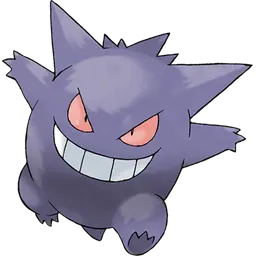
Gengar is a Ghost-type Pokémon and is usually described as having no single real-animal counterpart. Its official category, the Shadow Pokémon, refers to its ghostly nature rather than to an animal.
When people do compare it to animals, the usual suggestions are a cat, for its pointed ears and wide grin, which many link to the Cheshire Cat, and a bat, for its spiky silhouette and habit of lurking in the dark. Its round body and stubby limbs also recall an imp or a goblin from folklore more than any living species.
A popular theory points out that Gengar looks like a shadow of Clefairy, with a similar body shape and ears, which fits its story of hiding in people's shadows.
The fairest answer is that Gengar is a ghost or shadow creature built from cat-like and imp-like cues. No real animal is a close match, so AnimalDex pairs it loosely with the Egyptian fruit bat below, the bat it also pairs with Clefairy, and with the aye-aye, a wide-eyed nocturnal primate long feared in folklore.
Closest animal
Egyptian Fruit BatConfidence
Broad or mixed-animal match
How Gengar compares to the real Egyptian Fruit Bat
Gengar's official category is the Shadow Pokémon. AnimalDex rates its resemblance to the Egyptian Fruit Bat as a broad match, meaning the animal is one influence in a largely fantasy design. Gengar is a shadow ghost, not an animal, and is often read as the shadow of Clefairy. Its spiky bat-like silhouette and habit of lurking in the dark make a bat, the same fruit bat paired with Clefairy, the nearest real comparison.
The comparison covers looks and behavior cues, not biology: Gengar is a fictional Pokémon, while the Egyptian Fruit Bat (Rousettus aegyptiacus) is a real mammal. On AnimalDex the real Egyptian Fruit Bat scores 22 for dominance, 55 for speed, 10 for size and 48 for intelligence, out of 100, so its strongest trait is speed. AnimalDex also links Gengar to the Aye-aye, covered below.
Official category: Shadow Pokemon. This page is an AnimalDex comparison for real-animal resemblance, not an official design-origin claim.
Meet the real Egyptian Fruit Bat
Rousettus aegyptiacus
After dusk this fruit bat flies out to particular fruit trees. In tracking studies in Israel, bats commuted up to about 20 kilometres, took direct routes and returned to known trees, evidence that they navigate with a memorised map of the landscape.
How to recognize it
- Dog-like face with large dark eyes
- Soft brown to grey-brown fur, paler below
- Wingspan of roughly 60 centimetres
Real Egyptian Fruit Bat facts
- Unlike insect-eating bats, it makes its sonar clicks with its tongue rather than its larynx.
- Experiments suggest pups learn their calls from the colony around them, a rare case of vocal learning in mammals.
- Diet
- Mainly soft fruit such as figs, plus nectar, pollen and at times leaves. It chews fruit to extract the juice and spits out pellets of pulp and fibre.
- Lifespan
- Captive bats have lived more than 20 years; wild lifespans are shorter and less well documented.
- Predators and threats
- Owls, birds of prey, snakes and cats take bats at roosts and exits. Roosting deep in dark caves keeps them out of reach of most predators. People also fumigate or destroy cave colonies to protect orchards.
| Dominance | Speed | Size | Intelligence |
|---|---|---|---|
| 22/100 | 55/100 | 10/100 | 48/100 |
Meet the real Aye-aye
Daubentonia madagascariensis
The largest nocturnal primate, a dark, shaggy lemur found only in Madagascar, with front teeth that grow throughout life like a rodent's. It taps along a branch with a thin middle finger, up to about eight times a second, gnaws into the hollow it detects and hooks out the larva inside.
How to recognize it
- Coarse dark coat tipped with white guard hairs
- Large, bare, leathery ears
- Bushy tail longer than the head and body
- Diet
- Wood-boring larvae, fruit, seeds, nectar, and fungi.
- Lifespan
- They can live many years, giving the strange finger, learned routes, and night-foraging skill time to become mastery.
- Predators and threats
- Fossas, raptors, snakes, humans, superstition, and forest loss threaten Aye-ayes, making night secrecy and odd tools important.
| Dominance | Speed | Size | Intelligence |
|---|---|---|---|
| 42/100 | 41/100 | 26/100 | 52/100 |
Gengar animal FAQ
- What animal is Gengar based on?
- Gengar is mostly a fantasy design, but its closest real animal is the Egyptian Fruit Bat. Gengar is a Ghost-type Pokémon and is usually described as having no single real-animal counterpart. Its official category, the Shadow Pokémon, refers to its ghostly nature rather than to an animal.
- Is Gengar a real animal?
- No. Gengar is a fictional Pokémon. Its closest real counterpart is the Egyptian Fruit Bat (Rousettus aegyptiacus), which AnimalDex covers with real field-guide facts.
- What is the real Egyptian Fruit Bat like?
- After dusk this fruit bat flies out to particular fruit trees. In tracking studies in Israel, bats commuted up to about 20 kilometres, took direct routes and returned to known trees, evidence that they navigate with a memorised map of the landscape.
- Which other Pokémon are based on the Egyptian Fruit Bat?
- AnimalDex also pairs Clefairy, Clefable, Noibat and Noivern with the Egyptian Fruit Bat.
More Egyptian Fruit Bat comparisons in Generation I
| No. | Pokemon | Closest animal | Basis |
|---|---|---|---|
| #0035 |  Clefairy | broad | |
| #0036 |  Clefable | broad |