#0983 · Generation IX
What Animal Is Kingambit Based On?
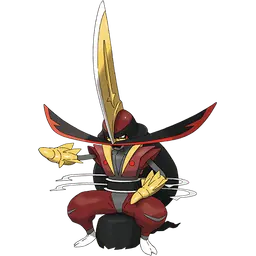
Kingambit is mostly a fantasy design, but its closest real animal is the Asiatic Rhinoceros Beetle.
Closest animal
Asiatic Rhinoceros BeetleConfidence
Broad or mixed-animal match
How Kingambit compares to the real Asiatic Rhinoceros Beetle
Kingambit's official category is the Big Blade Pokémon. AnimalDex rates its resemblance to the Asiatic Rhinoceros Beetle as a broad match, meaning the animal is one influence in a largely fantasy design. Kingambit is a humanoid blade warrior with a crown-like helmet, not a real animal. Like Bisharp, its armour and horned blade crest are loosely like a rhinoceros beetle, which makes it the nearest real comparison.
The comparison covers looks and behavior cues, not biology: Kingambit is a fictional Pokémon, while the Asiatic Rhinoceros Beetle (Oryctes rhinoceros) is a real invertebrate. On AnimalDex the real Asiatic Rhinoceros Beetle scores 20 for dominance, 15 for speed, 8 for size and 15 for intelligence, out of 100, so its strongest trait is dominance.
Official category: Big Blade Pokemon. This page is an AnimalDex comparison for real-animal resemblance, not an official design-origin claim.
Meet the real Asiatic Rhinoceros Beetle
Oryctes rhinoceros
A heavy, horned scarab beetle, 3 to 5 centimetres long. Adults bore head first into the crown of a living palm, forcing a tunnel through the tightly packed leaf bases to reach the soft, unopened spear at the centre. A beetle may stay in its tunnel for several days before flying on.
How to recognize it
- Glossy black-brown above, reddish-brown and hairy beneath
- Single horn curving backwards from the head
- Two small bumps on the ridge behind a hollow in the thorax
Real Asiatic Rhinoceros Beetle facts
- It reached Samoa in 1909, reportedly in a shipment of rubber seedlings from Sri Lanka, and spread from there to other islands.
- Males release a scent that draws both sexes to a breeding site, and a synthetic copy is used to bait traps.
- Diet
- Adults chew the soft tissue of unopened fronds for its sap and leave the fibre unswallowed. Coconut and oil palm are attacked most, with date, betel-nut and ornamental palms also taken. Grubs eat rotting wood, compost, sawdust and dung.
- Lifespan
- Adults are reported to live for several months, in some records up to about nine. Counting the months spent as a grub, the whole life usually lasts about a year.
- Predators and threats
- Pigs, rats and domestic fowl dig grubs out of the breeding sites, ants take eggs and small grubs, and scoliid wasps lay their eggs on larger ones. Adults are protected mainly by their thick armour.
| Dominance | Speed | Size | Intelligence |
|---|---|---|---|
| 20/100 | 15/100 | 8/100 | 15/100 |
Kingambit animal FAQ
- What animal is Kingambit based on?
- Kingambit is mostly a fantasy design, but its closest real animal is the Asiatic Rhinoceros Beetle. Kingambit is a humanoid blade warrior with a crown-like helmet, not a real animal. Like Bisharp, its armour and horned blade crest are loosely like a rhinoceros beetle, which makes it the nearest real comparison.
- Is Kingambit a real animal?
- No. Kingambit is a fictional Pokémon. Its closest real counterpart is the Asiatic Rhinoceros Beetle (Oryctes rhinoceros), which AnimalDex covers with real field-guide facts.
- What is the real Asiatic Rhinoceros Beetle like?
- A heavy, horned scarab beetle, 3 to 5 centimetres long. Adults bore head first into the crown of a living palm, forcing a tunnel through the tightly packed leaf bases to reach the soft, unopened spear at the centre. A beetle may stay in its tunnel for several days before flying on.
- Which other Pokémon are based on the Asiatic Rhinoceros Beetle?
- AnimalDex also pairs Heracross, Pawniard and Bisharp with the Asiatic Rhinoceros Beetle.