#0299 · Generation III
What Animal Is Nosepass Based On?
Nosepass is mostly a fantasy design, but its closest real animal is the European Robin.
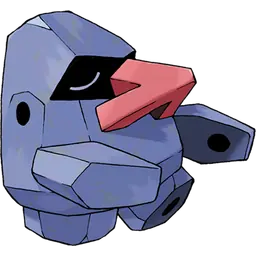
Closest animal
European RobinConfidence
Broad or mixed-animal match
How Nosepass compares to the real European Robin
Nosepass's official category is the Compass Pokémon. AnimalDex rates its resemblance to the European Robin as a broad match, meaning the animal is one influence in a largely fantasy design. Nosepass is a stone statue with a magnetic nose that always faces north. The European robin is the nearest comparison, as it uses Earth's magnetic field to navigate.
The comparison covers looks and behavior cues, not biology: Nosepass is a fictional Pokémon, while the European Robin (Erithacus rubecula) is a real bird. On AnimalDex the real European Robin scores 23 for dominance, 45 for speed, 6 for size and 42 for intelligence, out of 100, so its strongest trait is speed.
Official category: Compass Pokemon. This page is an AnimalDex comparison for real-animal resemblance, not an official design-origin claim.
Meet the real European Robin
Erithacus rubecula
European Robin teaches Territory through a small bird that makes itself impossible to ignore. Its red breast, upright posture, and repeated song turn gardens, hedgerows, and woodland edges into claimed space, showing that presence is built by returning to the same patch with a clear voice.
How to recognize it
- Red-breast signal: the robin carries a visible territorial marker on a small body.
- Song defense: both males and females can use voice to hold feeding or nesting space.
- Edge confidence: it thrives where gardens, hedges, lawns, and woods meet.
- Diet
- Insects, worms, spiders, berries, and seeds make the territory practical. The robin defends space because food access, winter survival, and nesting opportunity are all tied to the patch it knows.
- Lifespan
- Most wild robins live only about 1 to 2 years, as cold winters and predators kill many young birds; a few ringed birds have been recorded living beyond 8 years.
- Predators and threats
- Cats, sparrowhawks, owls, corvids, snakes, and nest predators make the robin’s clear signal useful. A small bird cannot overpower every threat, so it uses visibility, song, and quick retreat to reduce danger early.
| Dominance | Speed | Size | Intelligence |
|---|---|---|---|
| 23/100 | 45/100 | 6/100 | 42/100 |
Nosepass animal FAQ
- What animal is Nosepass based on?
- Nosepass is mostly a fantasy design, but its closest real animal is the European Robin. Nosepass is a stone statue with a magnetic nose that always faces north. The European robin is the nearest comparison, as it uses Earth's magnetic field to navigate.
- Is Nosepass a real animal?
- No. Nosepass is a fictional Pokémon. Its closest real counterpart is the European Robin (Erithacus rubecula), which AnimalDex covers with real field-guide facts.
- What is the real European Robin like?
- European Robin teaches Territory through a small bird that makes itself impossible to ignore. Its red breast, upright posture, and repeated song turn gardens, hedgerows, and woodland edges into claimed space, showing that presence is built by returning to the same patch with a clear voice.
- Which other Pokémon are based on the European Robin?
- AnimalDex also pairs Fletchling with the European Robin.