#0770 · Generation VII
What Animal Is Palossand Based On?
Palossand is mostly a fantasy design, but its closest real animal is the Magnetic Termite.
Closest animal
Magnetic TermiteConfidence
Broad or mixed-animal match
How Palossand compares to the real Magnetic Termite
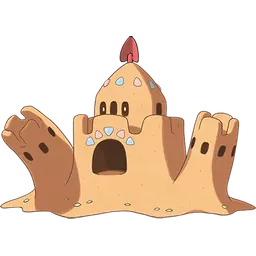
Palossand's official category is the Sand Castle Pokémon. AnimalDex rates its resemblance to the Magnetic Termite as a broad match, meaning the animal is one influence in a largely fantasy design. Palossand is a haunted sandcastle, mostly an object design; magnetic termite mounds are the closest real animal-made structure to a towering castle of sand. It drags victims into its sand, a ghostly idea rather than any real behaviour.
The comparison covers looks and behavior cues, not biology: Palossand is a fictional Pokémon, while the Magnetic Termite (Amitermes meridionalis) is a real animal. On AnimalDex the real Magnetic Termite scores 8 for dominance, 10 for speed, 1 for size and 9 for intelligence, out of 100, so its strongest trait is speed.
Official category: Sand Castle Pokemon. This page is an AnimalDex comparison for real-animal resemblance, not an official design-origin claim.
Meet the real Magnetic Termite
Amitermes meridionalis
Colonies of this northern Australian termite build flat, slab-shaped mounds up to about 4 metres tall, with the thin edges pointing north and south and the broad faces turned east and west. The broad sides catch the gentler morning and afternoon sun, while at midday only the narrow top edge faces it, so the mound heats less.
How to recognize it
- Mounds often stand in large groups across open floodplain
- Hard grey mound walls of cemented soil
- Mound thin and blade-like end-on, broad side-on
Real Magnetic Termite facts
- Experiments in which magnets were placed near mounds under repair suggest the termites can sense the Earth's magnetic field while building.
- It is known only from the Top End of the Northern Territory, around Darwin, including Litchfield National Park, where a boardwalk runs among the mounds.
- Diet
- Grass is the staple, mostly dry and dead blades and stems, with some other plant debris. Workers collect it close to the mound, and microbes in their gut help break down the tough plant fibre.
- Lifespan
- Figures for this species are not documented. Colony and queen longevity have not been measured for it; in many mound-building termites colonies persist for years.
- Predators and threats
- Ants raid colonies, and echidnas break into mounds to feed. Birds, lizards and frogs pick off the winged reproductives when they leave the mound. Workers quickly seal any breach with fresh mud while soldiers guard the opening.
| Dominance | Speed | Size | Intelligence |
|---|---|---|---|
| 8/100 | 10/100 | 1/100 | 9/100 |
Palossand animal FAQ
- What animal is Palossand based on?
- Palossand is mostly a fantasy design, but its closest real animal is the Magnetic Termite. Palossand is a haunted sandcastle, mostly an object design; magnetic termite mounds are the closest real animal-made structure to a towering castle of sand. It drags victims into its sand, a ghostly idea rather than any real behaviour.
- Is Palossand a real animal?
- No. Palossand is a fictional Pokémon. Its closest real counterpart is the Magnetic Termite (Amitermes meridionalis), which AnimalDex covers with real field-guide facts.
- What is the real Magnetic Termite like?
- Colonies of this northern Australian termite build flat, slab-shaped mounds up to about 4 metres tall, with the thin edges pointing north and south and the broad faces turned east and west. The broad sides catch the gentler morning and afternoon sun, while at midday only the narrow top edge faces it, so the mound heats less.
- Which other Pokémon are based on the Magnetic Termite?
- AnimalDex also pairs Magnezone, Probopass and Sandygast with the Magnetic Termite.
More Magnetic Termite comparisons in Generation VII
| No. | Pokemon | Closest animal | Basis |
|---|---|---|---|
| #0769 |  Sandygast | broad |