#0867 · Generation VIII
What Animal Is Runerigus Based On?
Runerigus is mostly a fantasy design, but its closest real animal is the Common Stingray.
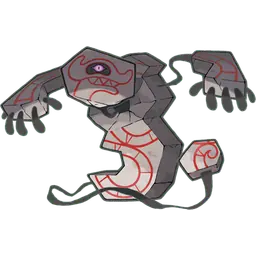
Closest animal
Common StingrayConfidence
Broad or mixed-animal match
How Runerigus compares to the real Common Stingray
Runerigus's official category is the Grudge Pokémon. AnimalDex rates its resemblance to the Common Stingray as a broad match, meaning the animal is one influence in a largely fantasy design. Runerigus is a cursed stone tablet with a shadowy tail, essentially an object design. The common stingray is the nearest animal comparison, with a flat, slab-like body trailing a long tail much as Runerigus drags its shadow.
The comparison covers looks and behavior cues, not biology: Runerigus is a fictional Pokémon, while the Common Stingray (Bathytoshia pastinaca) is a real animal. On AnimalDex the real Common Stingray scores 46 for dominance, 40 for speed, 36 for size and 30 for intelligence, out of 100, so its strongest trait is dominance.
Official category: Grudge Pokemon. This page is an AnimalDex comparison for real-animal resemblance, not an official design-origin claim.
Meet the real Common Stingray
Bathytoshia pastinaca
A large, plain-coloured ray of the eastern Atlantic and Mediterranean, reaching a disc width of about 45 to 60 centimetres. By day it often lies buried in sand with only its eyes and spiracles showing, drawing water in through the spiracles so it can breathe without clogging its gills with sediment.
How to recognize it
- Flat, diamond-shaped disc slightly wider than long
- Plain olive, grey or brown above, whitish below
- Whip-like tail armed with a serrated venomous spine
Real Common Stingray facts
- Its serrated tail spine carries venom, and a sting to a wader's foot is intensely painful; the spine is shed and replaced from time to time.
- Females give birth to live young, nourished in the uterus by a milky secretion; litters are usually of about four to nine pups.
- Diet
- Hunts bottom-living prey: crabs, shrimps and other crustaceans, bivalves and other molluscs, worms and small flatfish and gobies. Prey is found by smell and by electrical senses in the snout, then crushed with flat, plate-like teeth.
- Lifespan
- Lifespan in the wild is poorly known; ages of around ten years or a little more have been estimated from growth studies.
- Predators and threats
- Large sharks take adults, and young rays are eaten by sharks and bigger fish. It relies on staying buried and still; if grabbed or trodden on, it lashes its tail forward to drive in the venomous spine. Bottom trawls and nets also catch many.
| Dominance | Speed | Size | Intelligence |
|---|---|---|---|
| 46/100 | 40/100 | 36/100 | 30/100 |
Runerigus animal FAQ
- What animal is Runerigus based on?
- Runerigus is mostly a fantasy design, but its closest real animal is the Common Stingray. Runerigus is a cursed stone tablet with a shadowy tail, essentially an object design. The common stingray is the nearest animal comparison, with a flat, slab-like body trailing a long tail much as Runerigus drags its shadow.
- Is Runerigus a real animal?
- No. Runerigus is a fictional Pokémon. Its closest real counterpart is the Common Stingray (Bathytoshia pastinaca), which AnimalDex covers with real field-guide facts.
- What is the real Common Stingray like?
- A large, plain-coloured ray of the eastern Atlantic and Mediterranean, reaching a disc width of about 45 to 60 centimetres. By day it often lies buried in sand with only its eyes and spiracles showing, drawing water in through the spiracles so it can breathe without clogging its gills with sediment.