#0048 · Generation I
What Animal Is Venonat Based On?
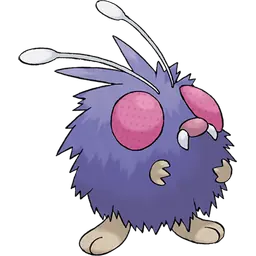
Venonat is mostly a fantasy design, but its closest real animal is the Rosy Maple Moth.
Closest animal
Rosy Maple MothConfidence
Broad or mixed-animal match
How Venonat compares to the real Rosy Maple Moth
Venonat's official category is the Insect Pokémon. AnimalDex rates its resemblance to the Rosy Maple Moth as a broad match, meaning the animal is one influence in a largely fantasy design. Venonat is a fuzzy, round insect with large compound eyes and antennae that evolves into a moth. Its plump hairy body and pink-purple tones make the rosy maple moth the nearest comparison.
The comparison covers looks and behavior cues, not biology: Venonat is a fictional Pokémon, while the Rosy Maple Moth (Dryocampa rubicunda) is a real insect. On AnimalDex the real Rosy Maple Moth scores 12 for dominance, 28 for speed, 3 for size and 15 for intelligence, out of 100, so its strongest trait is speed. AnimalDex also links Venonat to the Atlas Moth, covered below.
Official category: Insect Pokemon. This page is an AnimalDex comparison for real-animal resemblance, not an official design-origin claim.
Meet the real Rosy Maple Moth
Dryocampa rubicunda
Rosy Maple Moth teaches Softness through a pastel body that belongs to the night without becoming harsh. Pink-yellow wings, fuzzy body, feathery antennae, maple association, and quiet flight show that gentleness can still be fully adapted to darkness.
How to recognize it
- Pastel Warning-Beauty: pink and yellow color makes the moth unforgettable without aggression.
- Maple Connection: larvae feed on maple and related trees, tying softness to a specific host world.
- Night Glow: the adult moves in darkness with a body that feels delicate rather than threatening.
- Diet
- Larvae feed on maple leaves and sometimes related trees, while adults of many moths feed little or not at all.
- Lifespan
- Adults live only about one to two weeks. The winter is passed as a pupa in the soil; there is one generation a year in the north and two or three in the south.
- Predators and threats
- Birds, bats, spiders, wasps, ants, and other insect predators create pressure. The moth’s answer is night movement, seasonal timing, and a life cycle that hides vulnerability in stages.
| Dominance | Speed | Size | Intelligence |
|---|---|---|---|
| 12/100 | 28/100 | 3/100 | 15/100 |
Meet the real Atlas Moth
Attacus atlas
The atlas moth is one of the world’s largest moths, known for enormous patterned wings and a short adult life focused mainly on reproduction.
How to recognize it
- Huge rust-brown wings with pale windows and snake-head-like tips
- Heavy fuzzy body compared with most moths
- Usually seen resting rather than actively feeding as an adult
Real Atlas Moth facts
- The species is visually spectacular and biologically useful for teaching life-stage trade-offs.
- Its adult phase is a strong reminder that not every animal stage is built for feeding.
- Diet
- Caterpillars feed on leaves of many trees and shrubs, while adults do not feed.
- Lifespan
- Atlas Moths often live weeks as adults at most, after a longer larval and cocoon stage. The short adult life sharpens the lesson: preparation matters because the final opening is brief.
- Predators and threats
- Birds, bats, lizards, spiders, parasitoids, and habitat loss threaten Atlas Moths. Camouflage, large wing markings, and brief nighttime activity help protect a body built for one short opportunity.
| Dominance | Speed | Size | Intelligence |
|---|---|---|---|
| 9/100 | 32/100 | 14/100 | 11/100 |
Venonat animal FAQ
- What animal is Venonat based on?
- Venonat is mostly a fantasy design, but its closest real animal is the Rosy Maple Moth. Venonat is a fuzzy, round insect with large compound eyes and antennae that evolves into a moth. Its plump hairy body and pink-purple tones make the rosy maple moth the nearest comparison.
- Is Venonat a real animal?
- No. Venonat is a fictional Pokémon. Its closest real counterpart is the Rosy Maple Moth (Dryocampa rubicunda), which AnimalDex covers with real field-guide facts.
- What is the real Rosy Maple Moth like?
- Rosy Maple Moth teaches Softness through a pastel body that belongs to the night without becoming harsh. Pink-yellow wings, fuzzy body, feathery antennae, maple association, and quiet flight show that gentleness can still be fully adapted to darkness.