#0416 · Generation IV
What Animal Is Vespiquen Based On?
Vespiquen most closely resembles the Asian Honey Bee.
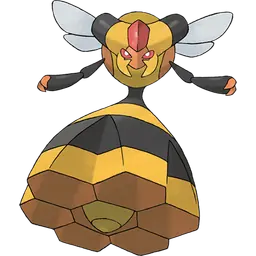
Closest animal
Asian Honey BeeConfidence
Reasonable animal match
How Vespiquen compares to the real Asian Honey Bee
Vespiquen's official category is the Beehive Pokémon. AnimalDex rates its resemblance to the Asian Honey Bee as a reasonable match, meaning the animal is clear but the design mixes in other traits. Vespiquen is the Beehive Pokemon, a queen whose abdomen doubles as a hive for her Combee workers. The design is a fantasy hive-queen, but the colony structure comes straight from honey bees.
The comparison covers looks and behavior cues, not biology: Vespiquen is a fictional Pokémon, while the Asian Honey Bee (Apis cerana) is a real invertebrate. On AnimalDex the real Asian Honey Bee scores 9 for dominance, 30 for speed, 2 for size and 19 for intelligence, out of 100, so its strongest trait is speed.
Official category: Beehive Pokemon. This page is an AnimalDex comparison for real-animal resemblance, not an official design-origin claim.
Meet the real Asian Honey Bee
Apis cerana
A honey bee native to southern and eastern Asia, a little smaller than the western honey bee kept by most beekeepers. In Japan, when a giant hornet enters the nest, several hundred workers engulf it in a tight ball and shiver their flight muscles, heating it to around 46 degrees Celsius, a temperature the hornet cannot survive but the bees can.
How to recognize it
- Workers about 10 to 11 millimetres long
- Abdomen evenly banded, dark with pale stripes
- Fanning workers stand at the entrance with heads pointing outwards
Real Asian Honey Bee facts
- When a hornet hovers at the entrance, the guard bees shake their abdomens in unison, a signal that the hunter has been seen.
- It is the original host of the Varroa mite; workers groom the mites off one another and remove infested brood, so colonies usually survive infestation.
- Diet
- Nectar and pollen from a wide range of wild flowers, crops and trees, mostly gathered within about a kilometre of the nest. Nectar is ripened into honey and stored in the combs; pollen feeds the developing larvae.
- Lifespan
- As in other honey bees, workers live a few weeks in the flying season and several months when overwintering; queens can live for two years or more.
- Predators and threats
- Hornets are the chief enemy, picking off workers at the entrance and sometimes raiding the whole nest. Bee-eaters, honey buzzards, weaver ants, wax moths, martens and bears take bees, brood or honey. Guards sting and hiss, and a harassed colony may abandon the nest and move elsewhere.
| Dominance | Speed | Size | Intelligence |
|---|---|---|---|
| 9/100 | 30/100 | 2/100 | 19/100 |
Vespiquen animal FAQ
- What animal is Vespiquen based on?
- Vespiquen most closely resembles the Asian Honey Bee. Vespiquen is the Beehive Pokemon, a queen whose abdomen doubles as a hive for her Combee workers. The design is a fantasy hive-queen, but the colony structure comes straight from honey bees.
- Is Vespiquen a real animal?
- No. Vespiquen is a fictional Pokémon. Its closest real counterpart is the Asian Honey Bee (Apis cerana), which AnimalDex covers with real field-guide facts.
- What is the real Asian Honey Bee like?
- A honey bee native to southern and eastern Asia, a little smaller than the western honey bee kept by most beekeepers. In Japan, when a giant hornet enters the nest, several hundred workers engulf it in a tight ball and shiver their flight muscles, heating it to around 46 degrees Celsius, a temperature the hornet cannot survive but the bees can.
- Which other Pokémon are based on the Asian Honey Bee?
- AnimalDex also pairs Combee with the Asian Honey Bee.
More Asian Honey Bee comparisons in Generation IV
| No. | Pokemon | Closest animal | Basis |
|---|---|---|---|
| #0415 |  Combee | strong |