Animal field guide
American Red Squirrel
Tamiasciurus hudsonicus
The American Red Squirrel is the small, noisy tree squirrel of North America's conifer forests, rusty above and white below with a bold white eye ring. Each one lives alone on a territory built around a store of cones, and scolds almost anything that walks beneath it.
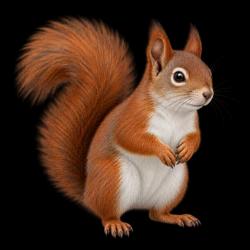
American Red Squirrel at a glance
Animal · North America · Spruce · Relatively common
Known for: Rusty red-brown back and tail, White belly, Bold white ring around each dark eye, Small compact body with a slim
Its Power
Guarded Midden
Keep the whole store in one place and defend it out loud.
Putting everything in one place works only for those prepared to guard it every single day.
“Guard the larder.”
Capture a American Red Squirrel, and it's yours when you finish one step it gives you.
Biological basis
Tamiasciurus hudsonicus cuts green conifer cones in late summer and piles them in a central larder called a midden, where the cool, damp heap of old cone scales keeps them from opening. Each squirrel holds the territory around its midden alone and drives off intruders with a loud rattle call, because losing the cache can mean not surviving the winter.
Put it into practice
A family that keeps all its savings in one account checks the statements every week, because a single store is only as safe as the attention paid to it.
What does the American red squirrel symbolize?
The American red squirrel symbolizes guarded midden: keep the whole store in one place and defend it out loud. It represents healthy territory, speaking up and saving for later. Its AnimalDex motto: "Guard the larder."
The American red squirrel as a spirit animal
If the American red squirrel is your spirit animal, the AnimalDex reading is Guarded Midden: putting everything in one place works only for those prepared to guard it every single day. It suggests a strength in healthy territory and speaking up, and a reminder to use it on purpose.
What can the American red squirrel help you with in life?
The American red squirrel is a guide for healthy territory, speaking up and saving for later. Its lesson applies wherever healthy territory matters: putting everything in one place works only for those prepared to guard it every single day.
- Healthy Territory
- Speaking Up
- Saving for Later
In practice: A family that keeps all its savings in one account checks the statements every week, because a single store is only as safe as the attention paid to it.
What can we learn from the American Red Squirrel?What does it mean to dream about or encounter a wild American red squirrel?
A wild American red squirrel, whether in a dream or in front of you, tends to show up when healthy territory or speaking up is on your mind. In AnimalDex, the American red squirrel's principle is Guarded Midden: keep the whole store in one place and defend it out loud. Read the moment through its core lesson: Putting everything in one place works only for those prepared to guard it every single day.
It depends on how the American red squirrel behaved. Calm or close by, it reads as speaking up within reach; aggressive or fleeing, it points to healthy territory you are resisting.
Spotting an American red squirrel in the wild
Coming across an American red squirrel in person asks for attention more than interpretation. Watch it for a minute; the American red squirrel's way of working is Guarded Midden, and the lesson is: putting everything in one place works only for those prepared to guard it every single day.
An American red squirrel that keeps appearing
Seeing the American red squirrel again and again, in dreams or outside, suggests healthy territory is a theme you have not settled yet.
Dreaming of being chased by an American red squirrel
Being chased suggests you are avoiding the Guarded Midden the American red squirrel stands for: putting everything in one place works only for those prepared to guard it every single day. Ask what you keep postponing that needs healthy territory.
Dreaming that an American red squirrel attacks you
An attack points to healthy territory turned against you: someone using it on you, or your own healthy territory overused until it costs you.
A calm or friendly American red squirrel
Meeting a peaceful American red squirrel is usually encouraging: speaking up and saving for later are within reach.
A dead or injured American red squirrel
Seeing the American red squirrel hurt may point to speaking up that has been neglected. Ask what it would take to restore it.
These readings are reflective prompts drawn from how the American red squirrel really lives, not predictions. If you meet one in the wild, watch from a distance and leave it undisturbed.
Capture your own American Red Squirrel
Photograph or film one in the wild, at a zoo or at home with the app. It becomes yours: it remembers you, gives you steps, and can debate your problems with your other animals.
Animal field guide
American Red Squirrel
Sign in to hear this read by a natural AI voice instead of your browser's.
The American Red Squirrel is the small, noisy tree squirrel of North America's conifer forests, rusty above and white below with a bold white eye ring. Each one lives alone on a territory built around a store of cones, and scolds almost anything that walks beneath it.
Native range
Natural range, not this capture location
Spruce, fir, pine and hemlock forest across Canada, Alaska, the northern United States and down the Rockies and Appalachians, along with mixed woods and conifer-planted parks. It needs cone-bearing trees and a cool shaded spot where a midden will not dry out.
Search near meAnimalDex stats
Dominance
22
Speed
36
Size
9
Intelligence
41
Rarity
12%
Total
120
Size scale
Understand the animal
Understand the American Red Squirrel
Factual biology first: what this animal is like, where it lives, how it survives, and why those traits exist.
01
Introduction to American Red Squirrel
The American Red Squirrel is the small, noisy tree squirrel of North America's conifer forests, rusty above and white below with a bold white eye ring. Each one lives alone on a territory built around a store of cones, and scolds almost anything that walks beneath it.
How to identify a American Red Squirrel
- Rusty red-brown back and tail
- White belly, often edged by a black side stripe
- Bold white ring around each dark eye
- Small compact body with a slim, lightly bushed tail
Why American Red Squirrel are interesting
- A midden can be used by one squirrel after another for decades, building up a mound of cone scales several metres across.
- It hangs mushrooms in the forks of branches to dry before storing them.
- In late winter it bites into sugar maple bark, leaves the sap to evaporate and returns later to lick the concentrated sugar.
- The rattle is a territorial advertisement, and each squirrel's rattle is measurably different from its neighbours'.
- A female is receptive to males for only about one day in each breeding season.
- The Douglas Squirrel of the Pacific coast is its closest relative and lookalike, but has an orange-buff belly where the American Red Squirrel is white.
02
Adaptations and biological abilities
03
Why does American Red Squirrel behave this way?
- Rusty red-brown back and tail
- White belly, often edged by a black side stripe
- Bold white ring around each dark eye
- Small compact body with a slim, lightly bushed tail
Active by day all year and does not hibernate, though it stays in the nest through the worst cold and storms. Nests are in tree cavities, in balls of grass and shredded bark among the branches, or in tunnels inside the midden itself.
04
Why Spruce?
Habitat: Spruce, fir, pine and hemlock forest across Canada, Alaska, the northern United States and down the Rockies and Appalachians, along with mixed woods and conifer-planted parks. It needs cone-bearing trees and a cool shaded spot where a midden will not dry out.
Native range: North America
Native range
Natural range, not this specific capture location.
Spruce, fir, pine and hemlock forest across Canada, Alaska, the northern United States and down the Rockies and Appalachians, along with mixed woods and conifer-planted parks. It needs cone-bearing trees and a cool shaded spot where a midden will not dry out.
05
Why this diet?
Seeds of conifer cones are the staple, supplemented by buds, flowers, berries, fungi, tree sap, insects and occasionally birds' eggs and nestlings. Cones are cut green and stored closed, which is why the larder has to be built in a few busy weeks and then held all winter.
06
Activity, rest, and lifespan
Active by day all year and does not hibernate, though it stays in the nest through the worst cold and storms. Nests are in tree cavities, in balls of grass and shredded bark among the branches, or in tunnels inside the midden itself.
Many die in their first year; those that win a territory commonly live three to five years, with a few reaching eight or more.
07
American Red Squirrel reproduction
After about five weeks of pregnancy a female bears a litter of usually three or four, raised alone in a nest. Young must find or inherit a territory with a midden before their first winter, and some mothers hand over part or all of their own to one of them.
Males and females are alike in size and colour, and both sexes hold and defend individual territories. Only on a female's single day of receptivity do males leave their own ground and gather on hers.
08
Predators, threats, and defense
American martens, fishers, lynx, bobcats, foxes, weasels, goshawks, red-tailed hawks and owls all hunt it. A squirrel on a long-held territory knows every escape route through the branches, which is another return on staying put.
09
Conservation and rarity
Rarity: Relatively common · 12/100. AnimalDex canonical rarity score: 12/100, maintained by the live indexed species profile.
- Observe from a respectful distance and avoid changing the animal's behavior.
- Do not block feeding, shelter, nesting, or travel routes.
- Use a live camera capture without handling or staging wildlife.
Talk to it
Talk to the American Red Squirrel
It answers as itself: ask about how it lives, or bring it something of yours and hear what it would do, from its own Power.
Anonymous: 3/day. Signed-in: 10/day. Pro: 100/day.
Side by side
The American Red Squirrel, side by side
Nothing written side by side for the American Red Squirrel yet. Pick any animal to compare it with. Compare with any animal →
Where to find them
Where to find American Red Squirrel
To find American Red Squirrel in the wild, focus on the exact habitat patches that match its body design and daily behavior, not just the broad country where it exists. You usually do better by working one good piece of habitat inside north America than by covering too much ground.
- Forest edge, canopy gaps, fruiting trees, or shaded trails where cover and food meet
- Protected habitat blocks within north America
Where explorers saw it
- Shubie Park, Halifax, CanadaAug · 1 sighting
Guides to seeing American Red Squirrel
Scientific name
Tamiasciurus hudsonicus
Category
Animal
Habitat
Spruce, fir, pine and hemlock forest across Canada, Alaska, the northern United States and down the Rockies and Appalachians, along with mixed woods and conifer-planted parks. It needs cone-bearing trees and a cool shaded spot where a midden will not dry out.
Rarity
Relatively common · 12/100
Native range
North America
Take the encyclopedia outside
AnimalDex helps you scan real animals, identify species, collect cards, and learn from nature wherever you are.