Animal field guide
Andean Sparrow
Zonotrichia capensis
Also called the Rufous-collared Sparrow, this small grey-headed sparrow with a rufous nape band is one of the commonest birds from southern Mexico to Tierra del Fuego. Its short whistled song differs from place to place, forming local dialects that researchers have linked to habitat and altitude.
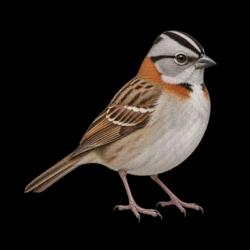
Andean Sparrow at a glance
Animal · North America · Open and semi-open country with · Relatively common
Known for: Rufous-chestnut band across the nape and neck sides, Grey head with black crown stripes, Small black patch at the side of the breast, Short crest often raised when excited
Its Power
Territorial Tune
Use your unique voice to establish clear boundaries.
The Andean Sparrow uses its distinct song to mark territory and communicate presence, emphasizing the power of clear, personal expression.
“Sing Your Boundaries.”
Capture a Andean Sparrow, and it's yours when you finish one step it gives you.
Biological basis
The Andean Sparrow sings a unique song to establish and defend its territory from other sparrows.
Put it into practice
In a busy office, Maria confidently presents her ideas, ensuring her contributions are acknowledged and respected.
What does the Andean sparrow symbolize?
The Andean sparrow symbolizes territorial tune: use your unique voice to establish clear boundaries. It represents boundaries, speaking up and clear communication. Its AnimalDex motto: "Sing Your Boundaries."
The Andean sparrow as a spirit animal
If the Andean sparrow is your spirit animal, the AnimalDex reading is Territorial Tune: the Andean Sparrow uses its distinct song to mark territory and communicate presence, emphasizing the power of clear, personal expression. It suggests a strength in boundaries and speaking up, and a reminder to use it on purpose.
What can the Andean sparrow help you with in life?
The Andean sparrow is a guide for boundaries, speaking up and clear communication. Its lesson applies wherever boundaries matters: the Andean Sparrow uses its distinct song to mark territory and communicate presence, emphasizing the power of clear, personal expression.
- Boundaries
- Speaking Up
- Clear Communication
In practice: In a busy office, Maria confidently presents her ideas, ensuring her contributions are acknowledged and respected.
What can we learn from the Andean Sparrow?What does it mean to dream about or encounter a wild Andean sparrow?
Meeting a wild Andean sparrow, asleep or awake, is often a nudge toward boundaries, the quality the Andean sparrow is built around. In AnimalDex, the Andean sparrow's principle is Territorial Tune: use your unique voice to establish clear boundaries. Read the moment through its core lesson: The Andean Sparrow uses its distinct song to mark territory and communicate presence, emphasizing the power of clear, personal expression.
It depends on how the Andean sparrow behaved. Calm or close by, it reads as speaking up within reach; aggressive or fleeing, it points to boundaries you are resisting.
Spotting an Andean sparrow in the wild
A real encounter is the plainest version of the sign: notice what the Andean sparrow was doing. Use your unique voice to establish clear boundaries. That is the boundaries worth borrowing today.
An Andean sparrow that keeps appearing
Repeated sightings of an Andean sparrow usually mean the Territorial Tune lesson is still open: the Andean Sparrow uses its distinct song to mark territory and communicate presence, emphasizing the power of clear, personal expression.
Dreaming of being chased by an Andean sparrow
Being chased suggests you are avoiding the Territorial Tune the Andean sparrow stands for: the Andean Sparrow uses its distinct song to mark territory and communicate presence, emphasizing the power of clear, personal expression. Ask what you keep postponing that needs boundaries.
Dreaming that an Andean sparrow attacks you
When the Andean sparrow attacks, the dream may be about pressure: speaking up or clear communication applied too hard, by you or by someone close to you.
A calm or friendly Andean sparrow
A relaxed Andean sparrow near you, in a dream or in person, reads as readiness: Territorial Tune is available to you now, as its motto puts it, "Sing Your Boundaries.".
A dead or injured Andean sparrow
An injured Andean sparrow often reflects boundaries under strain; rest and repair come before pushing again.
These readings are reflective prompts drawn from how the Andean sparrow really lives, not predictions. If you meet one in the wild, watch from a distance and leave it undisturbed.
Capture your own Andean Sparrow
Photograph or film one in the wild, at a zoo or at home with the app. It becomes yours: it remembers you, gives you steps, and can debate your problems with your other animals.
Animal field guide
Andean Sparrow
Sign in to hear this read by a natural AI voice instead of your browser's.
Also called the Rufous-collared Sparrow, this small grey-headed sparrow with a rufous nape band is one of the commonest birds from southern Mexico to Tierra del Fuego. Its short whistled song differs from place to place, forming local dialects that researchers have linked to habitat and altitude.
Native range
Natural range, not this capture location
Open and semi-open country with scattered shrubs: farmland, pasture, forest edges, parks, gardens and town squares, from lowlands in the south of its range up into high Andean grassland and scrub above 3,500 metres.
Search near meAnimalDex stats
Size scale
Understand the animal
Understand the Andean Sparrow
Factual biology first: what this animal is like, where it lives, how it survives, and why those traits exist.
01
Introduction to Andean Sparrow
Also called the Rufous-collared Sparrow, this small grey-headed sparrow with a rufous nape band is one of the commonest birds from southern Mexico to Tierra del Fuego. Its short whistled song differs from place to place, forming local dialects that researchers have linked to habitat and altitude.
How to identify a Andean Sparrow
- Rufous-chestnut band across the nape and neck sides
- Grey head with black crown stripes
- Small black patch at the side of the breast
- Short crest often raised when excited
- Pale grey underparts and streaked brown back
Why Andean Sparrow are interesting
- More than twenty subspecies have been described across its huge range, and they differ in size and in the boldness of the head pattern.
- In some Andean towns it is so familiar around houses that it fills the role house sparrows play elsewhere.
- Some populations breed almost all year, while others at high altitude or in the far south nest in a single season.
- Young birds leave the nest before they can fly well and hide in low cover while the parents keep feeding them.
02
Adaptations and biological abilities
03
Why does Andean Sparrow behave this way?
- Rufous-chestnut band across the nape and neck sides
- Grey head with black crown stripes
- Small black patch at the side of the breast
- Short crest often raised when excited
- Pale grey underparts and streaked brown back
Males often begin singing before sunrise, and birds keep foraging until dusk. The night is spent perched out of sight in dense shrubs or thick vegetation.
04
Why Open and semi-open country with scattered shrubs?
Habitat: Open and semi-open country with scattered shrubs: farmland, pasture, forest edges, parks, gardens and town squares, from lowlands in the south of its range up into high Andean grassland and scrub above 3,500 metres.
Native range: North America, South America
Native range
Natural range, not this specific capture location.
Open and semi-open country with scattered shrubs: farmland, pasture, forest edges, parks, gardens and town squares, from lowlands in the south of its range up into high Andean grassland and scrub above 3,500 metres.
05
Why this diet?
Mostly seeds of grasses and weeds picked from bare or short-grass ground, with insects and other small invertebrates taken especially when feeding young. It forages by hopping and scratching on the ground, often near people.
06
Activity, rest, and lifespan
Males often begin singing before sunrise, and birds keep foraging until dusk. The night is spent perched out of sight in dense shrubs or thick vegetation.
Wild lifespan is poorly documented; like most small sparrows it probably lives about 2 to 5 years, with some individuals surviving longer.
07
Andean Sparrow reproduction
The cup nest is built on the ground under a tuft of grass or low in a shrub. Clutches are usually 2 or 3 speckled eggs, incubated for about two weeks; both parents feed the chicks.
The sexes look alike. Juveniles lack the rufous collar and bold head stripes and are streaked brown below.
08
Predators, threats, and defense
09
Conservation and rarity
Rarity: Relatively common · 6/100. AnimalDex canonical rarity score: 6/100, maintained by the live indexed species profile.
- Observe from a respectful distance and avoid changing the animal's behavior.
- Do not block feeding, shelter, nesting, or travel routes.
- Use a live camera capture without handling or staging wildlife.
Talk to it
Talk to the Andean Sparrow
It answers as itself: ask about how it lives, or bring it something of yours and hear what it would do, from its own Power.
Anonymous: 6/day. Signed-in: 10/day. Pro: 100/day.
Side by side
The Andean Sparrow, side by side
Nothing written side by side for the Andean Sparrow yet. Pick any animal to compare it with. Compare with any animal →
Where to find them
Where to find Andean Sparrow
To find Andean Sparrow in the wild, focus on the exact habitat patches that match its body design and daily behavior, not just the broad country where it exists. You usually do better by working one good piece of habitat inside north America, South America than by covering too much ground.
- Forest edge, canopy gaps, fruiting trees, or shaded trails where cover and food meet
- Open grassland edges, lightly wooded plains, or raised ground where you can scan long distances
- Protected habitat blocks within north America, South America
Where explorers saw it
- Vista Alegre, Rio Grande do Sul, BrasilSep · 1 sighting
- Barra da Tijuca, Rio de Janeiro, BrasilJul · 1 sighting
Guides to seeing Andean Sparrow
Scientific name
Zonotrichia capensis
Category
Animal
Habitat
Open and semi-open country with scattered shrubs: farmland, pasture, forest edges, parks, gardens and town squares, from lowlands in the south of its range up into high Andean grassland and scrub above 3,500 metres.
Rarity
Relatively common · 6/100
Native range
North America, South America
Take the encyclopedia outside
AnimalDex helps you scan real animals, identify species, collect cards, and learn from nature wherever you are.