
Animal field guide
Annam Pond Turtle
Mauremys annamensis
A freshwater turtle found only in the lowlands of central Vietnam, and among the rarest turtles in Asia. Its habits are known mostly from captive animals, which bask at the water's edge in the morning.
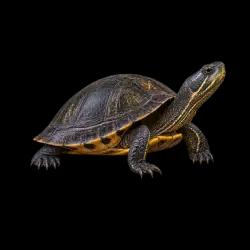
Annam Pond Turtle at a glance
Reptile · Southeast Asia · Lowland marshes · Very rare
Known for: Dark head with three or four yellow stripes each, Yellow to orange underside with a black blotch on, Dark brown to black upper shell with three low, Low
Its Power
Patient Browsing
Keep a copy somewhere the pressure cannot reach.
Known from museum specimens for most of a century and rediscovered in food markets rather than in the wild, this turtle now survives mainly in captive assurance populations. One population in one place is one bad event from gone.
“Hold one in reserve.”
Capture a Annam Pond Turtle, and it's yours when you finish one step it gives you.
Biological basis
Annam Pond Turtles are known for their slow and steady approach when foraging in their aquatic habitats, taking time to find and consume their food.
Put it into practice
A researcher reads every box in the archive slowly and finds the letter hurried visitors had missed.
What does the annam pond turtle symbolize?
The annam pond turtle symbolizes patient browsing: keep a copy somewhere the pressure cannot reach. It represents patient progress, pacing and finding hidden value. Its AnimalDex motto: "Hold one in reserve."
The annam pond turtle as a spirit animal
If the annam pond turtle is your spirit animal, the AnimalDex reading is Patient Browsing: known from museum specimens for most of a century and rediscovered in food markets rather than in the wild, this turtle now survives mainly in captive assurance populations. One population in one place is one bad event from gone. It suggests a strength in patient progress and pacing, and a reminder to use it on purpose.
What can the annam pond turtle help you with in life?
The annam pond turtle is a guide for patient progress, pacing and finding hidden value. Its lesson applies wherever patient progress matters: known from museum specimens for most of a century and rediscovered in food markets rather than in the wild, this turtle now survives mainly in captive assurance populations. One population in one place is one bad event from gone.
- Patient Progress
- Pacing
- Finding Hidden Value
In practice: A researcher reads every box in the archive slowly and finds the letter hurried visitors had missed.
What can we learn from the Annam Pond Turtle?What does it mean to dream about or encounter a wild annam pond turtle?
Dreaming about a wild annam pond turtle, or coming across one, usually points to patient progress and pacing: the qualities the annam pond turtle lives by. In AnimalDex, the annam pond turtle's principle is Patient Browsing: keep a copy somewhere the pressure cannot reach. Read the moment through its core lesson: Known from museum specimens for most of a century and rediscovered in food markets rather than in the wild, this turtle now survives mainly in captive assurance populations. One population in one place is one bad event from gone.
Mostly a prompt rather than a warning. A calm annam pond turtle suggests patient progress you already have; a threatening one suggests patient progress is being tested or pushed too far.
Spotting an annam pond turtle in the wild
Coming across an annam pond turtle in person asks for attention more than interpretation. Watch it for a minute; the annam pond turtle's way of working is Patient Browsing, and the lesson is: known from museum specimens for most of a century and rediscovered in food markets rather than in the wild, this turtle now survives mainly in captive assurance populations. One population in one place is one bad event from gone.
An annam pond turtle that keeps appearing
An annam pond turtle that keeps turning up points to pacing you keep circling back to. The repetition is the message.
Dreaming of being chased by an annam pond turtle
Being chased suggests you are avoiding the Patient Browsing the annam pond turtle stands for: known from museum specimens for most of a century and rediscovered in food markets rather than in the wild, this turtle now survives mainly in captive assurance populations. One population in one place is one bad event from gone. Ask what you keep postponing that needs patient progress.
Dreaming that an annam pond turtle attacks you
An attack points to patient progress turned against you: someone using it on you, or your own patient progress overused until it costs you.
A calm or friendly annam pond turtle
A calm annam pond turtle suggests you have made peace with patient progress and can use it without force.
A dead or injured annam pond turtle
Seeing the annam pond turtle hurt may point to pacing that has been neglected. Ask what it would take to restore it.
These readings are reflective prompts drawn from how the annam pond turtle really lives, not predictions. If you meet one in the wild, watch from a distance and leave it undisturbed.
Capture your own Annam Pond Turtle
Photograph or film one in the wild, at a zoo or at home with the app. It becomes yours: it remembers you, gives you steps, and can debate your problems with your other animals.
Animal field guide
Annam Pond Turtle
Sign in to hear this read by a natural AI voice instead of your browser's.
A freshwater turtle found only in the lowlands of central Vietnam, and among the rarest turtles in Asia. Its habits are known mostly from captive animals, which bask at the water's edge in the morning.
Native range
Natural range, not this capture location
Lowland marshes, ponds, slow streams and small rivers on the coastal plain of central Vietnam, with soft mud and dense water plants. Much of this wetland has since been converted to rice fields.
Search near meAnimalDex stats
Size scale
Understand the animal
Understand the Annam Pond Turtle
Factual biology first: what this animal is like, where it lives, how it survives, and why those traits exist.
01
Introduction to Annam Pond Turtle
A freshwater turtle found only in the lowlands of central Vietnam, and among the rarest turtles in Asia. Its habits are known mostly from captive animals, which bask at the water's edge in the morning.
How to identify a Annam Pond Turtle
- Dark head with three or four yellow stripes each side
- Yellow to orange underside with a black blotch on each plate
- Dark brown to black upper shell with three low ridges
- Low, smooth-edged shell of medium size
Why Annam Pond Turtle are interesting
- Friedrich Siebenrock described the species in 1903, and for many years it was placed in a genus of its own, Annamemys.
- For decades field surveys failed to find a single wild animal, until one was reported from central Vietnam in the mid-2000s.
- Zoos in Europe and North America hold reserve colonies, kept so that young turtles can one day be released in Vietnam.
- A turtle once named as a separate species, Ocadia glyphistoma, proved to be a hybrid between this species and the Chinese stripe-necked turtle.
02
Adaptations and biological abilities
03
Why does Annam Pond Turtle behave this way?
- Dark head with three or four yellow stripes each side
- Yellow to orange underside with a black blotch on each plate
- Dark brown to black upper shell with three low ridges
- Low, smooth-edged shell of medium size
Captive animals are active by day and rest on the bottom or among plants at night.
04
Why Lowland marshes?
Habitat: Lowland marshes, ponds, slow streams and small rivers on the coastal plain of central Vietnam, with soft mud and dense water plants. Much of this wetland has since been converted to rice fields.
Native range: Southeast Asia
Native range
Natural range, not this specific capture location.
Lowland marshes, ponds, slow streams and small rivers on the coastal plain of central Vietnam, with soft mud and dense water plants. Much of this wetland has since been converted to rice fields.
05
Why this diet?
Captive animals eat both plant and animal food: water plants, leafy greens and fruit, with insects, worms, snails and fish. What wild turtles eat has not been documented.
06
Activity, rest, and lifespan
Captive animals are active by day and rest on the bottom or among plants at night.
Husbandry records show Mauremys annamensis can live at least forty-one years, with zoo individuals reported near forty-six; wild longevity is unknown for this Vietnamese wetland turtle.
07
Annam Pond Turtle reproduction
Known mainly from captive breeding, where females lay clutches of about 5 to 8 eggs in a hole dug in soil, sometimes more than once a year. The eggs hatch after roughly 80 to 90 days and the hatchlings receive no care.
Males have a slightly hollowed underside to the shell and a longer, thicker tail, with the vent beyond the shell's edge. Females have a flat underside and a shorter tail, and tend to grow larger.
08
Predators, threats, and defense
People are the main threat: turtles are trapped for food, traditional medicine and the pet trade. Natural predators have not been documented. A disturbed turtle drops into the water and hides on the bottom.
09
Conservation and rarity
Rarity: Very rare · 89/100. AnimalDex canonical rarity score: 89/100, maintained by the live indexed species profile.
- Observe from a respectful distance and avoid changing the animal's behavior.
- Do not block feeding, shelter, nesting, or travel routes.
- Use a live camera capture without handling or staging wildlife.
Talk to it
Talk to the Annam Pond Turtle
It answers as itself: ask about how it lives, or bring it something of yours and hear what it would do, from its own Power.
Anonymous: 6/day. Signed-in: 10/day. Pro: 100/day.
Side by side
The Annam Pond Turtle, side by side
Nothing written side by side for the Annam Pond Turtle yet. Pick any animal to compare it with. Compare with any animal →
Where to find them
Where to find Annam Pond Turtle
To find Annam Pond Turtle in the wild, focus on the exact habitat patches that match its body design and daily behavior, not just the broad country where it exists. You usually do better by working one good piece of habitat inside southeast Asia than by covering too much ground.
- Quiet marsh edges, reedbeds, river bends, or shallow wetland margins
- Open grassland edges, lightly wooded plains, or raised ground where you can scan long distances
- Headlands, reef edges, island colonies, tidal channels, or productive coastal water
In the Ark
1 Annam Pond Turtle is aboard right now.
Since November 5: 1 came aboard.
The Ark is a live, shared animal world. Animals come aboard when people capture them, and live there by rules based on their field guides.
Scientific name
Mauremys annamensis
Category
Reptile
Habitat
Lowland marshes, ponds, slow streams and small rivers on the coastal plain of central Vietnam, with soft mud and dense water plants. Much of this wetland has since been converted to rice fields.
Rarity
Very rare · 89/100
Native range
Southeast Asia
Take the encyclopedia outside
AnimalDex helps you scan real animals, identify species, collect cards, and learn from nature wherever you are.