Animal field guide
Black Giant Squirrel
Ratufa bicolor
Among the largest tree squirrels in the world, with a head and body that can pass 35 centimetres. It lives almost entirely in the high canopy, crossing gaps between trees in long leaps.
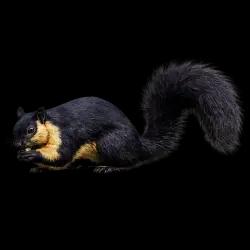
Black Giant Squirrel at a glance
Animal · Southeast Asia · Tall evergreen and semi-evergreen · Uncommon
Known for: Long, Black or dark brown back, Buff to pale yellow underside, Short
Its Power
Canopy Strategy
Utilize high vantage points to gain perspective.
The Black Giant Squirrel navigates the forest canopy to avoid predators and access food, demonstrating the advantage of elevated perspectives.
“Rise Above.”
Capture a Black Giant Squirrel, and it's yours when you finish one step it gives you.
Biological basis
Black Giant Squirrels spend most of their time in the forest canopy, using their agility to move between trees and avoid ground-based threats.
Put it into practice
A coach watches the match from the top of the stand and sees gaps nobody spots from the touchline.
What does the black giant squirrel symbolize?
The black giant squirrel symbolizes canopy strategy: utilize high vantage points to gain perspective. It represents perspective, balance and agility. Its AnimalDex motto: "Rise Above."
The black giant squirrel as a spirit animal
If the black giant squirrel is your spirit animal, the AnimalDex reading is Canopy Strategy: the Black Giant Squirrel navigates the forest canopy to avoid predators and access food, demonstrating the advantage of elevated perspectives. It suggests a strength in perspective and balance, and a reminder to use it on purpose.
What can the black giant squirrel help you with in life?
The black giant squirrel is a guide for perspective, balance and agility. Its lesson applies wherever perspective matters: the Black Giant Squirrel navigates the forest canopy to avoid predators and access food, demonstrating the advantage of elevated perspectives.
- Perspective
- Balance
- Agility
In practice: A coach watches the match from the top of the stand and sees gaps nobody spots from the touchline.
What can we learn from the Black Giant Squirrel?What does it mean to dream about or encounter a wild black giant squirrel?
Meeting a wild black giant squirrel, asleep or awake, is often a nudge toward perspective, the quality the black giant squirrel is built around. In AnimalDex, the black giant squirrel's principle is Canopy Strategy: utilize high vantage points to gain perspective. Read the moment through its core lesson: The Black Giant Squirrel navigates the forest canopy to avoid predators and access food, demonstrating the advantage of elevated perspectives.
Mostly a prompt rather than a warning. A calm black giant squirrel suggests perspective you already have; a threatening one suggests perspective is being tested or pushed too far.
Spotting a black giant squirrel in the wild
If a black giant squirrel crosses your path, take it as a cue to look at where perspective fits your day. Its AnimalDex motto: "Rise Above."
A black giant squirrel that keeps appearing
Seeing the black giant squirrel again and again, in dreams or outside, suggests perspective is a theme you have not settled yet.
Dreaming of being chased by a black giant squirrel
A chase often means a demand for perspective is catching up with you. The black giant squirrel's lesson, "The Black Giant Squirrel navigates the forest canopy to avoid predators and access food, demonstrating the advantage of elevated perspectives", is the part you may be running from.
Dreaming that a black giant squirrel attacks you
An aggressive black giant squirrel can mirror a conflict where perspective has become a weapon rather than a strength.
A calm or friendly black giant squirrel
A relaxed black giant squirrel near you, in a dream or in person, reads as readiness: Canopy Strategy is available to you now, as its motto puts it, "Rise Above.".
A dead or injured black giant squirrel
Seeing the black giant squirrel hurt may point to balance that has been neglected. Ask what it would take to restore it.
These readings are reflective prompts drawn from how the black giant squirrel really lives, not predictions. If you meet one in the wild, watch from a distance and leave it undisturbed.
Capture your own Black Giant Squirrel
Photograph or film one in the wild, at a zoo or at home with the app. It becomes yours: it remembers you, gives you steps, and can debate your problems with your other animals.
Animal field guide
Black Giant Squirrel
Sign in to hear this read by a natural AI voice instead of your browser's.
Among the largest tree squirrels in the world, with a head and body that can pass 35 centimetres. It lives almost entirely in the high canopy, crossing gaps between trees in long leaps.
Native range
Natural range, not this capture location
Tall evergreen and semi-evergreen forest, lowland and hill forest in mainland South-East Asia, Sumatra and Java, keeping to the upper canopy and avoiding cleared or heavily logged land.
Search near meAnimalDex stats
Dominance
32
Speed
38
Size
26
Intelligence
34
Rarity
55%
Total
185
Size scale
Understand the animal
Understand the Black Giant Squirrel
Factual biology first: what this animal is like, where it lives, how it survives, and why those traits exist.
01
Introduction to Black Giant Squirrel
Among the largest tree squirrels in the world, with a head and body that can pass 35 centimetres. It lives almost entirely in the high canopy, crossing gaps between trees in long leaps.
How to identify a Black Giant Squirrel
- Long, bushy dark tail, about as long as the head and body or longer
- Black or dark brown back
- Buff to pale yellow underside
- Short, rounded ears
Why Black Giant Squirrel are interesting
- Giant squirrels of the genus Ratufa form an old lineage that split early from most other tree squirrels.
- It is listed as Near Threatened, mainly because of forest loss and hunting for meat.
- Unlike many squirrels, it is not known to store food in caches, feeding instead on what the canopy provides season by season.
- Like other giant squirrels, it is thought to build several nests within its home range and may switch between them.
02
Adaptations and biological abilities
03
Why does Black Giant Squirrel behave this way?
- Long, bushy dark tail, about as long as the head and body or longer
- Black or dark brown back
- Buff to pale yellow underside
- Short, rounded ears
Active by day, busiest in early morning and late afternoon, resting through the midday heat. Nights are spent in a bulky nest of twigs and leaves high in a tree, or in a tree hollow.
04
Why Tall evergreen and semi-evergreen forest?
Habitat: Tall evergreen and semi-evergreen forest, lowland and hill forest in mainland South-East Asia, Sumatra and Java, keeping to the upper canopy and avoiding cleared or heavily logged land.
Native range: Southeast Asia
Native range
Natural range, not this specific capture location.
Tall evergreen and semi-evergreen forest, lowland and hill forest in mainland South-East Asia, Sumatra and Java, keeping to the upper canopy and avoiding cleared or heavily logged land.
05
Why this diet?
Seeds, fruit, nuts, young leaves and flowers gathered in the canopy and held in the forepaws while it eats.
06
Activity, rest, and lifespan
Active by day, busiest in early morning and late afternoon, resting through the midday heat. Nights are spent in a bulky nest of twigs and leaves high in a tree, or in a tree hollow.
Lifespan in the wild has not been documented; zoo animals have been reported living around 15 to 20 years.
07
Black Giant Squirrel reproduction
Litters are small, usually one or two young, born in a leafy nest high in the trees. Details of breeding season and gestation in the wild are poorly known.
Males and females look alike and cannot be told apart in the field.
08
Predators, threats, and defense
09
Conservation and rarity
Rarity: Uncommon · 55/100. AnimalDex canonical rarity score: 55/100, maintained by the live indexed species profile.
- Observe from a respectful distance and avoid changing the animal's behavior.
- Do not block feeding, shelter, nesting, or travel routes.
- Use a live camera capture without handling or staging wildlife.
Talk to it
Talk to the Black Giant Squirrel
It answers as itself: ask about how it lives, or bring it something of yours and hear what it would do, from its own Power.
Anonymous: 3/day. Signed-in: 10/day. Pro: 100/day.
Side by side
The Black Giant Squirrel, side by side
Nothing written side by side for the Black Giant Squirrel yet. Pick any animal to compare it with. Compare with any animal →
Where to find them
Where to find Black Giant Squirrel
To find Black Giant Squirrel in the wild, focus on the exact habitat patches that match its body design and daily behavior, not just the broad country where it exists. You usually do better by working one good piece of habitat inside southeast Asia than by covering too much ground.
- Forest edge, canopy gaps, fruiting trees, or shaded trails where cover and food meet
- Protected habitat blocks within southeast Asia
Where explorers saw it
- Kepong CHURCH, Bukit Lagong Forest Reserve, MalaysiaAug · 1 sighting
Scientific name
Ratufa bicolor
Category
Animal
Habitat
Tall evergreen and semi-evergreen forest, lowland and hill forest in mainland South-East Asia, Sumatra and Java, keeping to the upper canopy and avoiding cleared or heavily logged land.
Rarity
Uncommon · 55/100
Native range
Southeast Asia
Take the encyclopedia outside
AnimalDex helps you scan real animals, identify species, collect cards, and learn from nature wherever you are.