
Animal field guide
Brimstone Butterfly
Gonepteryx rhamni
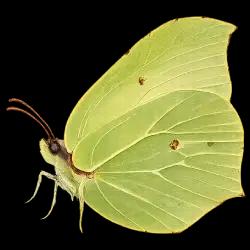
Closed, the wings of this large butterfly look remarkably like a leaf, down to the raised veins on the underside. It almost always rests with its wings shut, so a settled Brimstone shows only this leaf-like underside and vanishes among foliage.
Brimstone Butterfly at a glance
Invertebrate · Europe · Open woodland · Relatively common
Known for: Wing tips drawn out into a short hooked point, Wingspan roughly 5 to 6 centimetres, Small orange spot at the centre of each wing, Strong
Its Power
Seasonal Adaptability
Winter through it as you are rather than changing form.
Most temperate butterflies pass the winter as egg, larva or pupa. The brimstone does it as an adult, hanging in ivy through frost and snow, protected by glycerol that stops ice forming in its tissues. It emerges already finished and ready.
“Overwinter whole.”
Capture a Brimstone Butterfly, and it's yours when you finish one step it gives you.
Biological basis
The Brimstone Butterfly is known for its ability to hibernate during winter months, effectively pausing its life cycle until favorable conditions return.
Put it into practice
An injured runner rests fully through the winter and returns stronger when spring training starts.
What does the brimstone butterfly symbolize?
The brimstone butterfly symbolizes seasonal adaptability: winter through it as you are rather than changing form. It represents knowing the season, mode switching and resilience. Its AnimalDex motto: "Overwinter whole."
The brimstone butterfly as a spirit animal
If the brimstone butterfly is your spirit animal, the AnimalDex reading is Seasonal Adaptability: most temperate butterflies pass the winter as egg, larva or pupa. The brimstone does it as an adult, hanging in ivy through frost and snow, protected by glycerol that stops ice forming in its tissues. It emerges already finished and ready. It suggests a strength in knowing the season and mode switching, and a reminder to use it on purpose.
What can the brimstone butterfly help you with in life?
The brimstone butterfly is a guide for knowing the season, mode switching and resilience. Its lesson applies wherever knowing the season matters: most temperate butterflies pass the winter as egg, larva or pupa. The brimstone does it as an adult, hanging in ivy through frost and snow, protected by glycerol that stops ice forming in its tissues. It emerges already finished and ready.
- Knowing the Season
- Mode Switching
- Resilience
In practice: An injured runner rests fully through the winter and returns stronger when spring training starts.
What can we learn from the Brimstone Butterfly?What does it mean to dream about or encounter a wild brimstone butterfly?
Meeting a wild brimstone butterfly, asleep or awake, is often a nudge toward knowing the season, the quality the brimstone butterfly is built around. In AnimalDex, the brimstone butterfly's principle is Seasonal Adaptability: winter through it as you are rather than changing form. Read the moment through its core lesson: Most temperate butterflies pass the winter as egg, larva or pupa. The brimstone does it as an adult, hanging in ivy through frost and snow, protected by glycerol that stops ice forming in its tissues. It emerges already finished and ready.
Mostly a prompt rather than a warning. A calm brimstone butterfly suggests knowing the season you already have; a threatening one suggests knowing the season is being tested or pushed too far.
Spotting a brimstone butterfly in the wild
A real encounter is the plainest version of the sign: notice what the brimstone butterfly was doing. Winter through it as you are rather than changing form. That is the knowing the season worth borrowing today.
A brimstone butterfly that keeps appearing
A brimstone butterfly that keeps turning up points to mode switching you keep circling back to. The repetition is the message.
Dreaming of being chased by a brimstone butterfly
A chase often means a demand for knowing the season is catching up with you. The brimstone butterfly's lesson, "Most temperate butterflies pass the winter as egg, larva or pupa. The brimstone does it as an adult, hanging in ivy through frost and snow, protected by glycerol that stops ice forming in its tissues. It emerges already finished and ready", is the part you may be running from.
Dreaming that a brimstone butterfly attacks you
An aggressive brimstone butterfly can mirror a conflict where knowing the season has become a weapon rather than a strength.
A calm or friendly brimstone butterfly
A relaxed brimstone butterfly near you, in a dream or in person, reads as readiness: Seasonal Adaptability is available to you now, as its motto puts it, "Overwinter whole.".
A dead or injured brimstone butterfly
An injured brimstone butterfly often reflects knowing the season under strain; rest and repair come before pushing again.
These readings are reflective prompts drawn from how the brimstone butterfly really lives, not predictions. If you meet one in the wild, watch from a distance and leave it undisturbed.
Capture your own Brimstone Butterfly
Photograph or film one in the wild, at a zoo or at home with the app. It becomes yours: it remembers you, gives you steps, and can debate your problems with your other animals.
Animal field guide
Brimstone Butterfly
Sign in to hear this read by a natural AI voice instead of your browser's.
Closed, the wings of this large butterfly look remarkably like a leaf, down to the raised veins on the underside. It almost always rests with its wings shut, so a settled Brimstone shows only this leaf-like underside and vanishes among foliage.
Native range
Natural range, not this capture location
Open woodland, woodland rides and edges, scrub, hedgerows, fens and gardens, wherever its buckthorn foodplants grow; in the north-west, buckthorn favours chalk and limestone and alder buckthorn damp, acid soils. Adults wander and turn up well away from these shrubs.
Search near meAnimalDex stats
Size scale
Understand the animal
Understand the Brimstone Butterfly
Factual biology first: what this animal is like, where it lives, how it survives, and why those traits exist.
01
Introduction to Brimstone Butterfly
Closed, the wings of this large butterfly look remarkably like a leaf, down to the raised veins on the underside. It almost always rests with its wings shut, so a settled Brimstone shows only this leaf-like underside and vanishes among foliage.
How to identify a Brimstone Butterfly
- Wing tips drawn out into a short hooked point
- Wingspan roughly 5 to 6 centimetres
- Small orange spot at the centre of each wing
- Strong, fast, bouncing flight along hedges and rides
Why Brimstone Butterfly are interesting
- The male's butter-yellow colour has been suggested as the origin of the English word butterfly, though this is not proven.
- The chrysalis is green and angular and hangs from a silk girdle beneath a leaf, looking like a curled leaf itself.
- Planting buckthorn has been used to encourage the butterfly back into areas where it had become scarce.
- Its English name comes from brimstone, an old word for sulphur, the yellow mineral the male's wings resemble in colour.
02
Adaptations and biological abilities
03
Why does Brimstone Butterfly behave this way?
- Wing tips drawn out into a short hooked point
- Wingspan roughly 5 to 6 centimetres
- Small orange spot at the centre of each wing
- Strong, fast, bouncing flight along hedges and rides
Flies only in warmth and sunshine. At night and in cloudy weather it roosts hanging beneath leaves or among dense foliage.
04
Why Open woodland?
Habitat: Open woodland, woodland rides and edges, scrub, hedgerows, fens and gardens, wherever its buckthorn foodplants grow; in the north-west, buckthorn favours chalk and limestone and alder buckthorn damp, acid soils. Adults wander and turn up well away from these shrubs.
Native range: Europe
Native range
Natural range, not this specific capture location.
Open woodland, woodland rides and edges, scrub, hedgerows, fens and gardens, wherever its buckthorn foodplants grow; in the north-west, buckthorn favours chalk and limestone and alder buckthorn damp, acid soils. Adults wander and turn up well away from these shrubs.
05
Why this diet?
Caterpillars feed only on buckthorns, in north-west Europe chiefly buckthorn and alder buckthorn. Adults drink nectar with a long tongue, from primroses, dandelions and sallow catkins in spring and from thistles, knapweeds and teasels in late summer.
06
Activity, rest, and lifespan
Flies only in warmth and sunshine. At night and in cloudy weather it roosts hanging beneath leaves or among dense foliage.
Adults can live about 10 to 12 months, from emergence in midsummer to egg-laying the following spring, which makes it one of Europe's longest-lived butterflies.
07
Brimstone Butterfly reproduction
Females lay eggs singly on buds or young leaves of the foodplant in spring; each bottle-shaped egg is pale at first and usually turns yellowish as it develops. Caterpillars feed for about a month and pupate among the foliage. There is one generation a year.
Males are bright sulphur yellow; females are a pale greenish white and can be mistaken for a white butterfly in flight.
08
Predators, threats, and defense
Like most butterflies, it is eaten by birds at every stage of life, and many caterpillars are killed by parasitic wasps and flies that develop inside them. The green caterpillar rests pressed along a leaf midrib, where its colour matches the leaf.
09
Conservation and rarity
Rarity: Relatively common · 19/100. AnimalDex canonical rarity score: 19/100, maintained by the live indexed species profile.
- Observe from a respectful distance and avoid changing the animal's behavior.
- Do not block feeding, shelter, nesting, or travel routes.
- Use a live camera capture without handling or staging wildlife.
Talk to it
Talk to the Brimstone Butterfly
It answers as itself: ask about how it lives, or bring it something of yours and hear what it would do, from its own Power.
Anonymous: 6/day. Signed-in: 10/day. Pro: 100/day.
Side by side
The Brimstone Butterfly, side by side
Nothing written side by side for the Brimstone Butterfly yet. Pick any animal to compare it with. Compare with any animal →
Where to find them
Where to find Brimstone Butterfly
To find Brimstone Butterfly in the wild, focus on the exact habitat patches that match its body design and daily behavior, not just the broad country where it exists. You usually do better by working one good piece of habitat inside europe than by covering too much ground.
- Forest edge, canopy gaps, fruiting trees, or shaded trails where cover and food meet
- Protected habitat blocks within europe
Where explorers saw it
- Jausa, Hiiu maakond, EstoniaJul · 1 sighting
Guides to seeing Brimstone Butterfly
In the Ark
4 Brimstone Butterflies are aboard right now.
Since November 5: 2 came aboard, 2 born.
The Ark is a live, shared animal world. Animals come aboard when people capture them, and live there by rules based on their field guides.
Scientific name
Gonepteryx rhamni
Category
Invertebrate
Habitat
Open woodland, woodland rides and edges, scrub, hedgerows, fens and gardens, wherever its buckthorn foodplants grow; in the north-west, buckthorn favours chalk and limestone and alder buckthorn damp, acid soils. Adults wander and turn up well away from these shrubs.
Rarity
Relatively common · 19/100
Native range
Europe
Take the encyclopedia outside
AnimalDex helps you scan real animals, identify species, collect cards, and learn from nature wherever you are.