Animal field guide
Bronze Ground Beetle
Carabus nemoralis
Across much of Europe this large ground beetle is as much at home in city gardens as in woodland. Its hind wings are reduced to useless stubs, so it cannot fly and does everything on foot, running down its prey at night over soil and leaf litter.
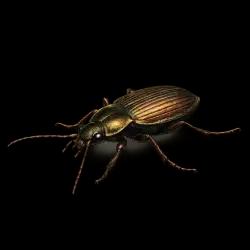
Bronze Ground Beetle at a glance
Invertebrate · Europe · Deciduous and mixed woodland · Relatively common
Known for: Body 20 to 26 millimetres long, Black above with a bronze, Edges of the thorax often tinged violet, Wing-cases finely ridged
Its Power
Quiet Strategy
Break it down where it lies instead of carrying it home.
Mandibles built for seizing rather than chewing meet prey larger than the beetle's own head, so it regurgitates digestive enzymes onto the animal and waits, then drinks the result. Processing at the point of capture removes the need to move it at all.
“Digest it in place.”
Capture a Bronze Ground Beetle, and it's yours when you finish one step it gives you.
Biological basis
Bronze Ground Beetles are nocturnal and rely on their ability to move silently and blend into the leaf litter to hunt and evade predators.
Put it into practice
A founder builds the product for a year without announcements and launches with it already working.
What does the bronze ground beetle symbolize?
The bronze ground beetle symbolizes quiet strategy: break it down where it lies instead of carrying it home. It represents quiet strategy, purpose and efficiency. Its AnimalDex motto: "Digest it in place."
The bronze ground beetle as a spirit animal
If the bronze ground beetle is your spirit animal, the AnimalDex reading is Quiet Strategy: mandibles built for seizing rather than chewing meet prey larger than the beetle's own head, so it regurgitates digestive enzymes onto the animal and waits, then drinks the result. Processing at the point of capture removes the need to move it at all. It suggests a strength in quiet strategy and purpose, and a reminder to use it on purpose.
What can the bronze ground beetle help you with in life?
The bronze ground beetle is a guide for quiet strategy, purpose and efficiency. Its lesson applies wherever quiet strategy matters: mandibles built for seizing rather than chewing meet prey larger than the beetle's own head, so it regurgitates digestive enzymes onto the animal and waits, then drinks the result. Processing at the point of capture removes the need to move it at all.
- Quiet Strategy
- Purpose
- Efficiency
In practice: A founder builds the product for a year without announcements and launches with it already working.
What can we learn from the Bronze Ground Beetle?What does it mean to dream about or encounter a wild bronze ground beetle?
Dreaming about a wild bronze ground beetle, or coming across one, usually points to quiet strategy and purpose: the qualities the bronze ground beetle lives by. In AnimalDex, the bronze ground beetle's principle is Quiet Strategy: break it down where it lies instead of carrying it home. Read the moment through its core lesson: Mandibles built for seizing rather than chewing meet prey larger than the beetle's own head, so it regurgitates digestive enzymes onto the animal and waits, then drinks the result. Processing at the point of capture removes the need to move it at all.
It depends on how the bronze ground beetle behaved. Calm or close by, it reads as purpose within reach; aggressive or fleeing, it points to quiet strategy you are resisting.
Spotting a bronze ground beetle in the wild
If a bronze ground beetle crosses your path, take it as a cue to look at where quiet strategy fits your day. Its AnimalDex motto: "Digest it in place."
A bronze ground beetle that keeps appearing
Seeing the bronze ground beetle again and again, in dreams or outside, suggests quiet strategy is a theme you have not settled yet.
Dreaming of being chased by a bronze ground beetle
If the bronze ground beetle pursues you, look at where purpose is being asked of you and you are stepping away instead of meeting it.
Dreaming that a bronze ground beetle attacks you
An attack points to quiet strategy turned against you: someone using it on you, or your own quiet strategy overused until it costs you.
A calm or friendly bronze ground beetle
A calm bronze ground beetle suggests you have made peace with quiet strategy and can use it without force.
A dead or injured bronze ground beetle
An injured bronze ground beetle often reflects quiet strategy under strain; rest and repair come before pushing again.
These readings are reflective prompts drawn from how the bronze ground beetle really lives, not predictions. If you meet one in the wild, watch from a distance and leave it undisturbed.
Capture your own Bronze Ground Beetle
Photograph or film one in the wild, at a zoo or at home with the app. It becomes yours: it remembers you, gives you steps, and can debate your problems with your other animals.
Animal field guide
Bronze Ground Beetle
Sign in to hear this read by a natural AI voice instead of your browser's.
Across much of Europe this large ground beetle is as much at home in city gardens as in woodland. Its hind wings are reduced to useless stubs, so it cannot fly and does everything on foot, running down its prey at night over soil and leaf litter.
Native range
Natural range, not this capture location
Deciduous and mixed woodland, hedgerows, parks, gardens and farmland, mainly in the lowlands, on moist soil with leaf litter, logs or stones for shelter. It tolerates disturbed ground better than most large ground beetles.
Search near meAnimalDex stats
Dominance
9
Speed
18
Size
2
Intelligence
8
Rarity
14%
Total
51
Size scale
Understand the animal
Understand the Bronze Ground Beetle
Factual biology first: what this animal is like, where it lives, how it survives, and why those traits exist.
01
Introduction to Bronze Ground Beetle
Across much of Europe this large ground beetle is as much at home in city gardens as in woodland. Its hind wings are reduced to useless stubs, so it cannot fly and does everything on foot, running down its prey at night over soil and leaf litter.
How to identify a Bronze Ground Beetle
- Body 20 to 26 millimetres long, broadly oval
- Black above with a bronze, coppery or greenish sheen
- Edges of the thorax often tinged violet
- Wing-cases finely ridged, each with three rows of pits
- Long legs; runs fast when uncovered
Why Bronze Ground Beetle are interesting
- It has been introduced to North America, where it is now established in Canada and the northern United States.
- The larva passes through three growth stages, as is usual in the genus, before it pupates.
- Like other Carabus beetles it begins digesting prey outside the body, releasing digestive fluid onto the victim and taking in the liquefied tissue.
- A female that survives the winter can lay again the following spring, so one beetle may breed in two or more years.
02
Adaptations and biological abilities
03
Why does Bronze Ground Beetle behave this way?
- Body 20 to 26 millimetres long, broadly oval
- Black above with a bronze, coppery or greenish sheen
- Edges of the thorax often tinged violet
- Wing-cases finely ridged, each with three rows of pits
- Long legs; runs fast when uncovered
Nocturnal. It spends the day under logs, stones, bark or leaf litter and emerges after dusk. Adults pass the winter dormant in soil, moss or rotting wood.
04
Why Deciduous and mixed woodland?
Habitat: Deciduous and mixed woodland, hedgerows, parks, gardens and farmland, mainly in the lowlands, on moist soil with leaf litter, logs or stones for shelter. It tolerates disturbed ground better than most large ground beetles.
Native range: Europe
Native range
Natural range, not this specific capture location.
Deciduous and mixed woodland, hedgerows, parks, gardens and farmland, mainly in the lowlands, on moist soil with leaf litter, logs or stones for shelter. It tolerates disturbed ground better than most large ground beetles.
05
Why this diet?
Slugs and their eggs, snails, earthworms, caterpillars and other soft-bodied invertebrates, with some carrion. Prey is found on the ground by scent and touch and seized in large, curved jaws.
06
Activity, rest, and lifespan
Nocturnal. It spends the day under logs, stones, bark or leaf litter and emerges after dusk. Adults pass the winter dormant in soil, moss or rotting wood.
Adults commonly live about two years and sometimes three; figures vary between studies.
07
Bronze Ground Beetle reproduction
Mating takes place in spring, and the female lays her eggs singly in the soil. The long, dark larvae hunt on the ground through early summer, then pupate in an earthen cell. New adults appear in late summer or autumn and breed the following spring.
Males have the basal segments of the front feet broadened into pads, used to grip the female during mating; females have slender front feet. Females are on average slightly larger and broader.
08
Predators, threats, and defense
09
Conservation and rarity
Rarity: Relatively common · 14/100. AnimalDex canonical rarity score: 14/100, maintained by the live indexed species profile.
- Observe from a respectful distance and avoid changing the animal's behavior.
- Do not block feeding, shelter, nesting, or travel routes.
- Use a live camera capture without handling or staging wildlife.
Talk to it
Talk to the Bronze Ground Beetle
It answers as itself: ask about how it lives, or bring it something of yours and hear what it would do, from its own Power.
Anonymous: 6/day. Signed-in: 10/day. Pro: 100/day.
Side by side
The Bronze Ground Beetle, side by side
Nothing written side by side for the Bronze Ground Beetle yet. Pick any animal to compare it with. Compare with any animal →
Where to find them
Where to find Bronze Ground Beetle
To find Bronze Ground Beetle in the wild, focus on the exact habitat patches that match its body design and daily behavior, not just the broad country where it exists. You usually do better by working one good piece of habitat inside europe than by covering too much ground.
- Forest edge, canopy gaps, fruiting trees, or shaded trails where cover and food meet
- Protected habitat blocks within europe
Where explorers saw it
- Jausa, Hiiu maakond, EstoniaJul · 1 sighting
Guides to seeing Bronze Ground Beetle
Scientific name
Carabus nemoralis
Category
Invertebrate
Habitat
Deciduous and mixed woodland, hedgerows, parks, gardens and farmland, mainly in the lowlands, on moist soil with leaf litter, logs or stones for shelter. It tolerates disturbed ground better than most large ground beetles.
Rarity
Relatively common · 14/100
Native range
Europe
Take the encyclopedia outside
AnimalDex helps you scan real animals, identify species, collect cards, and learn from nature wherever you are.