Animal field guide
Spectacled Caiman
Caiman crocodilus
One of the most widespread and numerous crocodilians in the Americas, this caiman is named for a curved bony ridge between the eyes that looks like the bridge of a pair of spectacles. It copes with disturbed land better than most relatives, settling in cattle ponds, ditches and reservoirs as readily as in rivers and swamps.
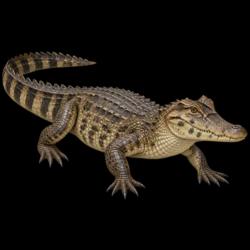
Spectacled Caiman at a glance
Animal · North America · Slow or still fresh water in the · Relatively common
Known for: Bony ridge across the snout just in front of the, Olive to grey-brown body with dark crossbands on, Juveniles yellowish with bold black bands, Fairly short
Its Power
Night Ambush
Harness the power of patience and timing.
Mastering the art of waiting in silence can lead to successful outcomes when the moment is right.
“Wait for the right moment.”
Capture a Spectacled Caiman, and it's yours when you finish one step it gives you.
Biological basis
The spectacled caiman often hunts at night, using its keen senses and patience to ambush prey in the darkness.
Put it into practice
In a high-stakes meeting, Maria listens quietly, waiting for the perfect moment to present her idea, ensuring maximum impact.
What does the spectacled caiman symbolize?
The spectacled caiman symbolizes night ambush: harness the power of patience and timing. It represents right timing, stillness and mode switching. Its AnimalDex motto: "Wait for the right moment."
The spectacled caiman as a spirit animal
If the spectacled caiman is your spirit animal, the AnimalDex reading is Night Ambush: mastering the art of waiting in silence can lead to successful outcomes when the moment is right. It suggests a strength in right timing and stillness, and a reminder to use it on purpose.
What can the spectacled caiman help you with in life?
The spectacled caiman is a guide for right timing, stillness and mode switching. Its lesson applies wherever right timing matters: mastering the art of waiting in silence can lead to successful outcomes when the moment is right.
- Right Timing
- Stillness
- Mode Switching
In practice: In a high-stakes meeting, Maria listens quietly, waiting for the perfect moment to present her idea, ensuring maximum impact.
What can we learn from the Spectacled Caiman?What does it mean to dream about or encounter a wild spectacled caiman?
A wild spectacled caiman, whether in a dream or in front of you, tends to show up when right timing or stillness is on your mind. In AnimalDex, the spectacled caiman's principle is Night Ambush: harness the power of patience and timing. Read the moment through its core lesson: Mastering the art of waiting in silence can lead to successful outcomes when the moment is right.
Neither good nor bad on its own. How the spectacled caiman acts matters: at ease, it reflects right timing; hostile, it flags right timing out of balance.
Spotting a spectacled caiman in the wild
Coming across a spectacled caiman in person asks for attention more than interpretation. Watch it for a minute; the spectacled caiman's way of working is Night Ambush, and the lesson is: mastering the art of waiting in silence can lead to successful outcomes when the moment is right.
A spectacled caiman that keeps appearing
Seeing the spectacled caiman again and again, in dreams or outside, suggests right timing is a theme you have not settled yet.
Dreaming of being chased by a spectacled caiman
Being chased suggests you are avoiding the Night Ambush the spectacled caiman stands for: mastering the art of waiting in silence can lead to successful outcomes when the moment is right. Ask what you keep postponing that needs right timing.
Dreaming that a spectacled caiman attacks you
When the spectacled caiman attacks, the dream may be about pressure: stillness or mode switching applied too hard, by you or by someone close to you.
A calm or friendly spectacled caiman
Meeting a peaceful spectacled caiman is usually encouraging: stillness and mode switching are within reach.
A dead or injured spectacled caiman
A dead or injured spectacled caiman, dreamed or found, can mark right timing you have let lapse, or a phase built on Night Ambush coming to an end.
These readings are reflective prompts drawn from how the spectacled caiman really lives, not predictions. If you meet one in the wild, watch from a distance and leave it undisturbed.
Capture your own Spectacled Caiman
Photograph or film one in the wild, at a zoo or at home with the app. It becomes yours: it remembers you, gives you steps, and can debate your problems with your other animals.
Animal field guide
Spectacled Caiman
Sign in to hear this read by a natural AI voice instead of your browser's.
One of the most widespread and numerous crocodilians in the Americas, this caiman is named for a curved bony ridge between the eyes that looks like the bridge of a pair of spectacles. It copes with disturbed land better than most relatives, settling in cattle ponds, ditches and reservoirs as readily as in rivers and swamps.
Native range
Natural range, not this capture location
Slow or still fresh water in the tropical lowlands of southern Mexico, Central America and northern and central South America, including the Magdalena, Orinoco and Amazon basins and the Pacific lowlands of Colombia and Ecuador. It uses marshes, oxbow lakes, flooded savanna, swamp forest and river margins with floating plants, and enters brackish lagoons.
Search near meAnimalDex stats
Size scale
Understand the animal
Understand the Spectacled Caiman
Factual biology first: what this animal is like, where it lives, how it survives, and why those traits exist.
01
Introduction to Spectacled Caiman
One of the most widespread and numerous crocodilians in the Americas, this caiman is named for a curved bony ridge between the eyes that looks like the bridge of a pair of spectacles. It copes with disturbed land better than most relatives, settling in cattle ponds, ditches and reservoirs as readily as in rivers and swamps.
How to identify a Spectacled Caiman
- Bony ridge across the snout just in front of the eyes
- Olive to grey-brown body with dark crossbands on the tail
- Juveniles yellowish with bold black bands
- Fairly short, broad snout with lower teeth mostly hidden when closed
Why Spectacled Caiman are interesting
- Bony plates in its belly skin made its hide less valuable than that of larger crocodilians, yet it was still traded in very large numbers once those were depleted.
- Animals released from the pet trade have established populations in southern Florida and Puerto Rico.
- The yacare caiman of the Paraguay basin was once treated as part of this species and is now usually ranked separately.
- A flap at the back of the throat seals its airway, so it can open its mouth underwater without drowning.
02
Adaptations and biological abilities
03
Why does Spectacled Caiman behave this way?
- Bony ridge across the snout just in front of the eyes
- Olive to grey-brown body with dark crossbands on the tail
- Juveniles yellowish with bold black bands
- Fairly short, broad snout with lower teeth mostly hidden when closed
Hunting happens mostly at night. By day it basks on banks and logs or rests in shallow water, and in severe droughts some animals shelter in mud or burrows and become dormant until rain returns.
04
Why Slow or still fresh water in the tropical lowlands of southern Mexico?
Habitat: Slow or still fresh water in the tropical lowlands of southern Mexico, Central America and northern and central South America, including the Magdalena, Orinoco and Amazon basins and the Pacific lowlands of Colombia and Ecuador. It uses marshes, oxbow lakes, flooded savanna, swamp forest and river margins with floating plants, and enters brackish lagoons.
Native range: North America, South America
Native range
Natural range, not this specific capture location.
Slow or still fresh water in the tropical lowlands of southern Mexico, Central America and northern and central South America, including the Magdalena, Orinoco and Amazon basins and the Pacific lowlands of Colombia and Ecuador. It uses marshes, oxbow lakes, flooded savanna, swamp forest and river margins with floating plants, and enters brackish lagoons.
05
Why this diet?
Juveniles eat insects, snails and small crustaceans; adults add fish, frogs, water birds and small mammals. In the dry season adults gather where fish are trapped in shrinking pools, and small prey is swallowed whole.
06
Activity, rest, and lifespan
Hunting happens mostly at night. By day it basks on banks and logs or rests in shallow water, and in severe droughts some animals shelter in mud or burrows and become dormant until rain returns.
Wild lifespan is not well documented. It matures slowly, over several years, and captive animals can live for several decades.
07
Spectacled Caiman reproduction
In the wet season the female heaps leaf litter and mud into a nest mound and lays about 15 to 40 eggs, which incubate for roughly 70 to 90 days. She guards the nest, opens it when the young call, and hatchlings stay in groups near her for months.
Males grow considerably larger than females, reaching about 2 to 2.5 metres against usually under 1.5 metres, and have heavier, broader heads. Otherwise the sexes look alike.
08
Predators, threats, and defense
09
Conservation and rarity
Rarity: Relatively common · 36/100. AnimalDex canonical rarity score: 36/100, maintained by the live indexed species profile.
- Observe from a respectful distance and avoid changing the animal's behavior.
- Do not block feeding, shelter, nesting, or travel routes.
- Use a live camera capture without handling or staging wildlife.
Talk to it
Talk to the Spectacled Caiman
It answers as itself: ask about how it lives, or bring it something of yours and hear what it would do, from its own Power.
Anonymous: 6/day. Signed-in: 10/day. Pro: 100/day.
Side by side
The Spectacled Caiman, side by side
Nothing written side by side for the Spectacled Caiman yet. Pick any animal to compare it with. Compare with any animal →
Where to find them
Where to find Spectacled Caiman
To find Spectacled Caiman in the wild, focus on the exact habitat patches that match its body design and daily behavior, not just the broad country where it exists. You usually do better by working one good piece of habitat inside north America, South America than by covering too much ground.
- Quiet marsh edges, reedbeds, river bends, or shallow wetland margins
- Forest edge, canopy gaps, fruiting trees, or shaded trails where cover and food meet
- Protected habitat blocks within north America, South America
In the Ark
No Spectacled Caiman is aboard yet.
The Ark is a live, shared animal world. Each animal comes aboard after a step that worked, and lives there by rules based on its field guide.
See the ArkScientific name
Caiman crocodilus
Category
Animal
Habitat
Slow or still fresh water in the tropical lowlands of southern Mexico, Central America and northern and central South America, including the Magdalena, Orinoco and Amazon basins and the Pacific lowlands of Colombia and Ecuador. It uses marshes, oxbow lakes, flooded savanna, swamp forest and river margins with floating plants, and enters brackish lagoons.
Rarity
Relatively common · 36/100
Native range
North America, South America
Take the encyclopedia outside
AnimalDex helps you scan real animals, identify species, collect cards, and learn from nature wherever you are.