
Animal field guide
Common Green Forest Lizard
Calotes calotes
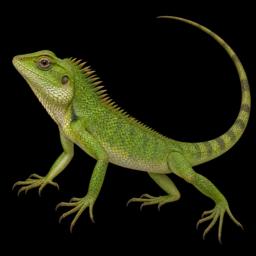
A bright green lizard with a spiny crest, living in the forests of southern India and Sri Lanka. In the breeding season males turn the head and throat a vivid red, which stands out sharply against the green of the forest.
Common Green Forest Lizard at a glance
Reptile · South Asia · Wet and moist forests · Relatively common
Known for: Bright green body with pale cross-bands, Row of spines along the neck and back, Very long, Slender body flattened from side to side
Its Power
Colour Signal
Green to hide, red to signal.
Stay unremarkable most of the time and make a strong, clear signal only when the moment calls for it.
“Blend, then flash red.”
Capture a Common Green Forest Lizard, and it's yours when you finish one step it gives you.
Biological basis
Calotes calotes is bright green among forest leaves, which helps it avoid snakes and birds of prey, but breeding males turn the head and throat vivid red, a display that stands out sharply to rivals and females.
Put it into practice
A quiet engineer rarely speaks in weekly meetings, but when a design change threatens safety she presents a single clear chart to the board and gets it reversed.
What does the common green forest lizard symbolize?
The common green forest lizard symbolizes colour signal: green to hide, red to signal. It represents speaking up, mode switching and clear communication. Its AnimalDex motto: "Blend, then flash red."
The common green forest lizard as a spirit animal
If the common green forest lizard is your spirit animal, the AnimalDex reading is Colour Signal: stay unremarkable most of the time and make a strong, clear signal only when the moment calls for it. It suggests a strength in speaking up and mode switching, and a reminder to use it on purpose.
What can the common green forest lizard help you with in life?
The common green forest lizard is a guide for speaking up, mode switching and clear communication. Its lesson applies wherever speaking up matters: stay unremarkable most of the time and make a strong, clear signal only when the moment calls for it.
- Speaking Up
- Mode Switching
- Clear Communication
In practice: A quiet engineer rarely speaks in weekly meetings, but when a design change threatens safety she presents a single clear chart to the board and gets it reversed.
What can we learn from the Common Green Forest Lizard?What does it mean to dream about or encounter a wild common green forest lizard?
A wild common green forest lizard, whether in a dream or in front of you, tends to show up when speaking up or mode switching is on your mind. In AnimalDex, the common green forest lizard's principle is Colour Signal: green to hide, red to signal. Read the moment through its core lesson: Stay unremarkable most of the time and make a strong, clear signal only when the moment calls for it.
Neither good nor bad on its own. How the common green forest lizard acts matters: at ease, it reflects speaking up; hostile, it flags speaking up out of balance.
Spotting a common green forest lizard in the wild
If a common green forest lizard crosses your path, take it as a cue to look at where speaking up fits your day. Its AnimalDex motto: "Blend, then flash red."
A common green forest lizard that keeps appearing
A common green forest lizard that keeps turning up points to mode switching you keep circling back to. The repetition is the message.
Dreaming of being chased by a common green forest lizard
A chase often means a demand for speaking up is catching up with you. The common green forest lizard's lesson, "Stay unremarkable most of the time and make a strong, clear signal only when the moment calls for it", is the part you may be running from.
Dreaming that a common green forest lizard attacks you
An attack points to speaking up turned against you: someone using it on you, or your own speaking up overused until it costs you.
A calm or friendly common green forest lizard
Meeting a peaceful common green forest lizard is usually encouraging: mode switching and clear communication are within reach.
A dead or injured common green forest lizard
Seeing the common green forest lizard hurt may point to mode switching that has been neglected. Ask what it would take to restore it.
These readings are reflective prompts drawn from how the common green forest lizard really lives, not predictions. If you meet one in the wild, watch from a distance and leave it undisturbed.
Capture your own Common Green Forest Lizard
Photograph or film one in the wild, at a zoo or at home with the app. It becomes yours: it remembers you, gives you steps, and can debate your problems with your other animals.
Animal field guide
Common Green Forest Lizard
Sign in to hear this read by a natural AI voice instead of your browser's.
A bright green lizard with a spiny crest, living in the forests of southern India and Sri Lanka. In the breeding season males turn the head and throat a vivid red, which stands out sharply against the green of the forest.
Native range
Natural range, not this capture location
Wet and moist forests, wooded hills, shaded plantations and well-wooded gardens, from the lowlands into the hills. It lives mainly on tree trunks and in shrubs rather than on the ground.
Search near meAnimalDex stats
Size scale
Understand the animal
Understand the Common Green Forest Lizard
Factual biology first: what this animal is like, where it lives, how it survives, and why those traits exist.
01
Introduction to Common Green Forest Lizard
A bright green lizard with a spiny crest, living in the forests of southern India and Sri Lanka. In the breeding season males turn the head and throat a vivid red, which stands out sharply against the green of the forest.
How to identify a Common Green Forest Lizard
- Bright green body with pale cross-bands
- Row of spines along the neck and back
- Very long, slender tail
- Slender body flattened from side to side
Why Common Green Forest Lizard are interesting
- Linnaeus named it Lacerta calotes in 1758; Cuvier later built the genus name Calotes from that species name, which makes this lizard the genus's type species.
- Its bright green can darken to olive or brownish within minutes when the lizard is cold or alarmed.
- Large adults measure roughly 12 to 14 cm from snout to vent, with the tail adding much more to the total length.
- Like other agamid lizards, most of its teeth are fused to the crest of the jawbone rather than set in sockets.
02
Adaptations and biological abilities
03
Why does Common Green Forest Lizard behave this way?
- Bright green body with pale cross-bands
- Row of spines along the neck and back
- Very long, slender tail
- Slender body flattened from side to side
Active by day, basking in morning sun. At night it sleeps clinging to a branch, twig or leaf in the vegetation.
04
Why Wet and moist forests?
Habitat: Wet and moist forests, wooded hills, shaded plantations and well-wooded gardens, from the lowlands into the hills. It lives mainly on tree trunks and in shrubs rather than on the ground.
Native range: South Asia
Native range
Natural range, not this specific capture location.
Wet and moist forests, wooded hills, shaded plantations and well-wooded gardens, from the lowlands into the hills. It lives mainly on tree trunks and in shrubs rather than on the ground.
05
Why this diet?
Mainly insects such as grasshoppers, beetles, caterpillars and ants. It waits on a trunk or branch and dashes out to seize prey that moves nearby.
06
Activity, rest, and lifespan
Active by day, basking in morning sun. At night it sleeps clinging to a branch, twig or leaf in the vegetation.
No reliable figures exist for how long it lives in the wild.
07
Common Green Forest Lizard reproduction
Females come down to the ground to bury a clutch of several eggs in soil or leaf litter. There is no parental care, and hatchlings climb into vegetation soon after emerging.
Males are larger, with bigger heads and taller crests. Females have smaller crests and keep a plainer green colouring through the year.
08
Predators, threats, and defense
09
Conservation and rarity
Rarity: Relatively common · 41/100. AnimalDex canonical rarity score: 41/100, maintained by the live indexed species profile.
- Observe from a respectful distance and avoid changing the animal's behavior.
- Do not block feeding, shelter, nesting, or travel routes.
- Use a live camera capture without handling or staging wildlife.
Talk to it
Talk to the Common Green Forest Lizard
It answers as itself: ask about how it lives, or bring it something of yours and hear what it would do, from its own Power.
Anonymous: 6/day. Signed-in: 10/day. Pro: 100/day.
Side by side
The Common Green Forest Lizard, side by side
Nothing written side by side for the Common Green Forest Lizard yet. Pick any animal to compare it with. Compare with any animal →
Where to find them
Where to find Common Green Forest Lizard
To find Common Green Forest Lizard in the wild, focus on the exact habitat patches that match its body design and daily behavior, not just the broad country where it exists. You usually do better by working one good piece of habitat inside south Asia than by covering too much ground.
- Forest edge, canopy gaps, fruiting trees, or shaded trails where cover and food meet
- Protected habitat blocks within south Asia
Where explorers saw it
- Wild safari with Anu, Cejlon, Zentralprovinz (Sri Lanka)Sep · 1 sighting
Guides to seeing Common Green Forest Lizard
In the Ark
1 Common Green Forest Lizard is aboard right now.
Since November 5: 1 came aboard.
The Ark is a live, shared animal world. Animals come aboard when people capture them, and live there by rules based on their field guides.
Scientific name
Calotes calotes
Category
Reptile
Habitat
Wet and moist forests, wooded hills, shaded plantations and well-wooded gardens, from the lowlands into the hills. It lives mainly on tree trunks and in shrubs rather than on the ground.
Rarity
Relatively common · 41/100
Native range
South Asia
Take the encyclopedia outside
AnimalDex helps you scan real animals, identify species, collect cards, and learn from nature wherever you are.