
Animal field guide
Crested Fireback
Lophura ignita
This rainforest pheasant courts with sound as well as colour. Like other firebacks, a displaying male is reported to draw himself up and whirr his wings rapidly, making a loud rattle.
Crested Fireback at a glance
Animal · Southeast Asia · Crested Firebacks are native to the · Uncommon
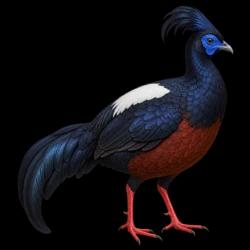
Known for: Short, Bare blue facial skin around the eye, Coppery-red lower back and rump in males, Scaled black-and-white underparts in females
Its Power
Confident Display Pattern
Show your true colors when the moment is right.
The Crested Fireback uses its vibrant plumage to attract mates and assert territory, teaching us the power of confident self-expression in key moments.
“Shine with purpose.”
Capture a Crested Fireback, and it's yours when you finish one step it gives you.
Biological basis
The male Crested Fireback displays its striking feathers during courtship and territorial displays, using visual signals to communicate strength and vitality.
Put it into practice
A quiet chorister steps forward for the solo audition and sings at full voice.
What does the crested fireback symbolize?
The crested fireback symbolizes confident display pattern: show your true colors when the moment is right. It represents self-expression, right timing and intentional connection. Its AnimalDex motto: "Shine with purpose."
The crested fireback as a spirit animal
If the crested fireback is your spirit animal, the AnimalDex reading is Confident Display Pattern: the Crested Fireback uses its vibrant plumage to attract mates and assert territory, teaching us the power of confident self-expression in key moments. It suggests a strength in self-expression and right timing, and a reminder to use it on purpose.
What can the crested fireback help you with in life?
The crested fireback is a guide for self-expression, right timing and intentional connection. Its lesson applies wherever self-expression matters: the Crested Fireback uses its vibrant plumage to attract mates and assert territory, teaching us the power of confident self-expression in key moments.
- Self-Expression
- Right Timing
- Intentional Connection
In practice: A quiet chorister steps forward for the solo audition and sings at full voice.
What can we learn from the Crested Fireback?What does it mean to dream about or encounter a wild crested fireback?
A wild crested fireback, whether in a dream or in front of you, tends to show up when self-expression or right timing is on your mind. In AnimalDex, the crested fireback's principle is Confident Display Pattern: show your true colors when the moment is right. Read the moment through its core lesson: The Crested Fireback uses its vibrant plumage to attract mates and assert territory, teaching us the power of confident self-expression in key moments.
Neither good nor bad on its own. How the crested fireback acts matters: at ease, it reflects self-expression; hostile, it flags self-expression out of balance.
Spotting a crested fireback in the wild
If a crested fireback crosses your path, take it as a cue to look at where self-expression fits your day. Its AnimalDex motto: "Shine with purpose."
A crested fireback that keeps appearing
Seeing the crested fireback again and again, in dreams or outside, suggests self-expression is a theme you have not settled yet.
Dreaming of being chased by a crested fireback
If the crested fireback pursues you, look at where right timing is being asked of you and you are stepping away instead of meeting it.
Dreaming that a crested fireback attacks you
An attack points to self-expression turned against you: someone using it on you, or your own self-expression overused until it costs you.
A calm or friendly crested fireback
A calm crested fireback suggests you have made peace with self-expression and can use it without force.
A dead or injured crested fireback
An injured crested fireback often reflects self-expression under strain; rest and repair come before pushing again.
These readings are reflective prompts drawn from how the crested fireback really lives, not predictions. If you meet one in the wild, watch from a distance and leave it undisturbed.
Capture your own Crested Fireback
Photograph or film one in the wild, at a zoo or at home with the app. It becomes yours: it remembers you, gives you steps, and can debate your problems with your other animals.
Animal field guide
Crested Fireback
Sign in to hear this read by a natural AI voice instead of your browser's.
This rainforest pheasant courts with sound as well as colour. Like other firebacks, a displaying male is reported to draw himself up and whirr his wings rapidly, making a loud rattle.
Native range
Natural range, not this capture location
Crested Firebacks are native to the Malay Peninsula, Sumatra, Borneo, and nearby parts of Southeast Asia. They inhabit lowland tropical rainforest, swamp forest, forest floor, and dense primary or mature secondary woodland.
Search near meAnimalDex stats
Size scale
Understand the animal
Understand the Crested Fireback
Factual biology first: what this animal is like, where it lives, how it survives, and why those traits exist.
01
Introduction to Crested Fireback
This rainforest pheasant courts with sound as well as colour. Like other firebacks, a displaying male is reported to draw himself up and whirr his wings rapidly, making a loud rattle.
How to identify a Crested Fireback
- Short, bushy crest held upright
- Bare blue facial skin around the eye
- Coppery-red lower back and rump in males
- Scaled black-and-white underparts in females
Why Crested Fireback are interesting
- Subspecies differ in the colour of the male's flanks and central tail feathers, which may be white or buff.
- Males carry sharp spurs on the legs, used in fights with rival males.
- At night it roosts off the ground in trees, flying up at dusk.
- Clearance of lowland rainforest has led to its listing as Near Threatened.
02
Adaptations and biological abilities
03
Why does Crested Fireback behave this way?
- Short, bushy crest held upright
- Bare blue facial skin around the eye
- Coppery-red lower back and rump in males
- Scaled black-and-white underparts in females
Active by day, mainly at dawn and in late afternoon. At night birds fly up to roost on branches above the forest floor.
04
Why Crested Firebacks are native to the Malay Peninsula?
Habitat: Crested Firebacks are native to the Malay Peninsula, Sumatra, Borneo, and nearby parts of Southeast Asia. They inhabit lowland tropical rainforest, swamp forest, forest floor, and dense primary or mature secondary woodland.
Native range: Southeast Asia
Native range
Natural range, not this specific capture location.
Crested Firebacks are native to the Malay Peninsula, Sumatra, Borneo, and nearby parts of Southeast Asia. They inhabit lowland tropical rainforest, swamp forest, forest floor, and dense primary or mature secondary woodland.
05
Why this diet?
06
Activity, rest, and lifespan
Active by day, mainly at dawn and in late afternoon. At night birds fly up to roost on branches above the forest floor.
Wild lifespan has not been documented; ages reached in aviaries are not reliably reported.
07
Crested Fireback reproduction
Breeding in the wild is poorly documented. The nest is a scrape on the forest floor, and captive hens lay about four to eight creamy eggs, incubated by the female for around three and a half weeks. Chicks follow the hen soon after hatching.
Strongly different. Males are larger and mostly blue-black with a long arched tail; females are rich brown with a shorter crest and tail.
08
Predators, threats, and defense
09
Conservation and rarity
Rarity: Uncommon · 65/100. AnimalDex canonical rarity score: 65/100, maintained by the live indexed species profile.
- Observe from a respectful distance and avoid changing the animal's behavior.
- Do not block feeding, shelter, nesting, or travel routes.
- Use a live camera capture without handling or staging wildlife.
Talk to it
Talk to the Crested Fireback
It answers as itself: ask about how it lives, or bring it something of yours and hear what it would do, from its own Power.
Anonymous: 6/day. Signed-in: 10/day. Pro: 100/day.
Side by side
The Crested Fireback, side by side
Nothing written side by side for the Crested Fireback yet. Pick any animal to compare it with. Compare with any animal →
Where to find them
Where to find Crested Fireback
To find Crested Fireback in the wild, focus on the exact habitat patches that match its body design and daily behavior, not just the broad country where it exists. You usually do better by working one good piece of habitat inside southeast Asia than by covering too much ground.
- Forest edge, canopy gaps, fruiting trees, or shaded trails where cover and food meet
- Protected habitat blocks within southeast Asia
In the Ark
2 Crested Firebacks are aboard right now.
None have come aboard or left since November 17.
The Ark is a live, shared animal world. Animals come aboard when people capture them, and live there by rules based on their field guides.
Scientific name
Lophura ignita
Category
Animal
Habitat
Crested Firebacks are native to the Malay Peninsula, Sumatra, Borneo, and nearby parts of Southeast Asia. They inhabit lowland tropical rainforest, swamp forest, forest floor, and dense primary or mature secondary woodland.
Rarity
Uncommon · 65/100
Native range
Southeast Asia
Take the encyclopedia outside
AnimalDex helps you scan real animals, identify species, collect cards, and learn from nature wherever you are.