Animal field guide
Eastern Lubber Grasshopper
Romalea microptera
A heavy, slow grasshopper of the south-eastern United States whose short wings cannot lift it off the ground. Instead of fleeing, it advertises: yellow, orange and black colouring, then a hiss of air forced from its breathing pores and a bubbling, foul-smelling froth when handled.
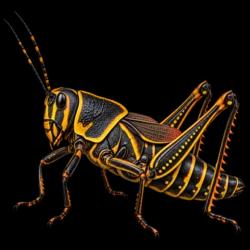
Eastern Lubber Grasshopper at a glance
Invertebrate · North America · Open · Relatively common
Known for: Bulky body, Short wings that do not reach the abdomen tip, Yellow or orange body with bold black markings, Black nymphs with a thin yellow or red stripe
Its Power
Warned Off
Say clearly what you are, and the fight need not happen.
Bright warning colours show how clearly setting boundaries can prevent constant threat.
“Announce it early.”
Capture a Eastern Lubber Grasshopper, and it's yours when you finish one step it gives you.
Biological basis
Romalea microptera is too heavy to fly and slow on the ground, so it defends itself in advance: bold yellow, red and black colouring, a loud hiss, and a foul froth sprayed from the thorax, all announcing toxicity before anything commits to an attack.
Put it into practice
A plumber states his rates and hours on the first call, so nobody haggles or rings at midnight.
What does the eastern lubber grasshopper symbolize?
The eastern lubber grasshopper symbolizes warned off: say clearly what you are, and the fight need not happen. It represents boundaries, conflict prevention and quiet confidence. Its AnimalDex motto: "Announce it early."
The eastern lubber grasshopper as a spirit animal
If the eastern lubber grasshopper is your spirit animal, the AnimalDex reading is Warned Off: bright warning colours show how clearly setting boundaries can prevent constant threat. It suggests a strength in boundaries and conflict prevention, and a reminder to use it on purpose.
What can the eastern lubber grasshopper help you with in life?
The eastern lubber grasshopper is a guide for boundaries, conflict prevention and quiet confidence. Its lesson applies wherever boundaries matters: bright warning colours show how clearly setting boundaries can prevent constant threat.
- Boundaries
- Conflict Prevention
- Quiet Confidence
In practice: A plumber states his rates and hours on the first call, so nobody haggles or rings at midnight.
What can we learn from the Eastern Lubber Grasshopper?What does it mean to dream about or encounter a wild eastern lubber grasshopper?
Dreaming about a wild eastern lubber grasshopper, or coming across one, usually points to boundaries and conflict prevention: the qualities the eastern lubber grasshopper lives by. In AnimalDex, the eastern lubber grasshopper's principle is Warned Off: say clearly what you are, and the fight need not happen. Read the moment through its core lesson: Bright warning colours show how clearly setting boundaries can prevent constant threat.
Neither good nor bad on its own. How the eastern lubber grasshopper acts matters: at ease, it reflects boundaries; hostile, it flags boundaries out of balance.
Spotting an eastern lubber grasshopper in the wild
If an eastern lubber grasshopper crosses your path, take it as a cue to look at where boundaries fits your day. Its AnimalDex motto: "Announce it early."
An eastern lubber grasshopper that keeps appearing
Seeing the eastern lubber grasshopper again and again, in dreams or outside, suggests boundaries is a theme you have not settled yet.
Dreaming of being chased by an eastern lubber grasshopper
A chase often means a demand for boundaries is catching up with you. The eastern lubber grasshopper's lesson, "Bright warning colours show how clearly setting boundaries can prevent constant threat", is the part you may be running from.
Dreaming that an eastern lubber grasshopper attacks you
An aggressive eastern lubber grasshopper can mirror a conflict where boundaries has become a weapon rather than a strength.
A calm or friendly eastern lubber grasshopper
A calm eastern lubber grasshopper suggests you have made peace with boundaries and can use it without force.
A dead or injured eastern lubber grasshopper
A dead or injured eastern lubber grasshopper, dreamed or found, can mark boundaries you have let lapse, or a phase built on Warned Off coming to an end.
These readings are reflective prompts drawn from how the eastern lubber grasshopper really lives, not predictions. If you meet one in the wild, watch from a distance and leave it undisturbed.
Capture your own Eastern Lubber Grasshopper
Photograph or film one in the wild, at a zoo or at home with the app. It becomes yours: it remembers you, gives you steps, and can debate your problems with your other animals.
Animal field guide
Eastern Lubber Grasshopper
Sign in to hear this read by a natural AI voice instead of your browser's.
A heavy, slow grasshopper of the south-eastern United States whose short wings cannot lift it off the ground. Instead of fleeing, it advertises: yellow, orange and black colouring, then a hiss of air forced from its breathing pores and a bubbling, foul-smelling froth when handled.
Native range
Natural range, not this capture location
Open, sunny ground with plenty of low herbs: weedy fields, pine flatwoods, ditch banks, marsh edges, roadsides and gardens across the lowland south-eastern United States, especially where the soil stays damp.
Search near meAnimalDex stats
Dominance
9
Speed
7
Size
6
Intelligence
6
Rarity
22%
Total
50
Size scale
Understand the animal
Understand the Eastern Lubber Grasshopper
Factual biology first: what this animal is like, where it lives, how it survives, and why those traits exist.
01
Introduction to Eastern Lubber Grasshopper
A heavy, slow grasshopper of the south-eastern United States whose short wings cannot lift it off the ground. Instead of fleeing, it advertises: yellow, orange and black colouring, then a hiss of air forced from its breathing pores and a bubbling, foul-smelling froth when handled.
How to identify a Eastern Lubber Grasshopper
- Bulky body, adults roughly 4 to 9 centimetres long
- Short wings that do not reach the abdomen tip
- Yellow or orange body with bold black markings
- Black nymphs with a thin yellow or red stripe
- Slow, clumsy walk and only a weak hop
Why Eastern Lubber Grasshopper are interesting
- Studies have found that the defensive froth can contain chemicals taken from the plants the grasshopper has eaten, so its make-up changes with diet.
- It belongs to the lubber grasshopper family, Romaleidae, whose members live in the warmer parts of the Americas.
- Because it is large and easy to keep, it has long been used in university teaching labs for insect dissection and physiology.
- Adults vary in colour; some are mostly yellow, others largely black, and the mix of forms is reported to differ from place to place.
02
Adaptations and biological abilities
03
Why does Eastern Lubber Grasshopper behave this way?
- Bulky body, adults roughly 4 to 9 centimetres long
- Short wings that do not reach the abdomen tip
- Yellow or orange body with bold black markings
- Black nymphs with a thin yellow or red stripe
- Slow, clumsy walk and only a weak hop
Active by day, it basks in early sun before feeding. At night and in bad weather it rests clinging to stems and leaves of low vegetation, often in small groups.
04
Why Open?
Habitat: Open, sunny ground with plenty of low herbs: weedy fields, pine flatwoods, ditch banks, marsh edges, roadsides and gardens across the lowland south-eastern United States, especially where the soil stays damp.
Native range: North America
Native range
Natural range, not this specific capture location.
Open, sunny ground with plenty of low herbs: weedy fields, pine flatwoods, ditch banks, marsh edges, roadsides and gardens across the lowland south-eastern United States, especially where the soil stays damp.
05
Why this diet?
Chews the leaves of a wide range of wild herbs and garden plants, including many that other insects avoid. In Florida gardens it is known to damage amaryllis, crinum lilies and citrus.
06
Activity, rest, and lifespan
Active by day, it basks in early sun before feeding. At night and in bad weather it rests clinging to stems and leaves of low vegetation, often in small groups.
About one year in total: eggs spend autumn and winter in the soil, and the active nymph and adult stages last roughly from spring to late autumn.
07
Eastern Lubber Grasshopper reproduction
Females push the abdomen into the soil and lay pods of several dozen eggs, often more than one pod per season. The eggs overwinter and hatch in spring; the young receive no care and pass through several moults before becoming adults in summer.
Females are noticeably longer and heavier than males. Colour patterns are much the same in both sexes.
08
Predators, threats, and defense
09
Conservation and rarity
Rarity: Relatively common · 22/100. AnimalDex canonical rarity score: 22/100, maintained by the live indexed species profile.
- Observe from a respectful distance and avoid changing the animal's behavior.
- Do not block feeding, shelter, nesting, or travel routes.
- Use a live camera capture without handling or staging wildlife.
Talk to it
Talk to the Eastern Lubber Grasshopper
It answers as itself: ask about how it lives, or bring it something of yours and hear what it would do, from its own Power.
Anonymous: 3/day. Signed-in: 10/day. Pro: 100/day.
Side by side
The Eastern Lubber Grasshopper, side by side
Nothing written side by side for the Eastern Lubber Grasshopper yet. Pick any animal to compare it with. Compare with any animal →
Where to find them
Where to find Eastern Lubber Grasshopper
To find Eastern Lubber Grasshopper in the wild, focus on the exact habitat patches that match its body design and daily behavior, not just the broad country where it exists. You usually do better by working one good piece of habitat inside north America than by covering too much ground.
- Quiet marsh edges, reedbeds, river bends, or shallow wetland margins
- Protected habitat blocks within north America
Scientific name
Romalea microptera
Category
Invertebrate
Habitat
Open, sunny ground with plenty of low herbs: weedy fields, pine flatwoods, ditch banks, marsh edges, roadsides and gardens across the lowland south-eastern United States, especially where the soil stays damp.
Rarity
Relatively common · 22/100
Native range
North America
Take the encyclopedia outside
AnimalDex helps you scan real animals, identify species, collect cards, and learn from nature wherever you are.