Animal field guide
Fox Squirrel
Sciurus niger
Usually counted as North America's largest tree squirrel, typically about 45 to 70 centimetres from nose to tail tip and roughly half a kilogram to a kilogram in weight. Heavy and deliberate, it spends much of its day foraging on the ground rather than in the branches.
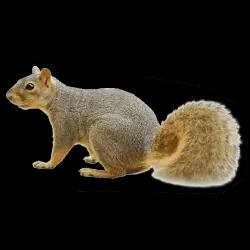
Fox Squirrel at a glance
Mammal · North America · Open woodland with scattered large · Relatively common
Known for: Long bushy tail with orange-edged hairs, Rusty-orange to yellowish belly in many populations, Grizzled grey-brown back washed with orange, Some southern animals black
Its Power
Resourceful Gathering
Collect and store resources for future needs.
Fox squirrels are adept at gathering and storing food, ensuring they have enough supplies to survive leaner times. This teaches us the value of preparation and foresight.
“Plan for tomorrow.”
Capture a Fox Squirrel, and it's yours when you finish one step it gives you.
Biological basis
Fox squirrels are known for their behavior of caching nuts and seeds in various locations to ensure they have food available during scarce periods.
Put it into practice
A seasonal worker spreads summer wages across three savings pots to cover the quiet winter months.
What does the fox squirrel symbolize?
The fox squirrel symbolizes resourceful gathering: collect and store resources for future needs. It represents saving for later, discernment and planning. Its AnimalDex motto: "Plan for tomorrow."
The fox squirrel as a spirit animal
If the fox squirrel is your spirit animal, the AnimalDex reading is Resourceful Gathering: fox squirrels are adept at gathering and storing food, ensuring they have enough supplies to survive leaner times. This teaches us the value of preparation and foresight. It suggests a strength in saving for later and discernment, and a reminder to use it on purpose.
What can the fox squirrel help you with in life?
The fox squirrel is a guide for saving for later, discernment and planning. Its lesson applies wherever saving for later matters: fox squirrels are adept at gathering and storing food, ensuring they have enough supplies to survive leaner times. This teaches us the value of preparation and foresight.
- Saving for Later
- Discernment
- Planning
In practice: A seasonal worker spreads summer wages across three savings pots to cover the quiet winter months.
What can we learn from the Fox Squirrel?What does it mean to dream about or encounter a wild fox squirrel?
Meeting a wild fox squirrel, asleep or awake, is often a nudge toward saving for later, the quality the fox squirrel is built around. In AnimalDex, the fox squirrel's principle is Resourceful Gathering: collect and store resources for future needs. Read the moment through its core lesson: Fox squirrels are adept at gathering and storing food, ensuring they have enough supplies to survive leaner times. This teaches us the value of preparation and foresight.
It depends on how the fox squirrel behaved. Calm or close by, it reads as discernment within reach; aggressive or fleeing, it points to saving for later you are resisting.
Spotting a fox squirrel in the wild
If a fox squirrel crosses your path, take it as a cue to look at where saving for later fits your day. Its AnimalDex motto: "Plan for tomorrow."
A fox squirrel that keeps appearing
A fox squirrel that keeps turning up points to discernment you keep circling back to. The repetition is the message.
Dreaming of being chased by a fox squirrel
Being chased suggests you are avoiding the Resourceful Gathering the fox squirrel stands for: fox squirrels are adept at gathering and storing food, ensuring they have enough supplies to survive leaner times. This teaches us the value of preparation and foresight. Ask what you keep postponing that needs saving for later.
Dreaming that a fox squirrel attacks you
An aggressive fox squirrel can mirror a conflict where saving for later has become a weapon rather than a strength.
A calm or friendly fox squirrel
A calm fox squirrel suggests you have made peace with saving for later and can use it without force.
A dead or injured fox squirrel
A dead or injured fox squirrel, dreamed or found, can mark saving for later you have let lapse, or a phase built on Resourceful Gathering coming to an end.
These readings are reflective prompts drawn from how the fox squirrel really lives, not predictions. If you meet one in the wild, watch from a distance and leave it undisturbed.
Capture your own Fox Squirrel
Photograph or film one in the wild, at a zoo or at home with the app. It becomes yours: it remembers you, gives you steps, and can debate your problems with your other animals.
Animal field guide
Fox Squirrel
Sign in to hear this read by a natural AI voice instead of your browser's.
Usually counted as North America's largest tree squirrel, typically about 45 to 70 centimetres from nose to tail tip and roughly half a kilogram to a kilogram in weight. Heavy and deliberate, it spends much of its day foraging on the ground rather than in the branches.
Native range
Natural range, not this capture location
Open woodland with scattered large oaks, hickories, walnuts and pines, woodland edges, farm woodlots, river-bottom forest and town parks. It favours more open stands with a thin understorey than dense forest.
Search near meAnimalDex stats
Dominance
24
Speed
36
Size
18
Intelligence
40
Rarity
9%
Total
127
Size scale
Understand the animal
Understand the Fox Squirrel
Factual biology first: what this animal is like, where it lives, how it survives, and why those traits exist.
01
Introduction to Fox Squirrel
Usually counted as North America's largest tree squirrel, typically about 45 to 70 centimetres from nose to tail tip and roughly half a kilogram to a kilogram in weight. Heavy and deliberate, it spends much of its day foraging on the ground rather than in the branches.
How to identify a Fox Squirrel
- Long bushy tail with orange-edged hairs
- Rusty-orange to yellowish belly in many populations
- Grizzled grey-brown back washed with orange
- Some southern animals black, often with white nose and ears
Why Fox Squirrel are interesting
- Its bones and teeth are tinged pink by porphyrin pigments and glow red under ultraviolet light.
- The Delmarva fox squirrel, a subspecies of the Chesapeake Bay region, was removed from the US endangered species list in 2015.
- It has been introduced to parts of the western United States, where it is now common in some towns.
- Strong jaws let it gnaw into thick-shelled black walnuts and hickory nuts.
02
Adaptations and biological abilities
03
Why does Fox Squirrel behave this way?
- Long bushy tail with orange-edged hairs
- Rusty-orange to yellowish belly in many populations
- Grizzled grey-brown back washed with orange
- Some southern animals black, often with white nose and ears
Active by day, tending to start later in the morning than many squirrels. Nights, storms and hard cold are spent in a leafy drey high in a tree fork or in a tree cavity.
04
Why Open woodland with scattered large oaks?
Habitat: Open woodland with scattered large oaks, hickories, walnuts and pines, woodland edges, farm woodlots, river-bottom forest and town parks. It favours more open stands with a thin understorey than dense forest.
Native range: North America
Native range
Natural range, not this specific capture location.
Open woodland with scattered large oaks, hickories, walnuts and pines, woodland edges, farm woodlots, river-bottom forest and town parks. It favours more open stands with a thin understorey than dense forest.
05
Why this diet?
Acorns, hickory nuts, walnuts and pine seeds make up much of the diet, with buds, flowers, fruit, fungi, maize, insects and the occasional bird's egg. In spring it climbs out to twig tips for buds and flowers, and from late summer it cuts nuts from the branches.
06
Activity, rest, and lifespan
Active by day, tending to start later in the morning than many squirrels. Nights, storms and hard cold are spent in a leafy drey high in a tree fork or in a tree cavity.
Most wild fox squirrels live fewer than about 5 years, and many die in their first year; exceptionally, wild animals have passed 10.
07
Fox Squirrel reproduction
Mating chases happen in midwinter and early summer. After about 45 days' gestation the female bears usually two to four young in a drey or cavity and raises them alone; their eyes open at about five weeks and they are weaned at roughly three months.
The sexes look alike in colour, pattern and size and are hard to tell apart at a distance; nursing females show visible teats on the belly.
08
Predators, threats, and defense
Red-tailed hawks, great horned owls, bobcats, foxes, coyotes and dogs take fox squirrels, snakes raid nests, and people hunt them. A threatened squirrel slips round to the far side of a trunk or climbs high, chattering and flicking its tail.
09
Conservation and rarity
Rarity: Relatively common · 9/100. AnimalDex canonical rarity score: 9/100, maintained by the live indexed species profile.
- Observe from a respectful distance and avoid changing the animal's behavior.
- Do not block feeding, shelter, nesting, or travel routes.
- Use a live camera capture without handling or staging wildlife.
Talk to it
Talk to the Fox Squirrel
It answers as itself: ask about how it lives, or bring it something of yours and hear what it would do, from its own Power.
Anonymous: 3/day. Signed-in: 10/day. Pro: 100/day.
Side by side
The Fox Squirrel, side by side
Nothing written side by side for the Fox Squirrel yet. Pick any animal to compare it with. Compare with any animal →
Where to find them
Where to find Fox Squirrel
To find Fox Squirrel in the wild, focus on the exact habitat patches that match its body design and daily behavior, not just the broad country where it exists. You usually do better by working one good piece of habitat inside north America than by covering too much ground.
- Quiet marsh edges, reedbeds, river bends, or shallow wetland margins
- Forest edge, canopy gaps, fruiting trees, or shaded trails where cover and food meet
- Sunlit logs, exposed branches, warm rocks, or regular perch sites used for scanning
Where explorers saw it
- Prattville, Autauga County, United StatesAug · 1 sighting
Guides to seeing Fox Squirrel
Scientific name
Sciurus niger
Category
Mammal
Habitat
Open woodland with scattered large oaks, hickories, walnuts and pines, woodland edges, farm woodlots, river-bottom forest and town parks. It favours more open stands with a thin understorey than dense forest.
Rarity
Relatively common · 9/100
Native range
North America
Take the encyclopedia outside
AnimalDex helps you scan real animals, identify species, collect cards, and learn from nature wherever you are.