
Animal field guide
Geometer Moth
Geometridae
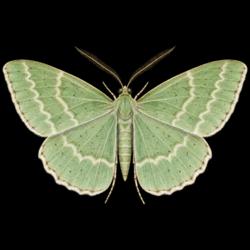
A family of about 23,000 moth species with slender bodies and broad, thin wings, often held spread flat at rest. Their caterpillars have lost most of the middle prolegs, so they walk by drawing the rear end up to the front and looping the body forward. When still, many hold rigid at an angle from a twig.
Geometer Moth at a glance
Invertebrate · Australia & Oceania · Woodland · Relatively common
Known for: Slender body with broad, Wings usually held flat and spread at rest, Wavy lines running across fore and hind wings, Weak
Its Power
Measured Advance
Move in measured steps and the distance still closes.
Careful, measured steps can still cover surprising distances over time.
“Loop, and keep going.”
Capture a Geometer Moth, and it's yours when you finish one step it gives you.
Biological basis
Geometrid caterpillars have lost most of their middle prolegs, so they travel by drawing the rear end up to the front and looping the body forward — the earth-measuring gait that names the family — and hold rigid at an angle from a twig when still.
Put it into practice
A man pays off a large debt with the same small payment every Friday for six years.
What does the geometer moth symbolize?
The geometer moth symbolizes measured advance: move in measured steps and the distance still closes. It represents pacing, patient progress and discipline. Its AnimalDex motto: "Loop, and keep going."
The geometer moth as a spirit animal
If the geometer moth is your spirit animal, the AnimalDex reading is Measured Advance: careful, measured steps can still cover surprising distances over time. It suggests a strength in pacing and patient progress, and a reminder to use it on purpose.
What can the geometer moth help you with in life?
The geometer moth is a guide for pacing, patient progress and discipline. Its lesson applies wherever pacing matters: careful, measured steps can still cover surprising distances over time.
- Pacing
- Patient Progress
- Discipline
In practice: A man pays off a large debt with the same small payment every Friday for six years.
What can we learn from the Geometer Moth?What does it mean to dream about or encounter a wild geometer moth?
A wild geometer moth, whether in a dream or in front of you, tends to show up when pacing or patient progress is on your mind. In AnimalDex, the geometer moth's principle is Measured Advance: move in measured steps and the distance still closes. Read the moment through its core lesson: Careful, measured steps can still cover surprising distances over time.
Neither good nor bad on its own. How the geometer moth acts matters: at ease, it reflects pacing; hostile, it flags pacing out of balance.
Spotting a geometer moth in the wild
If a geometer moth crosses your path, take it as a cue to look at where pacing fits your day. Its AnimalDex motto: "Loop, and keep going."
A geometer moth that keeps appearing
Seeing the geometer moth again and again, in dreams or outside, suggests pacing is a theme you have not settled yet.
Dreaming of being chased by a geometer moth
Being chased suggests you are avoiding the Measured Advance the geometer moth stands for: careful, measured steps can still cover surprising distances over time. Ask what you keep postponing that needs pacing.
Dreaming that a geometer moth attacks you
When the geometer moth attacks, the dream may be about pressure: patient progress or discipline applied too hard, by you or by someone close to you.
A calm or friendly geometer moth
Meeting a peaceful geometer moth is usually encouraging: patient progress and discipline are within reach.
A dead or injured geometer moth
A dead or injured geometer moth, dreamed or found, can mark pacing you have let lapse, or a phase built on Measured Advance coming to an end.
These readings are reflective prompts drawn from how the geometer moth really lives, not predictions. If you meet one in the wild, watch from a distance and leave it undisturbed.
Capture your own Geometer Moth
Photograph or film one in the wild, at a zoo or at home with the app. It becomes yours: it remembers you, gives you steps, and can debate your problems with your other animals.
Animal field guide
Geometer Moth
Sign in to hear this read by a natural AI voice instead of your browser's.
A family of about 23,000 moth species with slender bodies and broad, thin wings, often held spread flat at rest. When still, many hold rigid at an angle from a twig.
Native range
Natural range, not this capture location
Woodland, hedgerows, scrub, heath, grassland, gardens and orchards, wherever the caterpillars' food plants grow. The family is most diverse in forests, from lowland tropical rainforest to cool mountain and northern woods, and many species live in towns.
Search near meAnimalDex stats
Size scale
Understand the animal
Understand the Geometer Moth
Factual biology first: what this animal is like, where it lives, how it survives, and why those traits exist.
01
Introduction to Geometer Moth
A family of about 23,000 moth species with slender bodies and broad, thin wings, often held spread flat at rest. Their caterpillars have lost most of the middle prolegs, so they walk by drawing the rear end up to the front and looping the body forward. When still, many hold rigid at an angle from a twig.
How to identify a Geometer Moth
- Slender body with broad, thin wings
- Wings usually held flat and spread at rest
- Wavy lines running across fore and hind wings
- Weak, fluttering flight
- Caterpillar walks by arching its body into a loop
Why Geometer Moth are interesting
- The family name comes from Greek words meaning earth measurer, because the caterpillar seems to pace out the ground span by span.
- The peppered moth, a geometer, became a textbook case of natural selection when dark forms spread through soot-blackened industrial Britain.
- Caterpillars of some Hawaiian pug moths are ambush predators that seize flies and other insects with their clawed front legs.
- Several species, such as the winter moth and the cankerworms, can strip the leaves from orchard and forest trees in outbreak years.
- Caterpillars of some emerald moths fasten fragments of petals and leaves to their backs as camouflage.
02
Adaptations and biological abilities
03
Why does Geometer Moth behave this way?
- Slender body with broad, thin wings
- Wings usually held flat and spread at rest
- Wavy lines running across fore and hind wings
- Weak, fluttering flight
- Caterpillar walks by arching its body into a loop
Most adults fly at dusk and through the night and rest by day flat against bark, walls or the undersides of leaves. A minority of species fly in sunshine. Many caterpillars feed at night and stay motionless by day.
04
Why Woodland?
Habitat: Woodland, hedgerows, scrub, heath, grassland, gardens and orchards, wherever the caterpillars' food plants grow. The family is most diverse in forests, from lowland tropical rainforest to cool mountain and northern woods, and many species live in towns.
Native range: Australia & Oceania, Central Asia, East Asia, Europe, North Africa & Middle East, North America, South America, South Asia, Southeast Asia, Sub-Saharan Africa
Native range
Natural range, not this specific capture location.
Woodland, hedgerows, scrub, heath, grassland, gardens and orchards, wherever the caterpillars' food plants grow. The family is most diverse in forests, from lowland tropical rainforest to cool mountain and northern woods, and many species live in towns.
05
Why this diet?
Caterpillars chew the leaves, buds or flowers of trees, shrubs and herbs, and many species are restricted to a few host plants. Adults of many species sip nectar or sap through a coiled tongue; others have reduced mouthparts and do not feed.
06
Activity, rest, and lifespan
Most adults fly at dusk and through the night and rest by day flat against bark, walls or the undersides of leaves. A minority of species fly in sunshine. Many caterpillars feed at night and stay motionless by day.
Adults usually live one to three weeks. The whole life cycle typically takes a year or less, and temperate species pass the winter as an egg, caterpillar or pupa, depending on species; some have two or more generations a year.
07
Geometer Moth reproduction
Females lay from a few dozen to several hundred eggs, singly or in batches, on or near the food plant. There is no parental care. Caterpillars moult several times, then pupate in soil, leaf litter or a loose cocoon among leaves.
Males of many species have feathery antennae and slimmer bodies, while females have thread-like antennae and stouter abdomens. In some species, including the winter moth, females are wingless or have only wing stubs.
08
Predators, threats, and defense
Birds, bats, spiders and parasitic wasps and flies are the main enemies. Many caterpillars stand rigid like a twig or drop on a silk line when disturbed; adults rely on bark-like patterns and can hear the calls of hunting bats.
09
Conservation and rarity
Rarity: Relatively common · 11/100. AnimalDex canonical rarity score: 11/100, maintained by the live indexed species profile.
- Observe from a respectful distance and avoid changing the animal's behavior.
- Do not block feeding, shelter, nesting, or travel routes.
- Use a live camera capture without handling or staging wildlife.
Talk to it
Talk to the Geometer Moth
It answers as itself: ask about how it lives, or bring it something of yours and hear what it would do, from its own Power.
Anonymous: 6/day. Signed-in: 10/day. Pro: 100/day.
Side by side
The Geometer Moth, side by side
Nothing written side by side for the Geometer Moth yet. Pick any animal to compare it with. Compare with any animal →
Where to find them
Where to find Geometer Moth
To find Geometer Moth in the wild, focus on the exact habitat patches that match its body design and daily behavior, not just the broad country where it exists. You usually do better by working one good piece of habitat inside australia & Oceania, Central Asia, East Asia, Europe, North Africa & Middle East, North America, South America, South Asia, Southeast Asia, Sub-Saharan Africa than by covering too much ground.
- Forest edge, canopy gaps, fruiting trees, or shaded trails where cover and food meet
- Rocky slopes, ridge lines, cliff ledges, or open mountain meadows with a wide view
- Open grassland edges, lightly wooded plains, or raised ground where you can scan long distances
Where explorers saw it
- Saint-Denis-d'Oléron, Nouvelle-Aquitaine, FranceOct · 2 sightings
- Jerteh, Terengganu, MalaysiaOct · 1 sighting
- San Juan de Lurigancho, Provincia de Lima, PerúOct · 1 sighting
- Bana, Komáromi járás, MagyarországAug · 1 sighting
- Riverside, Washington County, United StatesAug · 1 sighting
- Wellman, Iowa, United StatesAug · 1 sighting
Guides to seeing Geometer Moth
In the Ark
10 Geometer Moths are aboard right now.
Since November 5: 10 came aboard.
The Ark is a live, shared animal world. Animals come aboard when people capture them, and live there by rules based on their field guides.
Scientific name
Geometridae
Category
Invertebrate
Habitat
Woodland, hedgerows, scrub, heath, grassland, gardens and orchards, wherever the caterpillars' food plants grow. The family is most diverse in forests, from lowland tropical rainforest to cool mountain and northern woods, and many species live in towns.
Rarity
Relatively common · 11/100
Native range
Australia & Oceania, Central Asia, East Asia, Europe, North Africa & Middle East, North America, South America, South Asia, Southeast Asia, Sub-Saharan Africa
Take the encyclopedia outside
AnimalDex helps you scan real animals, identify species, collect cards, and learn from nature wherever you are.