
Animal field guide
Great Green Bush-cricket
Tettigonia viridissima
One of Europe's largest bush-crickets, up to about 4 centimetres of body with long wings reaching past the abdomen. Its bright leaf-green colour matches summer foliage so closely that a singing male metres away can be almost impossible to see.
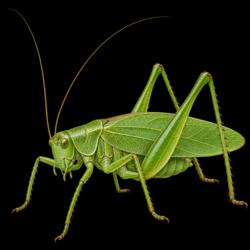
Great Green Bush-cricket at a glance
Invertebrate · Europe · Great Green Bush-Crickets occur · Relatively common
Known for: Uniform bright green body and wings, Brownish stripe along the top of the back, Wings extend well beyond the abdomen tip, Very long
Its Power
Bramble-Leaf Hue
Leaf-Green Motionless Perch
The Great Green Bush-Cricket uses its green coloration to blend seamlessly with foliage, allowing it to remain undetected by predators and prey.
“Still as a bramble leaf.”
Capture a Great Green Bush-cricket, and it's yours when you finish one step it gives you.
Biological basis
This cricket's vibrant green color matches the leaves it inhabits, providing effective camouflage against predators.
Put it into practice
A novelist rides the same commuter train daily, unnoticed, listening to how people really talk.
What does the great green bush-cricket symbolize?
The great green bush-cricket symbolizes bramble-leaf hue: leaf-Green Motionless Perch. It represents blending in, sharp observation and stillness. Its AnimalDex motto: "Still as a bramble leaf."
The great green bush-cricket as a spirit animal
If the great green bush-cricket is your spirit animal, the AnimalDex reading is Bramble-Leaf Hue: the Great Green Bush-Cricket uses its green coloration to blend seamlessly with foliage, allowing it to remain undetected by predators and prey. It suggests a strength in blending in and sharp observation, and a reminder to use it on purpose.
What can the great green bush-cricket help you with in life?
The great green bush-cricket is a guide for blending in, sharp observation and stillness. Its lesson applies wherever blending in matters: the Great Green Bush-Cricket uses its green coloration to blend seamlessly with foliage, allowing it to remain undetected by predators and prey.
- Blending In
- Sharp Observation
- Stillness
In practice: A novelist rides the same commuter train daily, unnoticed, listening to how people really talk.
What can we learn from the Great Green Bush-cricket?What does it mean to dream about or encounter a wild great green bush-cricket?
Dreaming about a wild great green bush-cricket, or coming across one, usually points to blending in and sharp observation: the qualities the great green bush-cricket lives by. In AnimalDex, the great green bush-cricket's principle is Bramble-Leaf Hue: leaf-Green Motionless Perch. Read the moment through its core lesson: The Great Green Bush-Cricket uses its green coloration to blend seamlessly with foliage, allowing it to remain undetected by predators and prey.
Neither good nor bad on its own. How the great green bush-cricket acts matters: at ease, it reflects blending in; hostile, it flags blending in out of balance.
Spotting a great green bush-cricket in the wild
A real encounter is the plainest version of the sign: notice what the great green bush-cricket was doing. Leaf-Green Motionless Perch. That is the blending in worth borrowing today.
A great green bush-cricket that keeps appearing
Repeated sightings of a great green bush-cricket usually mean the Bramble-Leaf Hue lesson is still open: the Great Green Bush-Cricket uses its green coloration to blend seamlessly with foliage, allowing it to remain undetected by predators and prey.
Dreaming of being chased by a great green bush-cricket
If the great green bush-cricket pursues you, look at where sharp observation is being asked of you and you are stepping away instead of meeting it.
Dreaming that a great green bush-cricket attacks you
When the great green bush-cricket attacks, the dream may be about pressure: sharp observation or stillness applied too hard, by you or by someone close to you.
A calm or friendly great green bush-cricket
A calm great green bush-cricket suggests you have made peace with blending in and can use it without force.
A dead or injured great green bush-cricket
A dead or injured great green bush-cricket, dreamed or found, can mark blending in you have let lapse, or a phase built on Bramble-Leaf Hue coming to an end.
These readings are reflective prompts drawn from how the great green bush-cricket really lives, not predictions. If you meet one in the wild, watch from a distance and leave it undisturbed.
Capture your own Great Green Bush-cricket
Photograph or film one in the wild, at a zoo or at home with the app. It becomes yours: it remembers you, gives you steps, and can debate your problems with your other animals.
Animal field guide
Great Green Bush-cricket
Sign in to hear this read by a natural AI voice instead of your browser's.
One of Europe's largest bush-crickets, up to about 4 centimetres of body with long wings reaching past the abdomen. Its bright leaf-green colour matches summer foliage so closely that a singing male metres away can be almost impossible to see.
Native range
Natural range, not this capture location
Great Green Bush-Crickets occur across much of Europe and extend into western and central Asia and parts of North Africa. They favour tall grass, scrub, hedgerows, woodland edges, meadows, and other dense vegetation.
Search near meAnimalDex stats
Size scale
Understand the animal
Understand the Great Green Bush-cricket
Factual biology first: what this animal is like, where it lives, how it survives, and why those traits exist.
01
Introduction to Great Green Bush-cricket
One of Europe's largest bush-crickets, up to about 4 centimetres of body with long wings reaching past the abdomen. Its bright leaf-green colour matches summer foliage so closely that a singing male metres away can be almost impossible to see.
How to identify a Great Green Bush-cricket
- Uniform bright green body and wings
- Brownish stripe along the top of the back
- Wings extend well beyond the abdomen tip
- Very long, thread-like antennae
- Loud, continuous, sewing-machine-like song
Why Great Green Bush-cricket are interesting
- It hears through small slits on its front legs rather than on its head.
- Adults can fly strongly, sometimes turning up at lighted windows at night.
- It is common in southern England and parts of Wales but scarce farther north in Britain.
- It has been reported to eat pest insects such as larvae of the Colorado potato beetle.
02
Adaptations and biological abilities
03
Why does Great Green Bush-cricket behave this way?
- Uniform bright green body and wings
- Brownish stripe along the top of the back
- Wings extend well beyond the abdomen tip
- Very long, thread-like antennae
- Loud, continuous, sewing-machine-like song
Most active from mid-afternoon into the night, when males sing. It spends the morning resting motionless among dense leaves.
04
Why Great Green Bush-Crickets occur across much of Europe and extend into western and central Asia and parts of North Africa?
Habitat: Great Green Bush-Crickets occur across much of Europe and extend into western and central Asia and parts of North Africa. They favour tall grass, scrub, hedgerows, woodland edges, meadows, and other dense vegetation.
Native range: Europe, North Africa & Middle East, Central Asia
Native range
Natural range, not this specific capture location.
Great Green Bush-Crickets occur across much of Europe and extend into western and central Asia and parts of North Africa. They favour tall grass, scrub, hedgerows, woodland edges, meadows, and other dense vegetation.
05
Why this diet?
Mainly a predator of other insects, including flies, caterpillars, aphids and larvae, seized with its spiny front legs. It also eats some plant material such as leaves and flowers.
06
Activity, rest, and lifespan
Most active from mid-afternoon into the night, when males sing. It spends the morning resting motionless among dense leaves.
Usually one to two years in total, most of it as an egg in the soil, and occasionally longer; adults live only a few months and die with the first hard frosts.
07
Great Green Bush-cricket reproduction
Females push eggs singly into soil using their long ovipositor. Eggs overwinter at least once, often longer, before nymphs hatch in spring; the young get no care and moult several times before becoming adult in midsummer.
Females carry a long, almost straight ovipositor at the tail end. Males lack it and have a brownish sound-producing area at the base of the folded forewings.
08
Predators, threats, and defense
Birds, bats, spiders and small mammals take adults and nymphs. It freezes and stays hidden among leaves, drops or flies off when touched, and can give a painful bite if handled.
09
Conservation and rarity
Rarity: Relatively common · 18/100. AnimalDex canonical rarity score: 18/100, maintained by the live indexed species profile.
- Observe from a respectful distance and avoid changing the animal's behavior.
- Do not block feeding, shelter, nesting, or travel routes.
- Use a live camera capture without handling or staging wildlife.
Talk to it
Talk to the Great Green Bush-cricket
It answers as itself: ask about how it lives, or bring it something of yours and hear what it would do, from its own Power.
Anonymous: 6/day. Signed-in: 10/day. Pro: 100/day.
Side by side
The Great Green Bush-cricket, side by side
Nothing written side by side for the Great Green Bush-cricket yet. Pick any animal to compare it with. Compare with any animal →
Where to find them
Where to find Great Green Bush-cricket
To find Great Green Bush-cricket in the wild, focus on the exact habitat patches that match its body design and daily behavior, not just the broad country where it exists. You usually do better by working one good piece of habitat inside europe, North Africa & Middle East, Central Asia than by covering too much ground.
- Forest edge, canopy gaps, fruiting trees, or shaded trails where cover and food meet
- Open grassland edges, lightly wooded plains, or raised ground where you can scan long distances
- Protected habitat blocks within europe, North Africa & Middle East, Central Asia
Where explorers saw it
- Erding, Bayern, DeutschlandAug · 1 sighting
Guides to seeing Great Green Bush-cricket
In the Ark
8 Great Green Bush-crickets are aboard right now.
None have come aboard or left since November 17.
The Ark is a live, shared animal world. Animals come aboard when people capture them, and live there by rules based on their field guides.
Scientific name
Tettigonia viridissima
Category
Invertebrate
Habitat
Great Green Bush-Crickets occur across much of Europe and extend into western and central Asia and parts of North Africa. They favour tall grass, scrub, hedgerows, woodland edges, meadows, and other dense vegetation.
Rarity
Relatively common · 18/100
Native range
Europe, North Africa & Middle East, Central Asia
Take the encyclopedia outside
AnimalDex helps you scan real animals, identify species, collect cards, and learn from nature wherever you are.