Animal field guide
Great Skua
Stercorarius skua
Great Skua teaches Kleptoparasitism through a storm-coast bird bold enough to turn pressure into food. Strong wings, seabird chases, fierce nest defense, and meal-raiding show that boldness can become a strategy in harsh air.
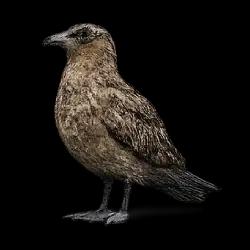
Great Skua at a glance
Bird · North Atlantic · island moorland · Uncommon
Known for: Aggressive food-stealing behavior from other, Powerful flight in rough coastal and ocean, Fierce territorial defense around nesting sites, Opportunistic feeding that includes fish
Its Power
Kleptoparasitism
Seabird Meal-Raiding
Boldness can become a feeding strategy.
“Raid the sky.”
Capture a Great Skua, and it's yours when you finish one step it gives you.
Biological basis
heavy pirate-like seabird body, hooked bill, and aggressive aerial chasing give the Great Skua a body plan tuned for its niche. Great Skuas operate through island moorland, sea cliff, and cold pelagic water. Their design links movement, feeding, shelter, and timing into one workable survival system.
What does the great skua symbolize?
The great skua symbolizes kleptoparasitism: seabird Meal-Raiding. It represents strategy, discipline and long-term thinking. Its AnimalDex motto: "Raid the sky."
The great skua as a spirit animal
If the great skua is your spirit animal, the AnimalDex reading is Kleptoparasitism: boldness can become a feeding strategy. It suggests a strength in strategy and discipline, and a reminder to use it on purpose.
What can the great skua help you with in life?
The great skua is a guide for strategy, discipline and long-term thinking. Its lesson applies wherever strategy matters: boldness can become a feeding strategy.
- Strategy
- Discipline
- Long-Term Thinking
What does it mean to dream about or encounter a wild great skua?
A wild great skua, whether in a dream or in front of you, tends to show up when strategy or discipline is on your mind. In AnimalDex, the great skua's principle is Kleptoparasitism: seabird Meal-Raiding. Read the moment through its core lesson: Boldness can become a feeding strategy.
Mostly a prompt rather than a warning. A calm great skua suggests strategy you already have; a threatening one suggests strategy is being tested or pushed too far.
Spotting a great skua in the wild
A real encounter is the plainest version of the sign: notice what the great skua was doing. Seabird Meal-Raiding. That is the strategy worth borrowing today.
A great skua that keeps appearing
Seeing the great skua again and again, in dreams or outside, suggests strategy is a theme you have not settled yet.
Dreaming of being chased by a great skua
Being chased suggests you are avoiding the Kleptoparasitism the great skua stands for: boldness can become a feeding strategy. Ask what you keep postponing that needs strategy.
Dreaming that a great skua attacks you
An aggressive great skua can mirror a conflict where strategy has become a weapon rather than a strength.
A calm or friendly great skua
A calm great skua suggests you have made peace with strategy and can use it without force.
A dead or injured great skua
Seeing the great skua hurt may point to discipline that has been neglected. Ask what it would take to restore it.
These readings are reflective prompts drawn from how the great skua really lives, not predictions. If you meet one in the wild, watch from a distance and leave it undisturbed.
Capture your own Great Skua
Photograph or film one in the wild, at a zoo or at home with the app. It becomes yours: it remembers you, gives you steps, and can debate your problems with your other animals.
Animal field guide
Great Skua
Sign in to hear this read by a natural AI voice instead of your browser's.
The Great Skua is a bird with heavy pirate-like seabird body, hooked bill, and aggressive aerial chasing. In human life, that means our best results often come from understanding what we are built for and using it well.
Native range
Natural range, not this capture location
island moorland, sea cliff, and cold pelagic water
Search near meAnimalDex stats
Dominance
51
Speed
56
Size
32
Intelligence
37
Rarity
61%
Total
237
Size scale
Understand the animal
Understand the Great Skua
Factual biology first: what this animal is like, where it lives, how it survives, and why those traits exist.
01
Introduction to Great Skua
Great Skua teaches Kleptoparasitism through a storm-coast bird bold enough to turn pressure into food. Strong wings, seabird chases, fierce nest defense, and meal-raiding show that boldness can become a strategy in harsh air.
How to identify a Great Skua
- Aggressive food-stealing behavior from other seabirds.
- Powerful flight in rough coastal and ocean conditions.
- Fierce territorial defense around nesting sites.
- Opportunistic feeding that includes fish, chicks, carrion, and stolen meals.
02
Adaptations and biological abilities
03
Why does Great Skua behave this way?
- Great Skuas are known for harassing other seabirds until they drop food.
- They defend nesting territories boldly, even against larger intruders.
- They breed in northern coastal and island habitats.
- Their feeding strategy mixes hunting, scavenging, and stealing.
Great Skuas are diurnal around colonies and feeding areas, active when other seabirds are moving.
04
Why island moorland?
Habitat: island moorland, sea cliff, and cold pelagic water
Native range: North Atlantic
Native range
Natural range, not this specific capture location.
Some regional overlays are unavailable in this web build.
island moorland, sea cliff, and cold pelagic water
05
Why this diet?
Fish, seabird eggs, chicks, carrion, offal, and stolen catches.
06
Activity, rest, and lifespan
Great Skuas are diurnal around colonies and feeding areas, active when other seabirds are moving.
Great Skuas can live for decades. Kleptoparasitism becomes a long-learned strategy because timing, target choice, and territory knowledge improve with age.
07
Great Skua reproduction
Females lay eggs on ground nests, and both parents defend chicks aggressively.
Males and females look similar, though size can vary.
08
Predators, threats, and defense
09
Conservation and rarity
Rarity: Uncommon · 61/100. Great Skua can still be found in good habitat, but local numbers shift when island moorland, sea cliff, and cold pelagic water changes.
- Keep distance and let the animal choose the space.
- Avoid blocking movement routes, nesting areas, or feeding behavior.
- Use optics, patience, and quiet observation instead of crowding for a closer view.
Talk to it
Talk to the Great Skua
It answers as itself: ask about how it lives, or bring it something of yours and hear what it would do, from its own Power.
Anonymous: 6/day. Signed-in: 10/day. Pro: 100/day.
Side by side
The Great Skua, side by side
Where to find them
Where to find Great Skua
To find Great Skua in the wild, focus on the exact habitat patches that match its body design and daily behavior, not just the broad country where it exists. You usually do better by working one good piece of habitat inside north Atlantic than by covering too much ground.
- Rocky slopes, ridge lines, cliff ledges, or open mountain meadows with a wide view
- Headlands, reef edges, island colonies, tidal channels, or productive coastal water
- Protected habitat blocks within north Atlantic
Scientific name
Stercorarius skua
Category
Bird
Habitat
island moorland, sea cliff, and cold pelagic water
Rarity
Uncommon · 61/100
Native range
North Atlantic
Related animals
Northern Fulmar
Northern Fulmar is a bird known for tube-nosed ocean sensing, stiff-winged gliding, and…
Read species guideHorned Puffin
Horned Puffin is a bird known for small yellow eye horns, thick bright bill, and cliff…
Read species guideTufted Puffin
Tufted Puffin is a bird known for tall blond head tufts, huge orange bill, and…
Read species guideMore animals with Strategy
African Grey Parrot
The African grey parrot is a highly intelligent parrot known for gray plumage, red…
Read species guideAldabra Giant Tortoise
Aldabra Giant Tortoise is a reptile known for immense domed shell, very long lifespan,…
Read species guideAlpine Newt
Alpine Newt is a amphibian known for orange belly in breeding season, smooth pond-ready…
Read species guideTake the encyclopedia outside
AnimalDex helps you scan real animals, identify species, collect cards, and learn from nature wherever you are.