
Animal field guide
Leopard Shark
Triakis semifasciata
A slender houndshark of the Pacific coast of North America, usually 1.2 to 1.5 metres long and harmless to people. In late summer, pregnant females gather in large numbers in warm, waist-deep water off southern California, where the heat is thought to speed the growth of their unborn young.
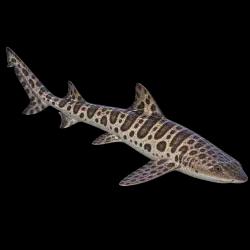
Leopard Shark at a glance
Fish · North Pacific · Sandy and muddy bays · Relatively common
Known for: Black saddle-shaped bars across the back, Saddles of older sharks often have pale centres, Silvery-grey to bronze background colour, Short
Its Power
Steady Movement Strategy
Move with calm and consistent purpose.
Leopard sharks glide through coastal waters with a steady, deliberate pace, conserving energy and maintaining focus on their path.
“Glide with purpose.”
Capture a Leopard Shark, and it's yours when you finish one step it gives you.
Biological basis
Leopard sharks are known for their smooth, consistent swimming patterns, which help them efficiently navigate their environment and conserve energy.
Put it into practice
A marathon runner holds the same easy pace while others sprint early and fade.
What does the leopard shark symbolize?
The leopard shark symbolizes steady movement strategy: move with calm and consistent purpose. It represents pacing, purpose and energy management. Its AnimalDex motto: "Glide with purpose."
The leopard shark as a spirit animal
If the leopard shark is your spirit animal, the AnimalDex reading is Steady Movement Strategy: leopard sharks glide through coastal waters with a steady, deliberate pace, conserving energy and maintaining focus on their path. It suggests a strength in pacing and purpose, and a reminder to use it on purpose.
What can the leopard shark help you with in life?
The leopard shark is a guide for pacing, purpose and energy management. Its lesson applies wherever pacing matters: leopard sharks glide through coastal waters with a steady, deliberate pace, conserving energy and maintaining focus on their path.
- Pacing
- Purpose
- Energy Management
In practice: A marathon runner holds the same easy pace while others sprint early and fade.
What can we learn from the Leopard Shark?What does it mean to dream about or encounter a wild leopard shark?
Dreaming about a wild leopard shark, or coming across one, usually points to pacing and purpose: the qualities the leopard shark lives by. In AnimalDex, the leopard shark's principle is Steady Movement Strategy: move with calm and consistent purpose. Read the moment through its core lesson: Leopard sharks glide through coastal waters with a steady, deliberate pace, conserving energy and maintaining focus on their path.
It depends on how the leopard shark behaved. Calm or close by, it reads as purpose within reach; aggressive or fleeing, it points to pacing you are resisting.
Spotting a leopard shark in the wild
Coming across a leopard shark in person asks for attention more than interpretation. Watch it for a minute; the leopard shark's way of working is Steady Movement Strategy, and the lesson is: leopard sharks glide through coastal waters with a steady, deliberate pace, conserving energy and maintaining focus on their path.
A leopard shark that keeps appearing
Repeated sightings of a leopard shark usually mean the Steady Movement Strategy lesson is still open: leopard sharks glide through coastal waters with a steady, deliberate pace, conserving energy and maintaining focus on their path.
Dreaming of being chased by a leopard shark
If the leopard shark pursues you, look at where purpose is being asked of you and you are stepping away instead of meeting it.
Dreaming that a leopard shark attacks you
An attack points to pacing turned against you: someone using it on you, or your own pacing overused until it costs you.
A calm or friendly leopard shark
Meeting a peaceful leopard shark is usually encouraging: purpose and energy management are within reach.
A dead or injured leopard shark
A dead or injured leopard shark, dreamed or found, can mark pacing you have let lapse, or a phase built on Steady Movement Strategy coming to an end.
These readings are reflective prompts drawn from how the leopard shark really lives, not predictions. If you meet one in the wild, watch from a distance and leave it undisturbed.
Capture your own Leopard Shark
Photograph or film one in the wild, at a zoo or at home with the app. It becomes yours: it remembers you, gives you steps, and can debate your problems with your other animals.
Animal field guide
Leopard Shark
Sign in to hear this read by a natural AI voice instead of your browser's.
A slender houndshark of the Pacific coast of North America, usually 1. In late summer, pregnant females gather in large numbers in warm, waist-deep water off southern California, where the heat is thought to speed the growth of their unborn young.
Native range
Natural range, not this capture location
Sandy and muddy bays, estuaries, eelgrass beds, kelp forest and rocky reef from Oregon to the Gulf of California in Mexico. It stays close to the bottom, mostly in water shallower than about 4 metres, though it has been recorded down to around 90.
Search near meAnimalDex stats
Size scale
Understand the animal
Understand the Leopard Shark
Factual biology first: what this animal is like, where it lives, how it survives, and why those traits exist.
01
Introduction to Leopard Shark
A slender houndshark of the Pacific coast of North America, usually 1.2 to 1.5 metres long and harmless to people. In late summer, pregnant females gather in large numbers in warm, waist-deep water off southern California, where the heat is thought to speed the growth of their unborn young.
How to identify a Leopard Shark
- Black saddle-shaped bars across the back, with large black spots below
- Saddles of older sharks often have pale centres
- Silvery-grey to bronze background colour, whitish underneath
- Short, broadly rounded snout
- Second dorsal fin nearly as large as the first
Why Leopard Shark are interesting
- Its red blood cells are smaller and more numerous than those of related sharks, which may help it take up oxygen in stagnant estuary water.
- Schools are often sorted by size and sex, and may include smoothhounds and spiny dogfish swimming alongside.
- Genetic studies have found several distinct populations along the California coast, which suggests that most individuals do not travel far.
- Females are thought not to breed until they are at least ten years old, which makes the species slow to recover from heavy fishing.
- Its species name semifasciata means half-banded, after the dark saddles that cross the back.
02
Adaptations and biological abilities
03
Why does Leopard Shark behave this way?
- Black saddle-shaped bars across the back, with large black spots below
- Saddles of older sharks often have pale centres
- Silvery-grey to bronze background colour, whitish underneath
- Short, broadly rounded snout
- Second dorsal fin nearly as large as the first
Swims by day and by night, and can also lie still on the sand because it is able to pump water over its gills. In one study at Santa Catalina Island, sharks gathered in the shallows by day and spread into deeper water after dark.
04
Why Sandy and muddy bays?
Habitat: Sandy and muddy bays, estuaries, eelgrass beds, kelp forest and rocky reef from Oregon to the Gulf of California in Mexico. It stays close to the bottom, mostly in water shallower than about 4 metres, though it has been recorded down to around 90.
Native range: North Pacific
Native range
Natural range, not this specific capture location.
Some regional overlays are unavailable in this web build.
Sandy and muddy bays, estuaries, eelgrass beds, kelp forest and rocky reef from Oregon to the Gulf of California in Mexico. It stays close to the bottom, mostly in water shallower than about 4 metres, though it has been recorded down to around 90.
05
Why this diet?
06
Activity, rest, and lifespan
Swims by day and by night, and can also lie still on the sand because it is able to pump water over its gills. In one study at Santa Catalina Island, sharks gathered in the shallows by day and spread into deeper water after dark.
Estimated at up to about 30 years from growth studies; typical lifespan in the wild is not well known.
07
Leopard Shark reproduction
Eggs hatch inside the mother and the young are fed by yolk, not a placenta. After 10 to 12 months she gives birth in spring to between 4 and about 30 pups, each roughly 20 centimetres long, in sheltered shallows.
Males carry a pair of claspers along the inner edge of the pelvic fins. Females grow larger, reaching about 1.8 metres, while males seldom exceed about 1.5 metres.
08
Predators, threats, and defense
09
Conservation and rarity
Rarity: Relatively common · 37/100. AnimalDex canonical rarity score: 37/100, maintained by the live indexed species profile.
- Observe from a respectful distance and avoid changing the animal's behavior.
- Do not block feeding, shelter, nesting, or travel routes.
- Use a live camera capture without handling or staging wildlife.
Talk to it
Talk to the Leopard Shark
It answers as itself: ask about how it lives, or bring it something of yours and hear what it would do, from its own Power.
Anonymous: 6/day. Signed-in: 10/day. Pro: 100/day.
Side by side
The Leopard Shark, side by side
Nothing written side by side for the Leopard Shark yet. Pick any animal to compare it with. Compare with any animal →
Where to find them
Where to find Leopard Shark
To find Leopard Shark in the wild, focus on the exact habitat patches that match its body design and daily behavior, not just the broad country where it exists. You usually do better by working one good piece of habitat inside north Pacific than by covering too much ground.
- Forest edge, canopy gaps, fruiting trees, or shaded trails where cover and food meet
- Headlands, reef edges, island colonies, tidal channels, or productive coastal water
- Protected habitat blocks within north Pacific
In the Ark
1 Leopard Shark is aboard right now.
None have come aboard or left since November 17.
The Ark is a live, shared animal world. Animals come aboard when people capture them, and live there by rules based on their field guides.
Scientific name
Triakis semifasciata
Category
Fish
Habitat
Sandy and muddy bays, estuaries, eelgrass beds, kelp forest and rocky reef from Oregon to the Gulf of California in Mexico. It stays close to the bottom, mostly in water shallower than about 4 metres, though it has been recorded down to around 90.
Rarity
Relatively common · 37/100
Native range
North Pacific
Take the encyclopedia outside
AnimalDex helps you scan real animals, identify species, collect cards, and learn from nature wherever you are.