Animal field guide
Malaysian Forest Scorpion
Heterometrus spinifer
A large, glossy black scorpion of South-east Asian rainforest that digs its own burrow beneath logs, stones and tree roots or into soft earth banks. The damp, sheltered chamber protects it from drying out, from heat and from many predators.
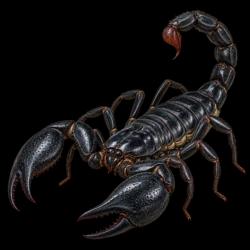
Malaysian Forest Scorpion at a glance
Arachnid · Southeast Asia · Humid lowland and hill rainforest · Relatively common
Known for: Body glossy black, Pincers broad and heavily granular, Tail relatively slender, Adults about 10 to 12 centimetres long
Its Power
Burrowed Retreat
Create a safe space to recharge and strategize.
The Malaysian Forest Scorpion digs burrows to hide and rest, showing the importance of having a secure place to regroup.
“Rest deep in the burrow.”
Capture a Malaysian Forest Scorpion, and it's yours when you finish one step it gives you.
Biological basis
Malaysian Forest Scorpions dig burrows in the forest floor to protect themselves from predators and harsh conditions.
Put it into practice
After a hectic day, Sarah spends an hour in her cozy reading nook to unwind and plan her next steps.
What does the malaysian forest scorpion symbolize?
The malaysian forest scorpion symbolizes burrowed retreat: create a safe space to recharge and strategize. It represents safe shelter, recovery and solitude. Its AnimalDex motto: "Rest deep in the burrow."
The malaysian forest scorpion as a spirit animal
If the malaysian forest scorpion is your spirit animal, the AnimalDex reading is Burrowed Retreat: the Malaysian Forest Scorpion digs burrows to hide and rest, showing the importance of having a secure place to regroup. It suggests a strength in safe shelter and recovery, and a reminder to use it on purpose.
What can the malaysian forest scorpion help you with in life?
The malaysian forest scorpion is a guide for safe shelter, recovery and solitude. Its lesson applies wherever safe shelter matters: the Malaysian Forest Scorpion digs burrows to hide and rest, showing the importance of having a secure place to regroup.
- Safe Shelter
- Recovery
- Solitude
In practice: After a hectic day, Sarah spends an hour in her cozy reading nook to unwind and plan her next steps.
What can we learn from the Malaysian Forest Scorpion?What does it mean to dream about or encounter a wild malaysian forest scorpion?
Meeting a wild malaysian forest scorpion, asleep or awake, is often a nudge toward safe shelter, the quality the malaysian forest scorpion is built around. In AnimalDex, the malaysian forest scorpion's principle is Burrowed Retreat: create a safe space to recharge and strategize. Read the moment through its core lesson: The Malaysian Forest Scorpion digs burrows to hide and rest, showing the importance of having a secure place to regroup.
It depends on how the malaysian forest scorpion behaved. Calm or close by, it reads as recovery within reach; aggressive or fleeing, it points to safe shelter you are resisting.
Spotting a malaysian forest scorpion in the wild
If a malaysian forest scorpion crosses your path, take it as a cue to look at where safe shelter fits your day. Its AnimalDex motto: "Rest deep in the burrow."
A malaysian forest scorpion that keeps appearing
A malaysian forest scorpion that keeps turning up points to recovery you keep circling back to. The repetition is the message.
Dreaming of being chased by a malaysian forest scorpion
Being chased suggests you are avoiding the Burrowed Retreat the malaysian forest scorpion stands for: the Malaysian Forest Scorpion digs burrows to hide and rest, showing the importance of having a secure place to regroup. Ask what you keep postponing that needs safe shelter.
Dreaming that a malaysian forest scorpion attacks you
An aggressive malaysian forest scorpion can mirror a conflict where safe shelter has become a weapon rather than a strength.
A calm or friendly malaysian forest scorpion
A calm malaysian forest scorpion suggests you have made peace with safe shelter and can use it without force.
A dead or injured malaysian forest scorpion
A dead or injured malaysian forest scorpion, dreamed or found, can mark safe shelter you have let lapse, or a phase built on Burrowed Retreat coming to an end.
These readings are reflective prompts drawn from how the malaysian forest scorpion really lives, not predictions. If you meet one in the wild, watch from a distance and leave it undisturbed.
Capture your own Malaysian Forest Scorpion
Photograph or film one in the wild, at a zoo or at home with the app. It becomes yours: it remembers you, gives you steps, and can debate your problems with your other animals.
Animal field guide
Malaysian Forest Scorpion
Sign in to hear this read by a natural AI voice instead of your browser's.
A large, glossy black scorpion of South-east Asian rainforest that digs its own burrow beneath logs, stones and tree roots or into soft earth banks. The damp, sheltered chamber protects it from drying out, from heat and from many predators.
Native range
Natural range, not this capture location
Humid lowland and hill rainforest, including secondary forest and plantation edges, where deep leaf litter and soft, damp soil allow burrowing; found in the Malay Peninsula and neighbouring parts of South-east Asia.
Search near meAnimalDex stats
Dominance
26
Speed
20
Size
15
Intelligence
25
Rarity
35%
Total
121
Size scale
Understand the animal
Understand the Malaysian Forest Scorpion
Factual biology first: what this animal is like, where it lives, how it survives, and why those traits exist.
01
Introduction to Malaysian Forest Scorpion
A large, glossy black scorpion of South-east Asian rainforest that digs its own burrow beneath logs, stones and tree roots or into soft earth banks. The damp, sheltered chamber protects it from drying out, from heat and from many predators.
How to identify a Malaysian Forest Scorpion
- Body glossy black, often with a blue or green sheen
- Pincers broad and heavily granular, much bulkier than the tail
- Tail relatively slender, ending in a small sting bulb
- Adults about 10 to 12 centimetres long
Why Malaysian Forest Scorpion are interesting
- Its sting usually causes local pain and swelling in people, often compared with a bee or wasp sting.
- Several very similar Heterometrus scorpions live in the same region, so reliable identification often needs close examination of the pincers and other features.
- It detects prey mainly through touch, air movement and ground vibrations, sensed by fine hairs on the pincers and slit-shaped sense organs in the legs, rather than by sight.
- It is widely sold in the pet trade, and many animals sold under this name are wild-caught.
02
Adaptations and biological abilities
03
Why does Malaysian Forest Scorpion behave this way?
- Body glossy black, often with a blue or green sheen
- Pincers broad and heavily granular, much bulkier than the tail
- Tail relatively slender, ending in a small sting bulb
- Adults about 10 to 12 centimetres long
Nocturnal. By day it stays inside its burrow, and after dark it sits at the entrance or wanders only a short way from it.
04
Why Humid lowland and hill rainforest?
Habitat: Humid lowland and hill rainforest, including secondary forest and plantation edges, where deep leaf litter and soft, damp soil allow burrowing; found in the Malay Peninsula and neighbouring parts of South-east Asia.
Native range: Southeast Asia
Native range
Natural range, not this specific capture location.
Humid lowland and hill rainforest, including secondary forest and plantation edges, where deep leaf litter and soft, damp soil allow burrowing; found in the Malay Peninsula and neighbouring parts of South-east Asia.
05
Why this diet?
Crickets, cockroaches, beetles and other arthropods, and occasionally small vertebrates. It seizes passing prey in its pincers and crushes it, using the sting mainly on large or struggling prey.
06
Activity, rest, and lifespan
Nocturnal. By day it stays inside its burrow, and after dark it sits at the entrance or wanders only a short way from it.
In captivity it commonly lives about 5 to 8 years; lifespan in the wild has not been measured.
07
Malaysian Forest Scorpion reproduction
Females give birth to live young, usually about 10 to 35 after a pregnancy of several months. The white newborns climb onto their mother's back and ride there until their first moult, then stay near her in the burrow for some time.
The sexes are hard to tell apart at a glance. Males usually have longer comb-like pectines under the body, with more teeth, and adult females tend to be bulkier with a broader abdomen.
08
Predators, threats, and defense
09
Conservation and rarity
Rarity: Relatively common · 35/100. AnimalDex canonical rarity score: 35/100, maintained by the live indexed species profile.
- Observe from a respectful distance and avoid changing the animal's behavior.
- Do not block feeding, shelter, nesting, or travel routes.
- Use a live camera capture without handling or staging wildlife.
Talk to it
Talk to the Malaysian Forest Scorpion
It answers as itself: ask about how it lives, or bring it something of yours and hear what it would do, from its own Power.
Anonymous: 3/day. Signed-in: 10/day. Pro: 100/day.
Side by side
The Malaysian Forest Scorpion, side by side
Nothing written side by side for the Malaysian Forest Scorpion yet. Pick any animal to compare it with. Compare with any animal →
Where to find them
Where to find Malaysian Forest Scorpion
To find Malaysian Forest Scorpion in the wild, focus on the exact habitat patches that match its body design and daily behavior, not just the broad country where it exists. You usually do better by working one good piece of habitat inside southeast Asia than by covering too much ground.
- Forest edge, canopy gaps, fruiting trees, or shaded trails where cover and food meet
- Burrow systems, sandy banks, fallen logs, or ground with clear den entrances
- Sunlit logs, exposed branches, warm rocks, or regular perch sites used for scanning
Scientific name
Heterometrus spinifer
Category
Arachnid
Habitat
Humid lowland and hill rainforest, including secondary forest and plantation edges, where deep leaf litter and soft, damp soil allow burrowing; found in the Malay Peninsula and neighbouring parts of South-east Asia.
Rarity
Relatively common · 35/100
Native range
Southeast Asia
Take the encyclopedia outside
AnimalDex helps you scan real animals, identify species, collect cards, and learn from nature wherever you are.